
The Four Gates.
Found, Matched, Believed, Clean — the Order Every Test Uses
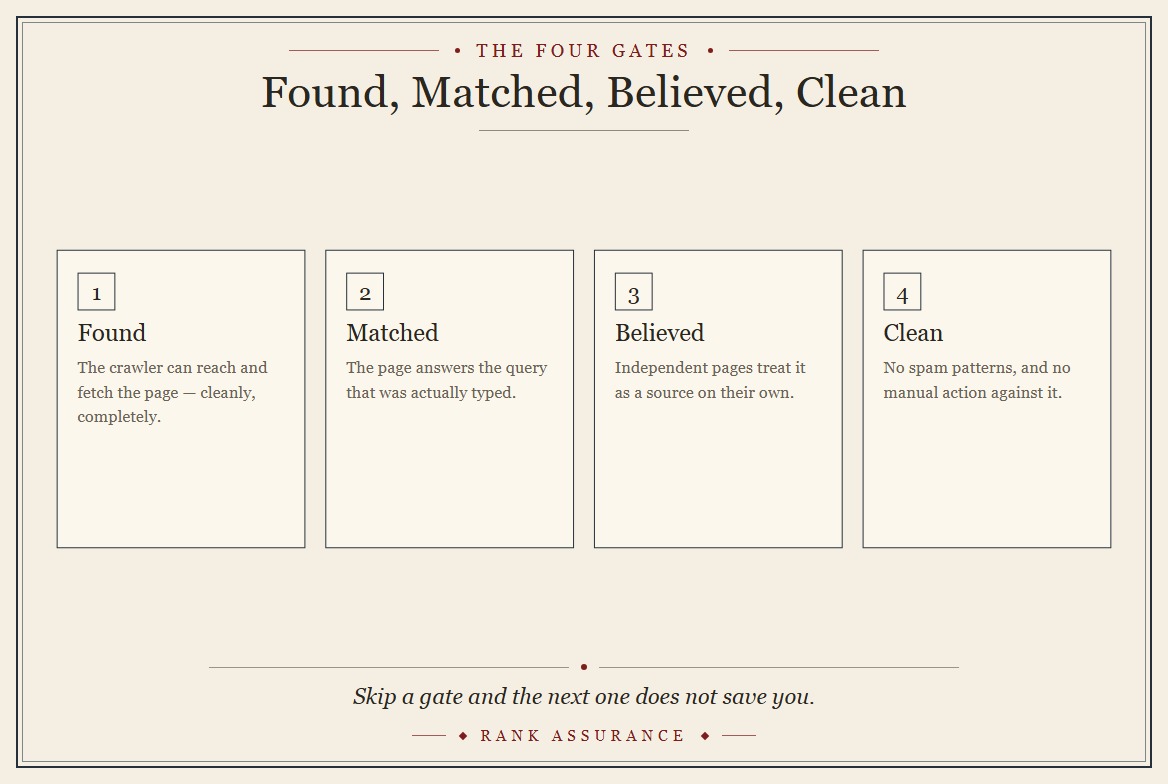
The Four Gates are the order search visibility is judged in: Found, Matched, Believed, Clean — skip a gate and the next one does not save you.
Four gates a page passes, in order, before a ranking — or an AI answer — can happen: Found, Matched, Believed, Clean. Skip a gate and the next one does not save you. This page is the frame's single definition.
The Question This Page Answers
Every test in this library leans on one frame: four gates a page passes, in order, before a ranking — or an AI answer — can happen. This page is the frame’s single definition. When a test says “gate 3,” this is what it means.
The Four Gates, in Order
Why the Order Matters
The gates are a sequence, not a menu. A blocked page does not have an authority problem — it has a fetch problem, and buying mentions for it buys nothing. A perfectly clean page that answers no real query has nothing for gate 3 to believe. Diagnosis in this library always means: find the first gate that fails, fix that, and only then look downstream. That is the Ranking-Problem Test’s whole method.
The Same Gates on the AI Surface
When the surface is an AI answer instead of a results page, the gates do not change — the prize does. Reachable and readable is still gate 1; being about the buyer’s actual question is still gate 2; and the independent record — who cites you, who names you — is what answer engines lean on for gate 3. The Citation-Surface Test reads the whole frame on that surface.
Where Each Gate Gets Tested
| Gate | The tests that own it |
|---|---|
| Found | First-Week · First-Index · Redirect-Map · Preview-Control |
| Matched | Topic-Fit · Content-Quota · E-E-A-T · Helpful-Content |
| Believed | Authority Gap · Earned-Mention · Link-Quality · Two-Site |
| Clean | Suppression Type · Sister-Site · Would-This-Exist · Retired-Tactic |
Questions
Is the Four Gates Frame Google’s?
No. It is this library’s editorial frame for reading the official documents in order — fetchability, relevance, independent belief, and the spam policies are all Google’s published concepts; the gate sequence is ours.
Which Gate Do I Check First?
Always gate 1, always in order. The Ranking-Problem Test is the ordered walk; stop at the first fail.
Do the Gates Apply to AI Answers?
Yes — unchanged. The surface changes what winning looks like (being named or cited instead of ranked), not what has to be true first.