
The Sister-Site Test.
When Extra Domains Help You Rank and When They Get Filtered
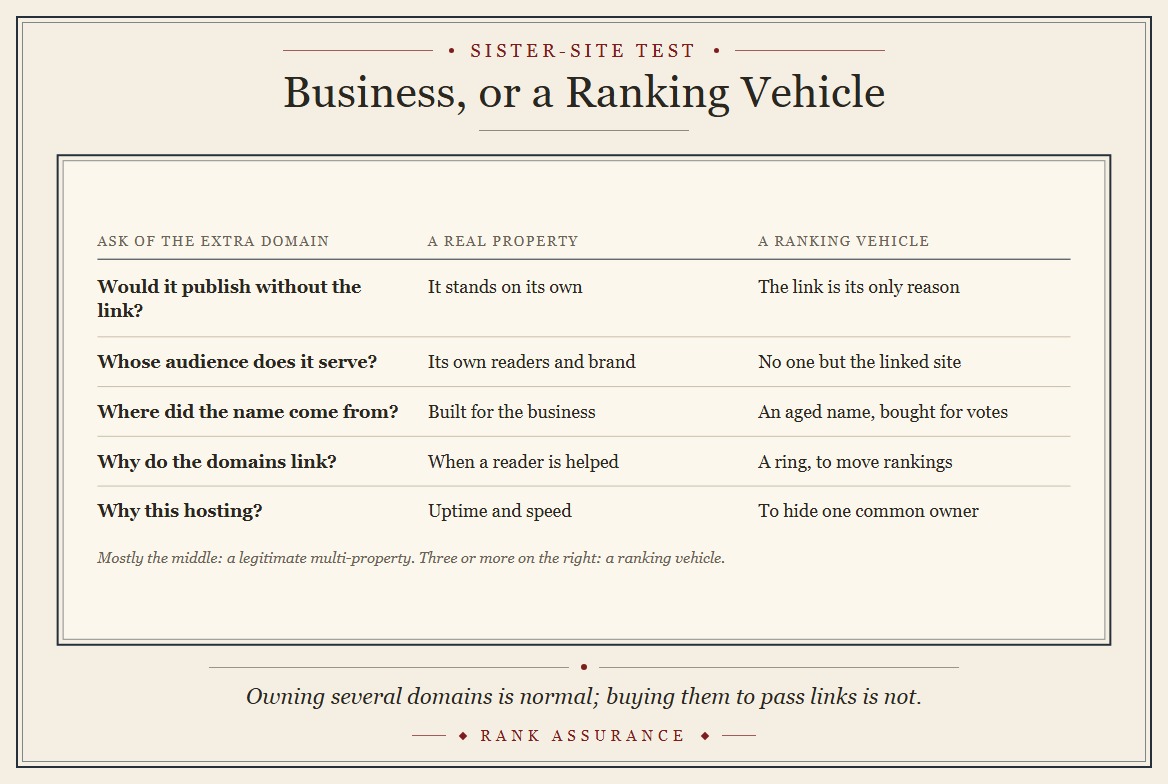
The Sister-Site Test is five questions that sort an extra domain into business or ranking vehicle: existence without the link, audience, intent, cross-links, concealment.
Owning more than one domain is normal. Buying an aged name, parking it on a “unique IP,” and writing 400-word posts so you can sell the outbound link is not. This article is one test for the whole lifecycle — acquire, host, operate — and the official line on each step.
The Question This Article Answers
Someone offers a second domain, or a fifth, and says the extra sites will pass authority if you host them “correctly.” The pitch is usually about IP addresses, not about readers. The useful question is narrower:
If the honest answer is no, you do not have a hosting problem. You have a link-spam problem. Google’s current spam policies name the pattern: links created primarily to manipulate rankings, and expired domains bought and repurposed primarily to boost low-quality pages. Unique IP addresses do not turn that pattern into a business.
The five questions, up front. Would the site exist without the link? Does it have an audience and a job besides linking? Was the name bought mainly for leftover links? Are the cross-links there to move rankings? Is the hosting chosen to hide the owner? Three or more wrong answers and the extra domain is a ranking vehicle, not a sister site — the rest of this article is each question in full.
Two Kinds of Extra Domains
Real companies run many properties on one host, one CDN, and one legal entity every day. Wikipedia’s language editions, a hospital’s foundation site, a retailer’s brand shops — those are sister sites. The test is purpose, not octet count.
The Sister-Site Test
Run this on every extra domain that links to your money site, or that an agency says will.
- Would this site still be published if it could not pass a link?
- Does it have a real audience, a brand, and a job besides linking?
- Was an expired or aged name bought mainly for leftover links or old reputation?
- Are the sites cross-linking primarily to move rankings?
- Is hosting being chosen to hide common ownership rather than to serve users?
These thresholds are a working diagnostic, not a Google score. They exist so you stop treating concealment as strategy.
“How many extra sites do I need?” is the wrong unit. There is no official safe count. Five hosts you control are still one owner. Fifty hosts you control are still one owner — and a larger set is usually easier to fingerprint (the Network-Footprint Test). A real sister brand can be one extra domain. A ranking vehicle does not become independent by adding more of itself.
A name that used to be a clinic, a school, or a newsroom and now sells an unrelated commercial page is expired-domain / site-reputation abuse — not a rebrand. Dumping every leftover path on that name onto the homepage is not a site move either: the Redirect-Map Test asks whether the destination is the same work, and a homepage dump fails it.
Calculator
Sister-Site Calculator
Two Walk-Throughs, Scored
Two composite cases, for illustration, each scored against the five questions.
A hospital and its foundation site. Would the foundation site exist without the link? Yes — donors, events, and grant records are its job. Audience and brand of its own? Yes. Name bought for leftover links? No — it was registered for the foundation. Cross-links to move rankings? No — the footer link exists because donors need the URL. Hosting chosen to hide ownership? No — the same company is named on both. Zero of five. A sister site. Host it for uptime and stop thinking about octets.
An aged blog with a client anchor. Would it exist without the link? No — the paid paragraph is the point. Audience of its own? None measurable; nobody would notice if it vanished. Name bought for leftovers? Yes — it was a retired trade publication picked for its old graph. Cross-links to move rankings? Yes — one keyword anchor per post, mid-article. Hosting chosen to hide ownership? Yes — different registrar, different host, no shared account. Five of five. A ranking vehicle, and every one of those answers is a policy object, not a style choice.
The Shared-IP Myth
What people fear. If two of my sites share an IP, Google will see one owner and deindex both. If a reverse-IP tool shows spammy neighbors, I will inherit them.
What Google has said. On 3 April 2024 John Mueller wrote that there is a limited number of IP addresses and it is normal that they are shared. Asked whether sharing an IP with 129 other sites, many of them spam, could hurt reputation, his short answer was no. Shared hosting and CDNs work that way. CDNs also change the visible address by time and location. Search Engine Roundtable recorded the exchange the next day.
Rare host-level actions exist. They are not the default, and they are not a reason to buy “unique C-class” products.
How the myth hurts. It sends budget into IP theater instead of into pages other sites would cite. It also trains people to treat concealment as the skill.
“SEO Hosting” as a Product Category
There is a hosting niche sold on octet diversity: different third numbers, “unique C-class,” sequential blocks dressed up as independence. The product exists because voting networks need to look unowned. That is not a ranking lever for a real site. It is a footprint of a scheme.
We are not going to walk through how those products are wired. The useful fact for a site owner is simpler: if an agency’s plan starts with host-and-IP camouflage, the plan is the network. Ask the five questions. If the extra domains fail the test, changing hosts will not make the links editorial.
Aged Names Bought for Leftover Votes
Google added expired-domain abuse to the spam policies in March 2024. The definition is buying an expired name and repurposing it primarily to manipulate rankings with content that adds little value. Official examples include turning a former government or school domain into unrelated commercial pages.
The same announcement said it is fine to use an old name for a new, original, people-first site. The difference is intent. A retired local paper revived as a paper is a sister site. A retired paper revived as a thin page that points at a clinic is a ranking vehicle.
How it hurts. Gate 4, the Clean gate: a spam-system demotion or a manual action. Gate 3, the Believed gate: the leftover links get discounted, so the “authority you bought” was never yours. After 2024, this is a named policy, not a gray area.
“The name does not lose all its authority” is not an official transfer guarantee. A vendor score on a dropped host is a vendor’s model, not a transferable asset — the Domain-Score Test is the full argument. If the new site is a different purpose, the leftover graph is not yours to wear, and redirecting every old path onto one commercial URL fails the Redirect-Map Test.
Buying an Old Name: What the Metrics Are Not
Third-party tools print domain-authority grades built from crawls the vendor runs. Those are vendor models of the web, useful as a rough filter when you are buying a business. They are not Google authority, and a band such as “10 to 40” is not a published ranking unit.
Referring-domain count is the same story. It is a third-party crawl of who links to the name. It is not a Google score you can transfer by changing the homepage. The Authority Gap Test measures referring domains on the URL that is competing — current, relevant, independent sites — not leftover votes attached to a name you just flipped.
Public web archives and site: queries are legitimate. Use them to see what the name used to be and whether it is indexed. That is due diligence for a real purchase. It is not a “safe to flip” certificate. A clean archive of a school site does not make casino pages on that host a people-first reuse.
Risk filters that are rational for a real brand: skip names with a spam or adult history you do not want associated with yours; skip a TLD or country mix that does not match the business. Those are brand decisions. They do not become a shopping protocol for voting domains.
Vendor Arguments, Answered
The pitches below arrive in every aged-name and “authority site” proposal. Each one has the same shape: an argument about markets, tools, or hosting standing in for the only question that is official — purpose.
“Look at the price — demand proves these names carry authority.”
Auction prices are a market, not Search Central. Demand for dead names is not a ranking system, and a follow-up that repeats the price argument is the same object. The official test remains purpose, value, and mismatch.
“Google would not allow the auctions if this were abuse.”
What a marketplace will sell is not a policy statement. The spam policies, not the auction house, define expired-domain abuse — and since March 2024 they name it explicitly.
“We keep the set hidden, so nothing traces to you.”
Hiding a graph you control — from tools, from a client, or from a public menu — does not make the extra site independent. Sister-Site is still purpose. Network-Footprint is still sameness. An operator who can hide a set from you can also take it down.
“We mix strong, weak, and brand-new names so the graph looks natural.”
A new name with a low vendor score that exists to vote is still a ranking vehicle. Mixing scores so the set resembles a “natural” graph does not create extra owners.
“You are not building anything — you are just renting a slot.”
Renting a slot on someone else’s controlled set is the Paid-Placement Test’s object, not a sister publication. A set that will not be shown as live independent publications fails Would-This-Exist.
“Authority only comes from backlinks, so you need this.”
Not official. Authority in the documents is independent belief — mentions and links you do not control, which is the Authority Gap Test’s whole subject. A graph with one owner is not independence, whatever it is called.
Operating Tells: Posts That Exist to Hold a Link
A real sister publication has a content program, analytics, and readers who would still show up if the outbound links vanished. A ranking vehicle has a seed of short posts, a contextual keyword pointing at a paying URL, and a plan for what to do when the invoice stops.
Industry playbooks describe the second pattern in operational detail: a handful of posts per domain, a word-count band, one client anchor in the middle of the article, a drip calendar so the graph does not arrive in one day, a cap on outbound links so the site does not look like a farm, Analytics left off so common ownership is harder to cluster, and the link removed when the client cancels.
We are not going to reprint those calendars. The useful fact is what they prove. If the page would be unpublished, or the anchor would be stripped, the moment nobody is paying for the vote, the page was never a publication. Google’s link-spam policy names that exact shape: creating low-value content primarily for manipulating linking and ranking signals, and buying or selling links for ranking purposes.
Scaled versions of the same seed — many domains, same template, same job — also sit under scaled content abuse. Hiding Analytics, splitting Search Console logins, and mixing which properties “serve” which client are concealment tells, the same family as unique-octet hosting. They do not make the links editorial.
What a real sister site does instead. It measures its own audience. It publishes on a schedule that matches its readers, not a drip that matches an invoice. If it mentions the parent brand, the mention would survive a cancelled contract. Paid mentions, if they exist, are marked rel="sponsored" or nofollow.
How AI Engines See Sister Brands
AI answers cite entities and pages, not link graphs. When an engine names a business, it is naming something it retrieved and could attribute — a page a reader would land on, an entity the public record supports. A concealed vote graph contributes nothing to that surface: there is no page in it anyone would cite, and the concealment that was supposed to be the skill makes the entity record thinner, not stronger. In the market run we published on the AI Answer explainer, being named at all was scarce even for real businesses — a hidden network is not competing for that scarcity; it is invisible to it.
The same holds for the completeness argument. Real businesses carry complete public surfaces — about pages, policies, named people — and our measured benchmarks show the top of the field separates from the bottom on exactly that hygiene. A ranking vehicle has an empty About page because nobody lives there. Engines that read pages can tell.
Cross-Links You Control
Google’s link-spam section covers links created to or from a site primarily to manipulate rankings, including excessive exchanges and partner pages that exist to cross-link. Links among properties you own are not automatically fatal. They become a scheme when the page would not exist without the vote.
A hospital linking its foundation site in the footer because donors need the URL is a reader link. Ten aged blogs you control, each with a keyword-rich paragraph pointing at a sales page, is a voting graph. The Sister-Site Test is how you tell them apart without a folklore percentage.
Shared Content Between Sister Brands
The lifecycle question real owners hit that no scheme playbook covers: two legitimate brands sell overlapping lines, and the product pages are nearly identical. That is not a penalty case. It is a selection case — Google will pick one version to index and rank, and without a signal it may not pick the one you wanted. The official tool is canonicalization: point the duplicate at the version that should represent the content, and let each brand keep the pages that are genuinely its own.
Syndication is the same shape. If the foundation site republishes the hospital’s article, the copy should identify the original — a visible credit and a canonical where you control both ends. None of this needs concealment, and none of it is cross-link spam: duplicated text between declared sister brands is a housekeeping problem, not a scheme.
What Hosting Actually Changes
Hosting can suppress a site. It does it through downtime, malware, mixed content, blocked crawling, and slow pages — not through the third octet.
| Hosting choice | Can move a ranking gate? | Why |
|---|---|---|
| Uptime and DNS | Yes — gate 1, Found | Google cannot reliably fetch a page that is down. |
| HTTPS, malware, hacked injections | Yes — gates 1 and 4 | Warnings turn readers away, and Security issues sit beside Manual actions in Search Console. |
| Time to first byte, Core Web Vitals | Sometimes — page experience | Core systems look at page experience. Vitals are not a substitute for relevancy or authority. |
| Shared vs dedicated IP | Not as a ranking lever | Shared IPs and CDNs are normal. Mueller, April 2024. |
| Buying IP diversity to hide sister sites | Can hurt gate 4, Clean | The concealment is the scheme, not the cure. |
Pick a host the way you pick any vendor: backups, support, TLS, location that matches your users, a status page you can read. Public hosting forums are useful for uptime gossip. They are not a shopping list for a voting fleet.
Acquire, Host, Operate — One Table
The three chapters of the industry playbook are one scheme. The official path treats them as one diagnosis. This table is the artifact to hand to whoever proposed the network.
If three cells in the middle column describe your extra domains, you do not have a hosting or content problem. You have a network. The Sister-Site Test will have already said so.
Official-Path Fix
If the extra domains pass the test, keep them. Host for reliability. Link when a reader is helped. Do not hide the corporate relationship; brand it.
If they fail the test:
- Stop buying more aged names for leftover graphs.
- Stop adding credit-passing links. Do not drip them more slowly. Do not rotate which properties “serve” which URL. Stop is stop.
- Remove or
rel="nofollow"/sponsoredthe scheme links you control. - Do not “spread IPs harder” and do not split Analytics to hide the owner. Concealment is not cleanup.
- If Search Console shows an unnatural-links or related manual action, follow the cleanup in the Suppression Type Test: remove, document, disavow leftovers, request review.
- Earn votes from sites you do not control. That is the Authority Gap work.
What This Is Not
- It is not a claim that companies may own only one domain.
- It is not a claim that shared hosting is “bad neighborhood” poison. Google’s public line is the opposite.
- It is not a guide to building, hiding, or “correctly hosting” a private network of sites that exist to pass ranking credit.
- It is not a vendor list.
Questions
If I put two real brands on the same host, will Google deindex me?
Not for sharing the host. Shared IPs are normal. Keep both sites independently useful. Link only when a reader needs the other brand.
An agency wants to “build me authority sites.” What do I ask?
The five questions. If the sites would not exist without the link, you are being sold a network. That is cheaper for them than earning mentions on sites they do not own. It is also the pattern in the link-spam policy.
Can I revive an expired domain for a real project?
Yes, if the new site is original and people-first. Google said so when the expired-domain policy launched. Buying the name to harvest the old graph and point it at something else is the abuse case.
Does a unique IP make a page more authoritative?
No. Authority among relevant pages still comes from independent sites voting for you. That is the Authority Gap Test. An octet is not a vote.
An agency seeded blogs and now places my keyword in the middle of a post. Is that a sister site?
Run question one. If the post would come down when you stop paying, it was a vote. Mark it sponsored if you keep a paid mention. Do not treat the vendor score of the host domain as your authority.
Should I turn Analytics off on extra domains so they look independent?
No. Hiding measurement so a search engine cannot cluster properties you own is concealment, not publishing. Real sister brands share a company in public.
Should my two brands share one Search Console account?
Verification is administration, not a ranking input. Manage both properties wherever your team works best. Splitting logins so the sites “do not look owned” is a concealment tell, not a safety measure.
Do AI assistants treat my brands as one company?
They read the public record, so if the relationship is public they may connect the entities — and that is fine. Being one company is not a demotion. What contributes nothing on that surface is a hidden vote graph: answers cite pages and entities, not link schemes.
Is a one-campaign microsite a ranking vehicle?
Run question one. A microsite that exists for the campaign’s readers and is retired honestly when the campaign ends is publishing. A microsite whose job is to pass a keyword link back to the money site is a vehicle, however short its life.
How should sister sites handle duplicated pages?
As a selection problem, not a penalty problem. Point the duplicate at the version that should represent the content with a canonical, credit syndicated copies visibly, and keep each brand’s own pages genuinely its own.
Sources
- Google Search Central, “Spam policies for Google web search” (updated August 2026) — link spam, expired-domain abuse, doorway abuse, scaled content abuse.
- Google Search Central Blog, March 2024 core update and new spam policies (5 March 2024) — expired-domain abuse defined; old names may be used for a new original people-first site.
- Search Engine Roundtable, “Google: Sharing IP Addresses On Shared Servers Is Normal & Fine For SEO” (4 April 2024) — John Mueller: limited IPs, sharing is normal; sharing with spammy neighbors is not, by itself, a ranking problem.
- Google, “New ways we’re tackling spammy, low-quality content on Search” (5 March 2024) — expired websites repurposed as spam repositories.
- Google Search Central, “Consolidate duplicate URLs” — canonicalization for duplicated pages across properties you own.
- Rank Assurance, “The Suppression Type Test” — manual action vs classifier vs core update vs not a penalty.
- Rank Assurance, “The Authority Gap Test” — referring-domain gap among relevant pages, not IP theater.