
The Suppression Type Test.
How to Tell a Penalty from a Ranking Drop
The Suppression Type Test is a five-check Search Console procedure that sorts a ranking drop into manual action, spam-system demotion, core-update re-rank, or no penalty.
Traffic fell off a cliff. The usual next moves are rewrite every page, upload a disavow file, or buy a new domain. Those moves only help one kind of drop. This article gives you a four-type test you can run in Search Console this afternoon, then the official cleanup order for each type.
The Question This Article Answers
A site that was on page 1 is suddenly on page 4, or gone. The owner calls it a penalty. An agency agrees, because “penalty recovery” is a product. Sometimes it is a penalty. Often it is not.
Those four events look similar in Analytics. They are not the same in Search Console, they do not share a cleanup, and one of them is not a penalty at all. Buying a new domain treats all four as if they were fatal. That is why this test exists.
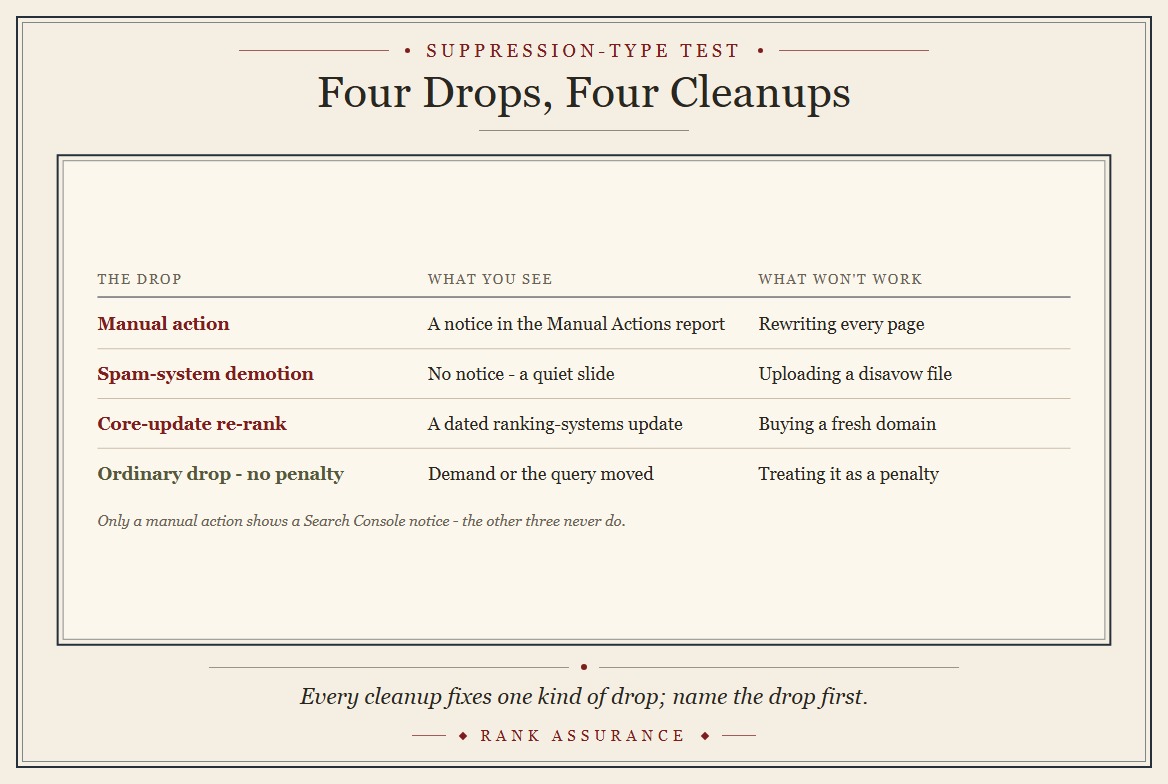
The answer in one box. Five Search Console checks name the type. A named notice is Type A — a manual action. No notice and the cliff sits inside a spam update: Type B. Inside a core update: Type C. No notice and no matching update: Type D — not a penalty at all. And if clicks fell while impressions and position held, nothing was suppressed; the results page changed shape around you.
The order never changes: removal before disavow, disavow before reconsideration, reconsideration only for a manual action, a new domain only after all of that has failed in good faith.
The Four Suppression Types
This classification is the original framework for the rest of the article. Google does not publish a four-box cartoon. The boxes map onto systems Google does publish: the Manual Actions report, automated spam detection, core ranking updates, and ordinary ranking competition.
Type D is why this article links to the Authority Gap Test. If Search Console is clean and the drop does not line up with an update, measure referring domains on the URL that lost position before you rewrite the company. If the URL turns out to be excluded, blocked, or noindexed, the drop is a fetch problem — the First-Index Test — and the Ranking-Problem Test is the ordered walk through every gate.
The Suppression Type Test
Run this on the property that lost traffic. Fifteen minutes. Do it before anyone touches content or links.
- Manual Actions. Search Console → Security & Manual Actions → Manual actions. If there is a named action, you have Type A. Read the type. Stop here until you know the scope (site-wide or partial).
- Security. Same menu, Security issues. A hack is not a ranking-factor debate. Clean the injection first.
- The date. Performance report, last 16 months, overlay the day the cliff started. Open Google Search Status Dashboard. Does that day sit inside a core update, a spam update, or neither?
- The page. URL Inspection on a money URL that vanished. Indexed? Excluded? Restricted by robots?
- The links. Links → Top linking sites → Export. You are looking for a sudden spike of off-topic hosts, or a wall of exact-match commercial anchors — not for a third-party “toxicity score.”
The Matrix: What Each Check Shows, by Type
The five checks and the four types cross into one table. Read a row when a check surprises you; read a column when you think you know the type and want to confirm the rest of the evidence agrees.
| Check | A Manual action | B Spam-system | C Core update | D Not a penalty |
|---|---|---|---|---|
| 1 Manual Actions | A named action is listed | No issues detected | No issues detected | No issues detected |
| 2 Security | Sometimes a hack as well | Clean | Clean | Clean, or the hack is the whole story |
| 3 The date | Any date — the notice rules | Cliff inside a spam update | Cliff inside a core update | No matching update |
| 4 The page | Indexed or removed, per the scope | Usually still indexed | Still indexed, ranked lower | Sometimes excluded or blocked |
| 5 The links | A scheme footprint if the action is link-related | A scheme footprint is common | Usually unremarkable | No unusual spike |
The Fifth Differential: Clicks Fell, Impressions Did Not
One pattern fails every check above and still lands on this page. Impressions are stable. Average position is stable. Clicks fell anyway. That is not suppression — nothing demoted the page. The results page changed shape around a stable ranking: AI summaries, feature blocks, and richer results absorb clicks that used to reach the plain link.
The test is the Performance report itself: put clicks, impressions, and position on the same window. If only clicks moved, there is no penalty to clean and no disavow to file. The work is on a different surface — whether engines read and cite you is the Citation-Surface Test, and the measured record of what happened to click-through when AI Overviews arrived is in the click-curve research.
When Two Updates Overlap
Rollouts run for days or weeks, and the windows overlap. The most common real ambiguity is a cliff that sits inside both a spam update and a core update. The dashboard cannot break that tie, so break it with the pattern, not the date:
- If the site carries a named spam pattern — scaled interchangeable pages, purchased links, stuffed templates — treat it as Type B. Stop the pattern first; that work is also the core-update work.
- If the site is clean of named patterns and the fade is concentrated in commodity pages, treat it as Type C and add proof only you have.
- If you cannot tell, do the cleanup that serves both: remove what a policy names, strengthen what only you can write. B and C never disagree about that order.
What the overlap does not change: no manual action means no reconsideration, whichever update it was.
A Worked Example
A composite case, for illustration. A services site loses roughly half its search traffic across one week. The owner is quoted a “penalty recovery” retainer before anyone opens Search Console. The five checks, in order:
- Manual Actions: “No issues detected.” Not Type A. Reconsideration is off the table.
- Security: clean. Not a hack.
- The date: the cliff starts mid-rollout — inside a spam update window that overlaps a core update. B or C.
- The page: the money URLs are still indexed. Not a technical exclusion.
- The links: the export shows no junk spike — but it does show two years of guest posts carrying the same commercial anchor.
The tie-breaker from the overlap rule: a named pattern exists — a purchased anchor campaign — so the working diagnosis is Type B, with the core update as background noise. The cleanup is the link-scheme cleanup, not a rewrite of every page, and not a reconsideration request against an action that was never filed. If the anchors had been clean and the fading pages commodity content, the same evidence would have read C.
Calculator
Answer five questions from the checks above. The output is the type and the next official-path action. It does not fetch live data.
Suppression Type Calculator
Keyword Stuffing and Template Language
What it is. Google’s spam policies define keyword stuffing as filling a page with keywords or numbers to manipulate rankings. The words appear as a list, a group, unnaturally, or out of context. Official examples include phone-number lists with no extra value, city lists a page is trying to rank for, and repetition so thick a person would not write it.
That last example is the useful test. Read the page out loud. If you would not send it to a customer, it is not “optimized.” It is stuffed.
Template language is the version people miss. A header, footer, or dropdown that stamps “blue widgets for sale / blue widget comparison / blue widget review” onto every URL is not a blog-post problem. It is a site-wide problem. Every page inherits the same phrase. That can fail relevancy on pages that are not about that phrase, and it can look like stuffing at the site level.
How it hurts. Gate 4 — the Clean gate — if it draws a “Hidden text and/or keyword stuffing” manual action. Gate 2 on every URL the template touches, because each one inherits a phrase it is not about. After March 2024, scaled or interchangeable pages with the same stuffed pattern also fade in core updates. The rest of the site inherits the template, so one menu can tax a hundred URLs.
Official-path fix. Rewrite until a person would say it. Take the money phrase out of the global header and footer. One URL per intent. Request Review only if Search Console named this action.
What not to do. Do not chase a 1.5 percent or 2–5 percent “keyword density.” Google does not publish a density cutoff. Those numbers are industry folklore. A page can be under 1.5 percent and still be a city-list doorway. A page can be above 2 percent and read like a normal expert talking about their subject. Density plugins measure the wrong thing.
Exact-Match Anchor Concentration
What it is. Too many inbound links use the same commercial phrase as the clickable text — “blue widgets,” “best personal injury lawyer Houston” — instead of the brand, the URL, or ordinary language. People call this “over-optimization.” Google does not publish that name. The official bucket is link spam: links created primarily to manipulate rankings, including paid ranking credit and large-scale article campaigns stuffed with keyword-rich links.
A natural mix looks like how people actually write links: brand name, naked URL, leftover “click here,” a partial phrase, and only a minority of exact commercial matches. A manufactured mix looks like a spreadsheet.
How it hurts. Gate 3 becomes gate 4: the votes bought to build belief trip the Clean gate instead. The same links that were supposed to lift the page can draw an “Unnatural links to your site” manual action, or be discounted by link-spam systems with no notice. Exact-match anchors on paid or guest placements are the footprint those systems are built to find.
Official-path fix. Stop adding exact-match links. Where you control the source page, change the anchor to brand, URL, or a sentence a person would write — or remove the link. Where you do not control it, ask once. Do not mass-swap every remaining exact-match overnight; a sudden coordinated rewrite can look like the same campaign in reverse. Build new mentions that would exist if SEO did not.
What not to do. There is no official “5 percent exact-match” cap. If you use a conservative working heuristic — keep exact commercial anchors as a small minority — label it as a heuristic, not as Google’s number. Do not buy a pack of “branded anchors” to dilute a scheme you are still running.
Inbound Links You Created
What it is. You paid for ranking credit, ran a reciprocal ring, published the same guest article across a farm, or built pages whose only job was to vote. Google’s link-spam examples cover money-for-links, goods-for-links, excessive exchanges, and low-value pages built to pass links.
How it hurts. A site-wide gate 4 failure if a reviewer applies “Unnatural links to your site.” Even without a notice, link-spam systems can discount the whole graph. New pages on the domain inherit the smell. AI systems that cite “prominent sites that link or refer to the content” will not treat a farm as prominence.
Official-path fix. Stop the campaign. Remove what you control. Mark remaining paid placements rel="sponsored" or nofollow. Ask hosts to remove what you cannot edit. Then, and only then, disavow the leftovers you could not get taken down. Google’s disavow help page is explicit: most sites will not need the tool; blindly dumping every backlink into a file is not a good-faith cleanup and can sink a reconsideration request.
What not to do. Do not keep buying while you disavow. Do not treat a third-party “toxic score” as a Google action. Do not teach or rebuild a private network of sites to replace the ones you just removed.
Inbound junk you did not create
What it is. A sudden pile of off-topic inbound links — casino, pharma, adult, scraped copies of your own pages — pointing at a brand that has nothing to do with those topics. People call this negative SEO. The public pattern is observable: thousands of new hosts, none of them in your industry, arriving in a short window.
How it hurts. Sometimes it does not. Google’s published stance, for years, is that their systems work so third-party actions should not harm you, and that obvious junk is often ignored. Sometimes it does: a reviewer can still apply an unnatural-links action if the graph looks like a scheme, even if you did not pay for it. The test decides which case you are in. Panic is not the test.
Official-path fix. Confirm Type A first. If there is no manual action and rankings did not actually move, do nothing to the link graph. If rankings did collapse and Search Console named unnatural links, attempt removal, document the attempt, disavow the domains you cannot reach, then Request Review. If there is no manual action but the cliff is real and the spike is huge, a narrow disavow of the attack domains is the advanced leftover step — not the first step, and not a weekly ritual.
What not to do. Do not disavow your real press, associations, or customers because a tool painted them red. Do not copy the site onto a new domain on day one. That throws away the entity the attack was trying to scare you into abandoning.
The New-Domain Temptation
What it is. The site is suppressed. Waiting feels expensive. Someone suggests buying a clean domain, copying the pages over, and starting the graph again.
How it hurts if you do it early. You abandon brand searches, existing links, reviews, and any entity Google already attached to the old host. A sloppy copy can also look like expired-domain abuse if the new host is just a vehicle for the same manipulative pages. Google’s site-move documentation exists for real moves with redirects. It is not a penalty-escape hatch.
When it can be rational. After a documented cleanup has failed across multiple reconsideration cycles, the domain is soaked in years of schemes you cannot unwind, and you are prepared to treat the new host as a new site — new entity work, no attempt to hide the history, no spam carried over. That is last resort. It is not step two.
Official Cleanup Order
- Name the type with the test above.
- If Type A: read the action. Fix every affected URL. Keep notes — what the issue was, what you changed, what remains. Then Request Review from the Manual Actions report. A good request explains the issue, the steps, and the outcome. Reviews often take days to weeks; link reviews can take longer. Do not resubmit while one is open.
- If Type B: stop the violating pattern. Give classifiers later passes. Months are normal. Reconsideration will not lift an algorithmic demotion.
- If Type C: cut scaled or interchangeable pages. Add first-hand proof. This is quality work, not penalty theater.
- If Type D: run the Authority Gap Test and fix relevancy or access. You do not have a penalty product to buy.
What This Is Not
- It is not a claim that manual actions are rare enough to ignore. When one exists, it is the whole job until it is gone.
- It is not a claim that disavow “never works.” Google still maintains the tool and still tells you to use it for leftovers after a removal attempt, especially with an unnatural-links action. It is an advanced leftover step, not a weekly hygiene file.
- It is not a keyword-density standard. None is published.
- It is not permission to rebuild the same scheme on a new host.
Questions
Search Console says “No issues detected.” Can I still be penalized?
You can still be demoted by automated spam systems or re-ranked by a core update. Those are not manual actions. Reconsideration will not apply. Use the date of the cliff against the Search Status Dashboard.
Should I disavow every “toxic” link a tool flags?
No. Google’s disavow help page says most sites will not need the tool. Use it when you have a considerable number of artificial links and a manual action — or a well-founded fear of one — after you tried to get them removed.
How long does a reconsideration review take?
Google says most reviews take several days or weeks. Link-related reviews can take longer. You get mail when the request is received and when there is a decision. Do not stack a second request on top of an open one.
Is a core-update drop a penalty?
No. It is a change in how core systems score helpfulness and quality. The March 2024 work, with the related spam-policy updates, was measured by Google as a 45 percent reduction in low-quality, unoriginal results versus the prior baseline. That is a re-rank, not a manual action.
Should I move to a new domain after a drop?
Not as an early step. A move abandons brand searches, existing links, reviews, and the entity Google already attached to the host — and a sloppy copy can read as expired-domain abuse. It becomes rational only after a documented cleanup has failed across multiple reconsideration cycles.
My impressions are stable but clicks fell — is that a penalty?
No. Suppression moves position and impressions. Clicks falling alone means the results page changed shape around a stable ranking — features and AI summaries absorb clicks. Read the Citation-Surface Test and the click-curve research; there is nothing to disavow.
Can a spam update and a core update hit at the same time?
Yes. Rollouts run for days or weeks and the windows overlap. Break the tie with the pattern, not the date: a named spam pattern makes it Type B work, and that cleanup serves the core update too.
Does a manual action affect whether AI answers cite me?
No one-to-one rule is published. But answer engines lean on search-grade retrieval and the public record, so a site that search suppresses is a weaker candidate to be retrieved and named. The Citation-Surface Test reads that surface directly.
Sources
- Google Search Central, “Spam policies for Google web search” (updated August 2026) — keyword stuffing, link spam, scaled content abuse, expired-domain abuse, site reputation abuse.
- Search Console Help, “Manual actions report” — what a manual action is, site-wide vs partial, how to request a review, typical review timing.
- Search Console Help, “Disavow links to your site” — most sites will not need the tool; use after a good-faith removal attempt when unnatural or artificial links are considerable.
- Google Search Central Blog, “Backlinks and reconsideration requests” (20 June 2013) — reconsideration is for manual actions, not for purely algorithmic changes.
- Google Search Central, “A guide to Google Search ranking systems” (updated December 2025) — link analysis and PageRank remain a core system.
- Google, “New ways we’re tackling spammy, low-quality content on Search” (5 March 2024; updated 26 April 2024) — combined work reduced low-quality, unoriginal results by 45 percent versus the prior baseline.
- Google Search Central Blog, March 2024 core update and new spam policies (5 March 2024) — expired-domain abuse, scaled content abuse, site reputation abuse.
- Google Search Central, “How to move a site” — official process if you truly change hosts; not a penalty shortcut.
- Google Search Status Dashboard — dated core and spam updates to overlay on a traffic cliff.