
The Authority Gap Test.
Why Better Content Still Loses on Google
The Authority Gap Test divides the top three ranking URLs' median referring-domain count by yours; the multiple says whether authority, not writing, is the constraint.
If a page is clear, useful, and still stuck on page 4, the usual advice is to write more. That advice solves the wrong problem. This article gives you a named test, a four-gate model, and a calculator you can run on one URL this afternoon.
The Question This Article Answers
Most stuck sites are not mysterious. They have a page that answers the query, and they keep improving that page, and the pages already sitting in positions 1–3 do not move. The owner concludes that the writing is not “good enough.” An agency agrees, because writing is easy to invoice. Six months later the article is longer and the position is the same.
The useful question is narrower:
Call the second case an authority gap. On competitive terms it is a frequent failure mode for a competent page that stays off page 1. More blog posts will not close it. We do not have a counted sample that proves it is “the most common” reason across the whole web, so this article treats it as a diagnosis to run, not as a frequency statistic.
This is not an argument against good pages. A thin, off-topic, or scaled page has its own failure mode. The point of the test is to stop treating every failure as a writing problem.
Where “Content Is King” Came From, and What It Became
The phrase did not start as a Google ranking rule. Bill Gates used it in a 1996 essay about the internet as a media business: the money would sit in the programming, not the pipes. SEO training flattened the slogan into something else — write enough useful articles and the engine will promote you.
That version survives because it is pleasant and easy to staff. Writers are visible; link acquisition that would survive a reading of Google’s spam policies is not. So the market fills with retainers whose only deliverable is a calendar.
Two sentences from Google’s own SEO Starter Guide show why the slogan is incomplete. Creating compelling, useful content will likely influence your presence in results “more than any of the other suggestions in this guide” — and the vast majority of new pages Google finds are found through links. Both can be true. The first is about whether you deserve to be in the results. The second is about whether you are discovered and trusted relative to everyone already there.
“Content is king” keeps the first sentence and throws away the second. The Authority Gap Test keeps both.
What Google Actually Says
Use the primary documents, not a thread. The current public stack is consistent on four points.
Independent measurement lines up with the official story without turning links into destiny. Backlinko’s April 2020 analysis of 11.8 million search results found the #1 result averaged 3.8 times more backlinks than positions 2–10. Writing does not automatically manufacture those votes.
Read those numbers as a gap tool, not as a promise. Google does not use third-party authority scores. Those scores are third-party guesses. Compare the pages already ranking for your query to the URL you want to rank. That comparison is the test.
Anchor text is sometimes cited to argue that a page can rank for words it never contains, so the words on the page are optional. That is the wrong lesson. Google’s Starter Guide still tells you to use descriptive anchors so people and Search can tell what the destination is about. Ranking systems use links to understand pages. Exact-match anchor campaigns built to rank a page for words it is not about sit under link spam, not under “content is irrelevant.” If the page is about the query, write the query on the page.
The Four Gates
This classification is the original framework for the rest of the article. Google does not publish a four-box cartoon. The boxes are a working map of systems Google does publish: eligibility and spam detection, relevance matching, link analysis, and helpful-content / original-content quality systems.
| Gate | If you fail | What people usually do instead |
|---|---|---|
| 1 Eligible | Nothing else matters. Rank can collapse site-wide. | Publish more. |
| 2 Relevant | You never enter that SERP. | Add another URL on the same intent. |
| 3 Authoritative | You live on page 4–20 with a fine article. | Rewrite the H1 and add an FAQ. |
| 4 Satisfying | You get a look, then fade after a core update. | Scale more commodity pages. |
Content strongly moves gates 2 and 4. It moves gate 3 only indirectly, when the page is worth citing. Links move gate 3. Cheap or manufactured links can fail gate 1. That is the whole model.
Lists that say “the four things you need to rank” are this same map under different labels. Map them honestly: “no penalty” is gate 1 (Suppression Type). “A page exists” is necessary for gates 2 and 4 — it is not permission to publish unhelpful copies (Content-Quota / Helpful-Content). “Authority” is gate 3 only when the mentioning page would exist without the follow (Would-This-Exist). “Relevancy” is gate 2 — Topic-Fit reads the page. Off-topic anchors do not rewrite the destination. How Search Works is the public model: after finding relevant pages, systems look at many quality signals, including whether other prominent sites refer to the work. There is no published 90-percent split.
The Authority Gap Test
Run this on one money URL and one query. Do not run it on the homepage and a branded term. Use the phrase a customer types.
- Eligibility. In Google Search Console: Security & Manual Actions. Then URL Inspection on the exact URL. If there is a manual action, or the URL is not on Google, stop. You do not have an authority problem yet.
- Relevancy. Open the page. Cover the logo. Would a stranger know, in five seconds, that this is the answer to the query? If the first screen is a brand story, or the page is really about a different service, fix the page before you touch links.
- The gap. Search the query in a private window. Ignore ads and the map pack. Record organic positions 1, 2, and 3. Get a referring-domain count for each of those URLs and for yours. Search Console → Links shows your side for free. A free checker is enough for a first estimate of theirs.
- The multiple. Divide the median referring-domain count of positions 1–3 by yours. That number is the authority gap.
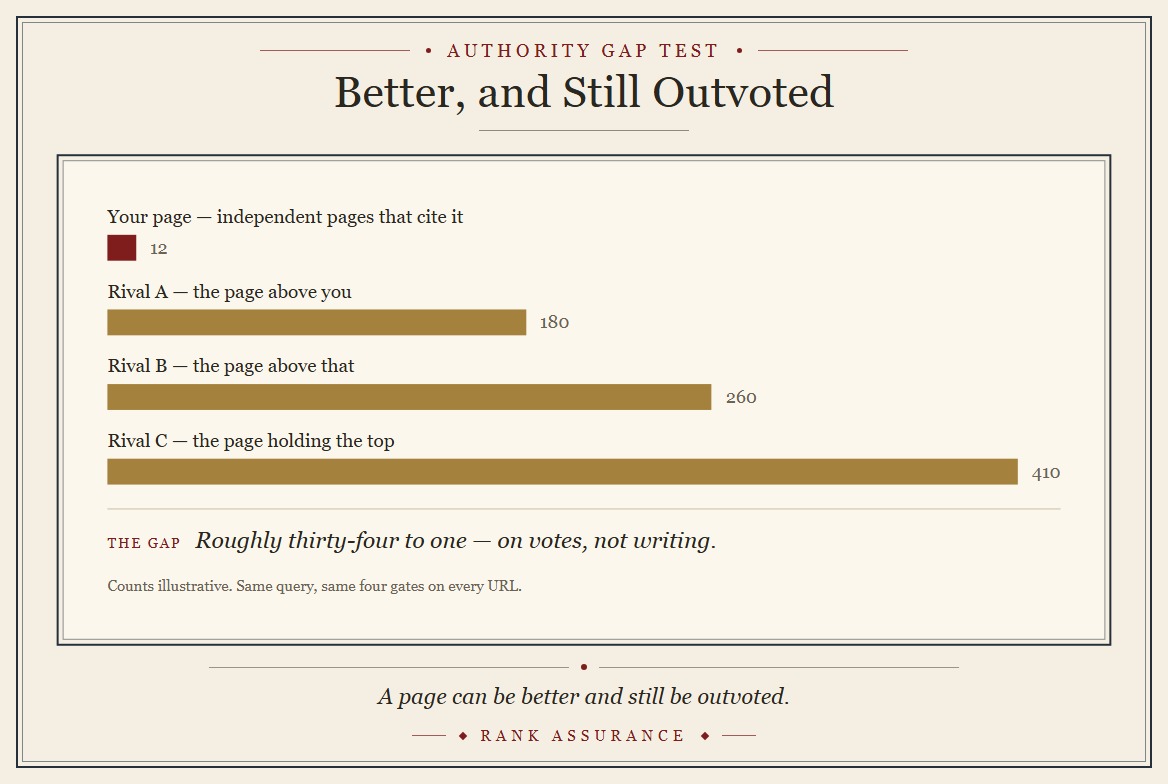
These thresholds are a working diagnostic heuristic, not a Google metric and not a published law. They are calibrated against Backlinko’s April 2020 analysis of 11.8 million search results, which found the #1 result averaged 3.8 times more backlinks than positions 2–10. The bands would move if a later study showed a much weaker or much stronger relationship, or if you are measuring a no-competition query. They exist so you stop guessing. A site with 12 referring domains cannot rewrite its way past three pages that have 180, 260, and 410. That pattern is observable on competitive health, legal, finance, and local service terms. The writing on the losing page is often fine. The graph is not.
Two extra checks keep the test honest:
- Anchor mix. If Search Console’s “top linking text” is dominated by exact money phrases from sites you do not recognize, you may already have the wrong kind of links. That is a gate 1 risk, not progress on gate 3. A natural mix looks like how people actually write links: brand name, naked URL, leftover “click here,” some topical language. Exact-match commercial phrases should be a minority.
- Commodity check. If you could swap your page with position 1 and a reader would not notice, you have a gate 4 problem even if some links exist. After March 2024, that is how sites lose ground in core updates with a graph that “looks fine.”
Calculator
Enter the referring-domain counts you collected. The output is the gap multiple and the next action. It does not fetch live data. The numbers have to be yours.
Authority Gap Calculator
The Same Gates, a New Prize
The same ranking stack now feeds a second surface. Google Search Central’s “AI features and your website” guidance says AI Overviews and AI Mode are rooted in Search’s core ranking and quality systems, and it asks for the same thing this article asks for: unique, non-commodity pages. The Four Gates apply unchanged when the surface is an AI answer instead of a blue link. Being reachable and readable by the systems that assemble the answer is gate 1. Being about the buyer’s question is gate 2.
At gate 3 the prize changes, not the mechanics. Independent mentions are what answer engines lean on when they decide which businesses to name and which sources to cite. A site with few independent votes sits in the same position it holds on page 4 of the classic results: competent, and absent at the moment the answer is composed.
The gap is measurable on this surface too. In one measured market run (September 2026, a medical-spa market), the subject business was named by one of four engines, held about a 1.2 percent share of answer voice, and was cited as a source in none of the answers. That is an authority gap read from a different surface. The measurement for it is the Citation-Surface Test.
What to Do with Each Result
Failed Gate 1 — Eligibility
Open the manual-action report and read the type. Unnatural links, scaled content, and scraped content each have a different cleanup. Stop publishing. Stop buying. Fix the pattern named in the report. Request reconsideration only after the cleanup. Algorithmic slides that line up with a documented core or spam update are slower: the last bad pattern has to stop, then you wait through later passes. Google’s helpful-content guidance notes that recovery after a sustained quality problem can take months.
Failed Gate 2 — Relevancy
One URL per intent. Title and first screen should name the query the way a customer types it. Take the money phrase out of the global header and footer so it is not stamped on every URL. If five of your pages split impressions for the same query in Search Console, merge them and redirect the extras to the winner.
Keyword stuffing is not a style issue. Google’s spam policies still define it as filling a page with words to manipulate rank — city lists with no extra value, unnatural repetition. Reading the page out loud is a better test than a density plugin.
Failed Gate 3 — Authority Gap
Keep the page. Point every related internal link at it. Then acquire votes a third party would defend.
What that looks like in practice, in order:
- Pages that already name you with no link. Search "your brand" -site:yourdomain.com and ask for the link.
- Suppliers, associations, boards, hospitals, universities, and software directories you actually belong to.
- One asset someone else can cite: a number, a public dataset, a calculator, a case series with methods. Put it on the URL you want to rank, or on a research URL that links clearly to it.
- Publications that already cite the pages in positions 1–3. Pitch them something they do not already have.
What it does not look like: $5 packs, “lifetime links,” one-time page-1 guarantees, or a private portfolio of sites that exist to pass ranking credit. Those are the product the market sells when someone hears “you need backlinks” and wants it done by Friday. They are also the examples in the link-spam policy.
Guest articles and outreach are not automatically fatal. They become a scheme when the piece would not exist without the paid exact-match link. A useful test: if you removed the link, would the host still want the article?
Define a useful linker without chasing a vendor score. It is a site Google already ranks for its own topic, with a real audience, topically related to you, linking from the body of a page rather than a footer, that would exist if SEO did not.
Failed Gate 4 — Commodity Page
Add what a competitor cannot copy: first-hand process, named author who did the work, original figures, specific cases, current dates. Do not add a second URL on the same intent. After helpful-content systems moved into core ranking, volume of interchangeable pages is a liability.
Special Cases, So the Test Is Not Treated as a Religion
Live Checks You Can Run Today
Inherited Authority
Search a common noun: photosynthesis, Napoleon, hypertension, rhinoplasty. A giant reference domain is usually near the top. That is not “best essay wins.” It is a domain that already passed gate 3, matches informational intent, and is cited constantly. A new URL on that domain can rank with little extra page-level linking. Your new domain cannot copy the move.
Cross-Site Copies That Still Rank
Search a hit song plus “lyrics.” Several sites with nearly the same body copy occupy page 1. That is why “duplicate content penalty” as civilians use it is the wrong fear. Now search one of your own distinctive sentences in quotes with site:yourdomain.com. If it hits fifteen of your URLs, you built the kind of duplication that splits your own signals.
The Content-Only Stall
A local or specialist site publishes a year of competent guides. Positions 1–3 are publishers or incumbents with referring-domain counts an order of magnitude higher. The losing page is often clearer. Clarity was not the constraint. This is the default shape of competitive informational and YMYL results, not a rare unlucky case.
The Metric People Chase
Search results are not sorted by a vendor authority score. A page can outrank a “stronger” domain when it is more relevant to the query. Use referring domains to the ranking URL as a gap estimate. Do not optimize for the third-party score.
A worked example (illustrative numbers), so the calculator is not abstract. Query pattern: a competitive local or YMYL service term.
| Referring domains to that URL | What the page is | |
|---|---|---|
| Position 1 | 180 | Incumbent publisher or established practice |
| Position 2 | 260 | National guide or association-level page |
| Position 3 | 410 | Large publisher |
| Your URL | 14 | Clear service page, mostly directories |
Median of the top three is 260. 260 ÷ 14 ≈ 18.6×. That is an authority gap. Rewriting the page to 2,200 words and adding an FAQ is the wrong project. Keeping the page, adding proof only you have, and spending two quarters on the kinds of mentions the winners already have — news, suppliers, associations, genuine partners — is the right one.
What This Is Not
- It is not a claim that content quality is irrelevant. That claim does not survive Google’s own documentation or the 2024 helpful-content work.
- It is not a claim that links are 80 percent of the algorithm. Click systems, language-understanding systems, and quality classifiers sit next to PageRank. The test asks whether links are the bottleneck for this URL, not whether they are the only system.
- It is not a how-to for private blog networks, expired-domain harvests, or guest-post farms. Those can move a chart until a classifier or a manual action catches the footprint. They are not the public version of this model.
- It is not “if you are not #1, fire everyone.” After 6–12 months on agreed terms, with no movement and no gap plan, you are paying for activity. Valid goals also include the local pack, a cluster of mid-volume terms, and being named in an AI Overview. Demand the gap math either way.
Questions
Is This Saying Content Does Not Matter?
No. Content moves relevancy and satisfaction. It does not, by itself, manufacture referring domains. Google’s Starter Guide keeps both points in one document.
Are the 2× and 5× Bands Official?
No. They are a working diagnostic heuristic, not a Google metric and not a published law. They are calibrated against Backlinko’s April 2020 analysis of 11.8 million search results, which found the #1 result averaged 3.8 times more backlinks than positions 2–10.
Can I Run This Without a Paid SEO Tool?
Yes for a first pass. Search Console shows your linking sites. A free checker is enough to estimate the pages already in positions 1–3. Recheck with a paid index before you spend a quarter on outreach.
What If I Am a New Site on a Term Nobody Ranks For?
Gate 3 is empty. Publish one clear page and get it indexed. Do not build an authority campaign for a query with no demand.
Sources
- Google Search Central, “A guide to Google Search ranking systems” (updated December 2025) — link analysis and PageRank remain a core system; helpful-content system folded into core ranking, March 2024.
- Google, “How Search Works” ranking-results overview — after finding relevant pages, quality includes whether other prominent sites link or refer to the content.
- Google Search Central, “SEO Starter Guide” (updated December 2025) — compelling content versus other suggestions in that guide; most new pages found through links; E-E-A-T is not a ranking factor; duplicate URLs are inefficient, not an automatic manual action.
- Google Search Central, “Creating helpful, reliable, people-first content” — E-E-A-T itself is not a specific ranking factor.
- Google Search Central, “Spam policies for Google web search” — link spam, keyword stuffing, scraped content, scaled content abuse, expired-domain abuse.
- Google Search Central, “AI features and your website” — AI Overviews and AI Mode are rooted in core ranking and quality systems; the guidance asks for unique, non-commodity content.
- Backlinko ranking-factors study (28 April 2020) — the #1 result averaged about 3.8× more backlinks than positions 2–10, across 11.8 million search results.
- First-party measured market run (September 2026, a medical-spa market) — the subject business named by one of four answer engines, about a 1.2 percent share of answer voice, cited as a source in none of the answers. Method: the Citation-Surface Test.
- Bill Gates, “Content is King” (3 January 1996) — original use of the phrase, media economics rather than ranking mechanics.