
The Would-This-Exist Test.
If Nobody Would Make This for a Person, Do Not Build It for Google
The Would-This-Exist Test asks one question of any page, mention, redirect, or domain: if it could not pass ranking credit, would a person still need it?
Most “bad SEO” lists are a pile of tactics. The useful filter is one question. Would this page, mention, redirect, or domain still be worth doing if it could not pass ranking credit? If the answer is no, you are building for a crawler. The spam policies already have names for that pile. This page does not teach you how to hide it.
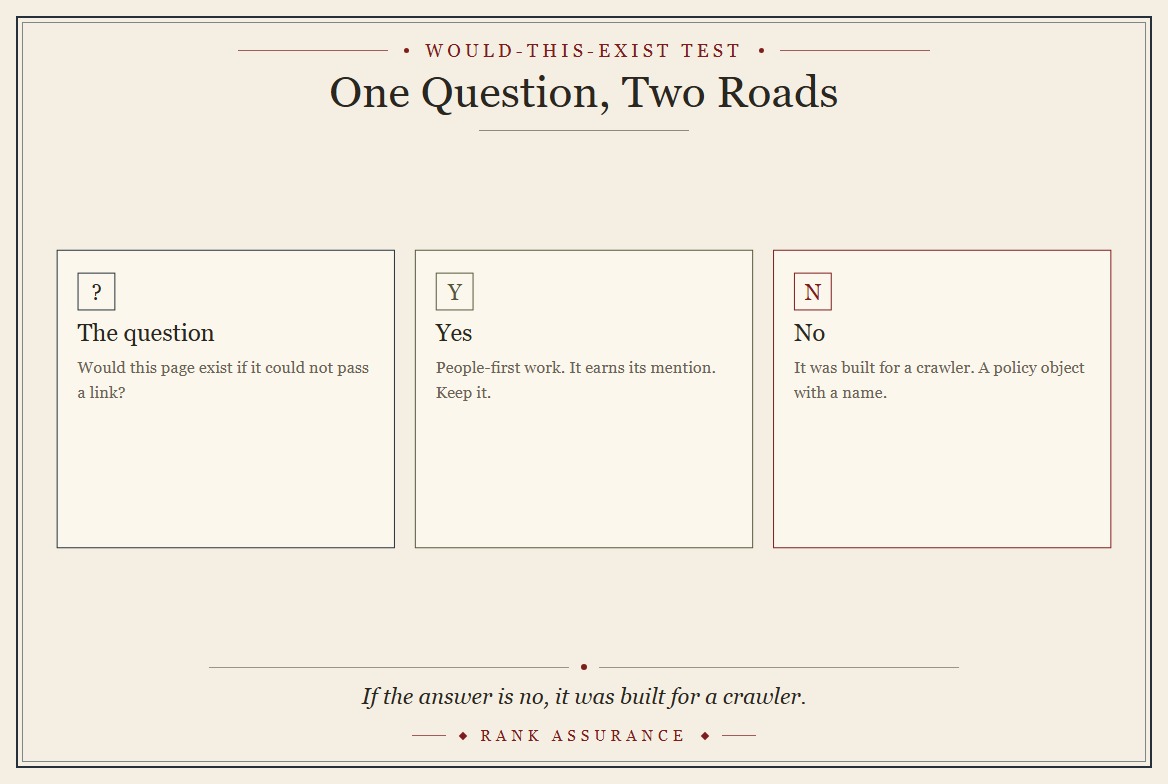
The Question This Article Answers
Industry filters say “would this happen organically?” and then explain how to make a manufactured graph look less manufactured: different hosts, staggered dates, mixed anchors, an irregular drip. That is not a decision test. That is evasion. The question that survives official documents is simpler.
The Filter, Walked
Three cases, run through the question — would this exist if it could not pass ranking credit?
- A city landing page with real staff, hours, and photos — yes, it survives.
- Forty near-identical service-area pages — no; the official name is scaled content abuse.
- An “AI content hub” of unreviewed model output on a rented subdomain — no; scaled content abuse plus site-reputation abuse.
Yes and No
Calculator
Would-This-Exist Calculator
The Official Names
Helpful, people-first pages are the other side of the same filter. The Starter Guide still wants content a person can use. That is not “content is 99 percent.” It is the relevancy gate.
What This Page Will Not Teach
How to split hosts across addresses. How to stagger registration dates. How to drip five mentions on an irregular calendar so the graph looks less planned. Those instructions exist to keep a scheme standing. They are not published here.
Official-Path Next Step
- Write the tactic in one sentence. Remove ranking credit from the sentence. If nothing useful remains, stop.
- If it remains useful, ship it so a person can use it. Fetchable, about a real query.
- If someone else should mention it, that mention has to survive the Earned-Mention Test.
- If you already have extra domains in play, open Sister-Site before you add another.
Questions
Is “Would This Happen Naturally?” the Official Test?
No. It is our filter. The official objects are the named spam types. Use both: the question first, then the policy name.
We Only Want Links from Well-Known Sites. Is That Safer?
Famous hosts are not a safe-harbor score. A purchased follow on a well-known site is still a purchased follow. Mark it or do not buy the credit.
Sources
- Spam policies (updated 28 August 2026) — link spam, expired-domain abuse, scaled content, stuffing, cloaking, site reputation abuse.
- Creating helpful, reliable, people-first content.
- SEO Starter Guide.
- Hiring an SEO.