
The Helpful-Content Test.
There Is No Separate HCU Penalty Form — and It Was Not “Links in Disguise”
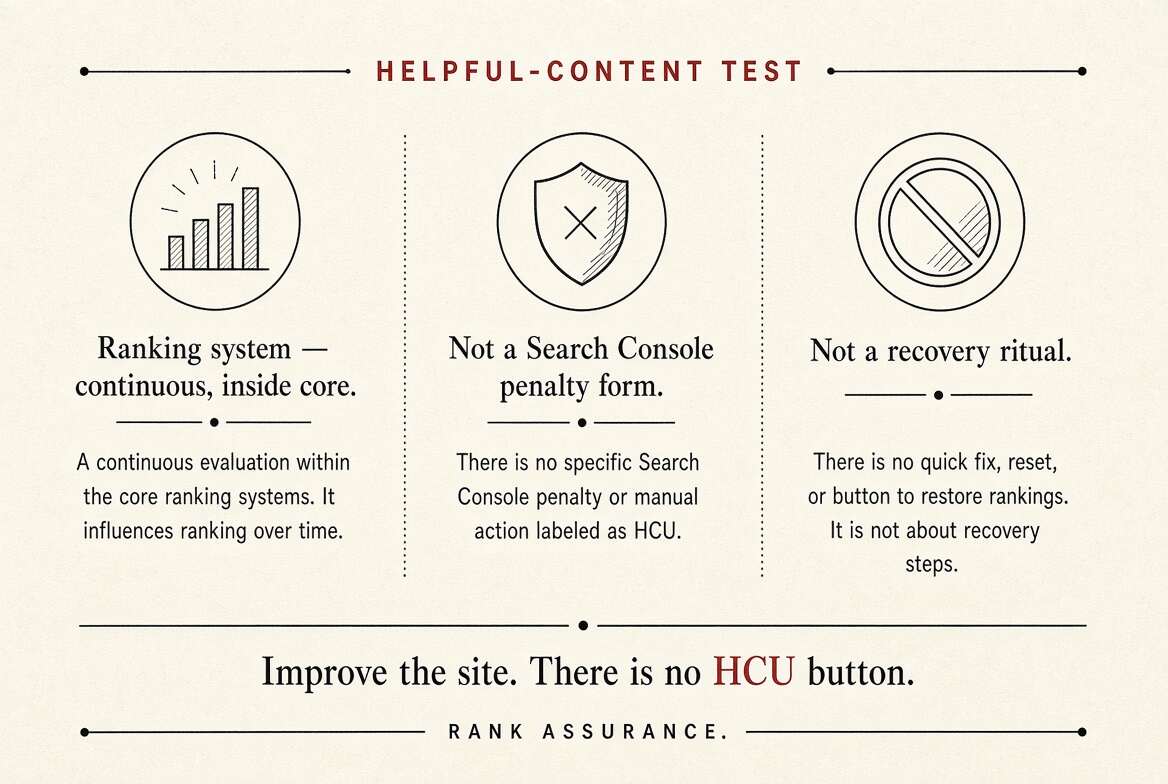
The Helpful-Content Test asks whether a traffic drop is the continuous core system reading search-first pages — not a manual action, and not a form you can file.
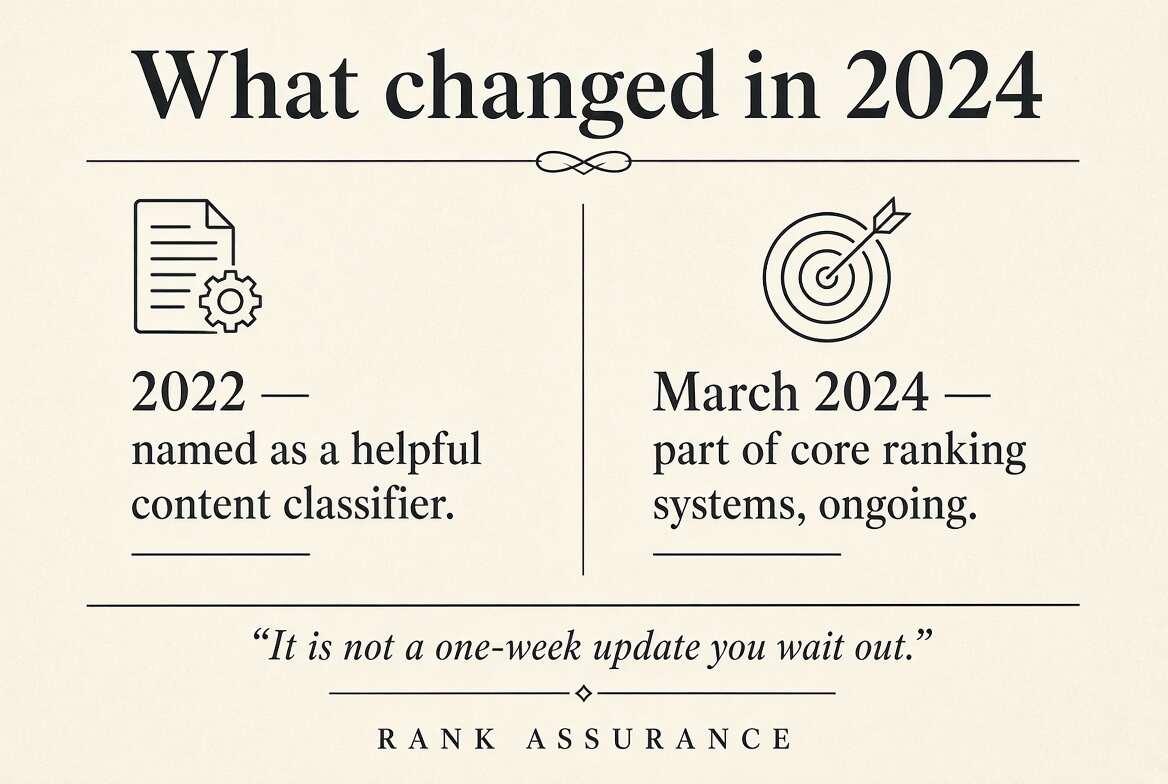
The helpful content system was announced in 2022. In March 2024 it became part of core ranking systems and runs continuously. Official target is pages made primarily to collect search visits. It is not a Search Console ticket. A vendor selling “HCU removal” is selling a name that is no longer a separate lever. Improve the site. There is no HCU button.
The Question This Article Answers
Did we get hit by “the HCU,” and is the fix more links or a reconsideration form? The named update is historical. The job it described is live: core systems try to prefer pages made for people, continuously. There is no HCU form, no button, and no rollout to wait for. Search Console manual actions are a different object — Suppression Type. The Helpful-Content Test asks whether a traffic drop is the continuous core system reading search-first pages, not a penalty you can appeal.
AI-assisted pages are not a separate penalty class. Origin is not the test. Scaled unhelpful or thin affiliate pages still fail this system. “AI cannot rank” and “AI cannot be demoted” are both too strong.
The Timeline, Sourced
Four Objects
| Object | What It Is | What It Is Not |
|---|---|---|
| 2022 named system | Helpful content classifier announced as its own system | A forever-separate switch |
| March 2024 core | Folded into core ranking systems. Runs continuously | A week you wait out |
| Manual action | A message in Search Console | The old HCU name |
| “HCU recovery” product | A vendor line item | A form that exists |
Scaled content abuse is a separate spam policy from the same period. Content-Quota. Unhelpful search-first pages and scaled commodity piles can travel together. They are not the same object as “authority was secretly redistributed.” That guess is not printed as fact.
Mentions still matter. Four Gates. Pruning a search-first pile does not retire Earned-Mention. Buying a packaged graph does not retire this system.
One Diagnosis, Walked
A services site’s clicks fall in mid-March 2024. The walk, in order:
- Date the drop. Search Console shows the slide starting inside a named core window — a ranking-system change, not a random Tuesday.
- Check manual actions. None. That closes the form path; there is nothing to appeal and nobody to write to.
- Classify the pages. Of 80 URLs, about 60 are query-collector posts — near-copies written to cover keyword variants; 20 are real service pages a customer would use.
- Prune, merge, rewrite. The near-copies merge into the few pages a person would bookmark; the search-first leftovers go; the real pages get the first-hand work the E-E-A-T Test asks to see.
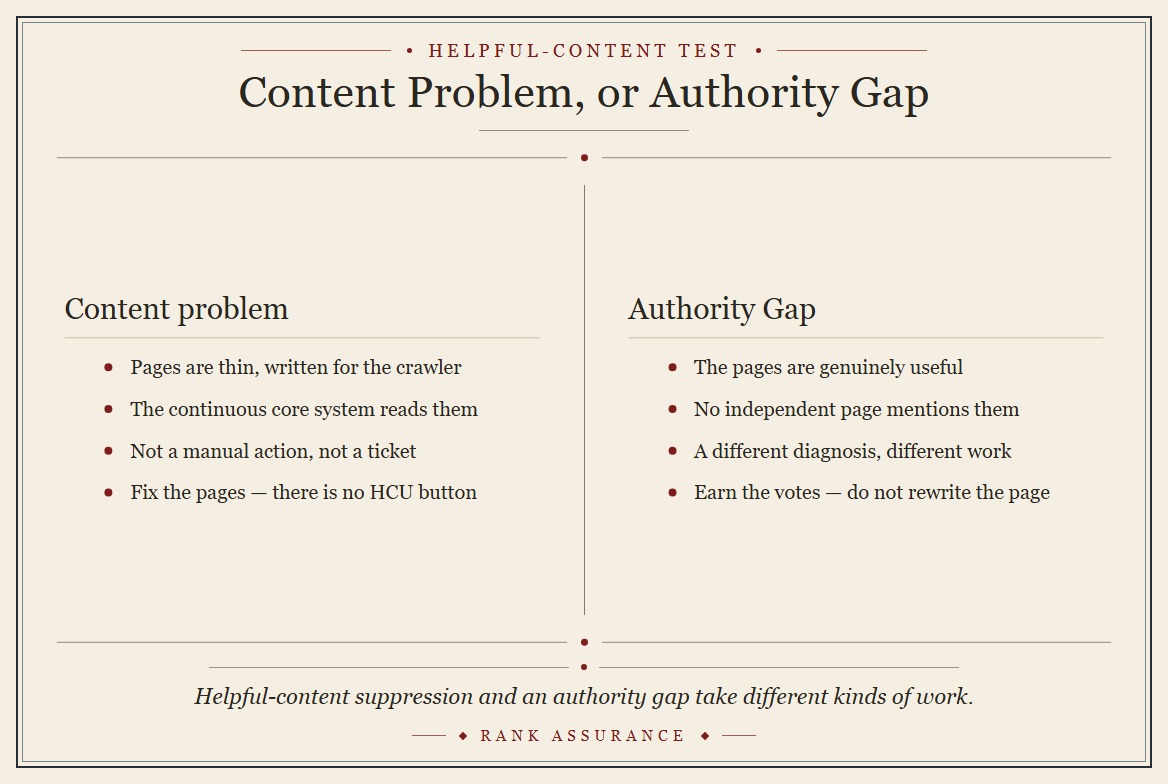
- Wait for recrawl, then reread. Weeks, not days. If the site is now useful and still invisible among peers, the remaining problem is the mention record — Authority Gap, not another rewrite.
The Same Test on the AI Surface
Pages written for search systems first fail answer engines too: an engine quoting one page per question has no reason to pick a query-collector. And the 2026 version of the question — “did my core-window drop also change my AI Overview presence?” — is readable in the performance data you already have: compare how the same queries surface you in classic results and in AI features across the window. The Citation-Surface Test and the AI Answer explainer cover how that surface is read.
Calculator
Helpful-Content Calculator
Official-Path Next Step
- Open Search Console. If there is a manual action, Suppression Type. That is the form path.
- If there is no action, list URLs written only to collect queries. Prune, merge, or rewrite so a person with a job would stay. Content-Quota.
- Show first-hand work where it is real. E-E-A-T Test. Fake “I tested this” is not experience.
- Give recrawl time. Then score mentions. Authority Gap if the pages are now useful and still invisible.
Questions
Is the Helpful Content System Still a Separate Update?
No. Official ranking-systems documentation lists it as historical and folded into core ranking systems in March 2024. Evaluation is continuous.
Can I Recover by Buying More Links and Leaving the Pages Alone?
That is not the official path. Prune or rewrite search-first URLs. Mentions still matter after the pages are useful. Four Gates.
How Long Does Recovery Take After Fixing Content?
No schedule is published. The system runs continuously, recrawl takes time, and honest reads happen weeks after real changes — not days. A vendor quoting an exact recovery date is quoting something Google does not publish.
Do I Delete Pages or Improve Them?
Improve what has a reader; merge near-copies into the definitive page; delete only what no person needs and nothing links to. Mass-deleting useful pages to appease a system is folklore, not the documented ask.
Does a Core-Window Drop Prove I Was Classified Unhelpful?
No. A window drop says a ranking system changed while many things were re-weighed. Classify the pages before concluding — the walkthrough above is the order.
Was the September 2023 Update Ever Reversed?
No reversal was announced. The separate system stopped existing in March 2024 when its job moved inside core — which is a change of machinery, not an amnesty.
Sources
- A guide to Google Search ranking systems (updated 10 December 2025) — helpful content system announced 2022, part of core March 2024, listed historical.
- Google Search Central Blog, “What creators should know about Google’s August 2022 helpful content update” — the announcement.
- Google Search ranking updates list — the September 2023 helpful content update; the March 2024 core update.
- Creating helpful, reliable, people-first content.
- Spam policies (updated 28 August 2026) — scaled content abuse.
- Suppression Type Test · Content-Quota Test · E-E-A-T Test · Topic-Fit Test.