
The Anchor-Text Test.
When the Clickable Words Help a Person — and When They Are a Spam Example
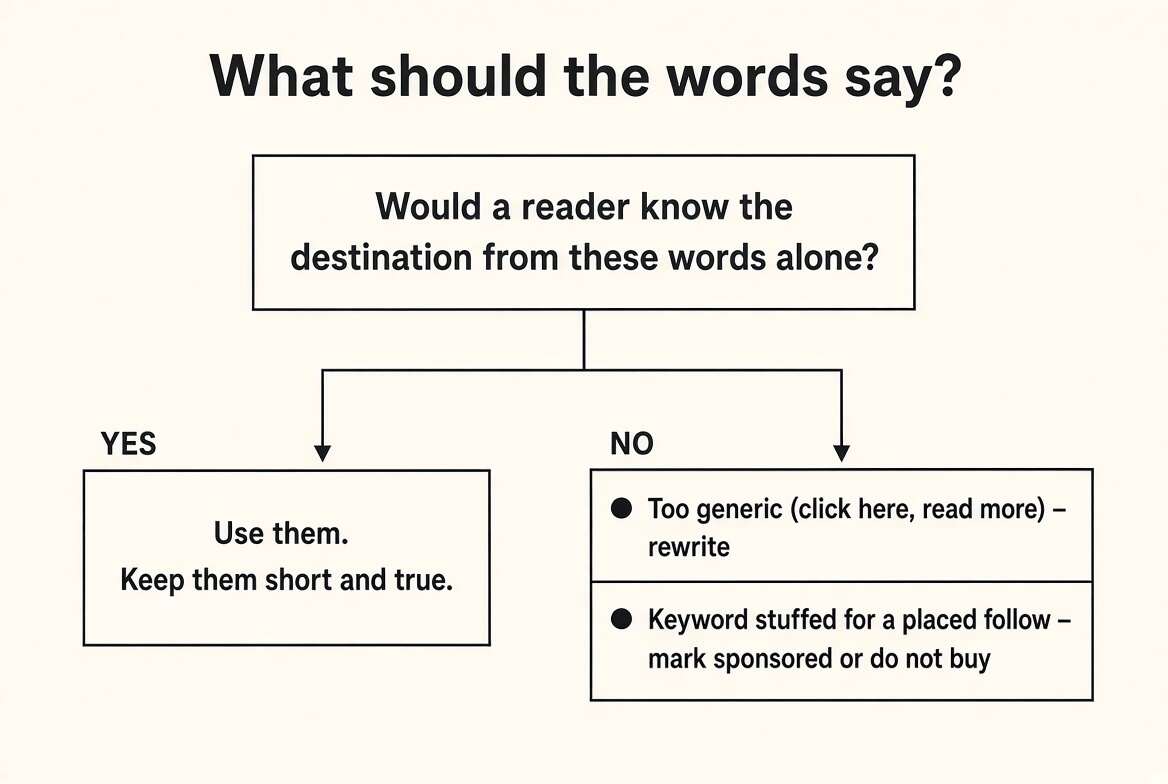
The Anchor-Text Test asks whether a reader would know the destination from the clickable words alone — and whether any paid, optimized anchor is marked.
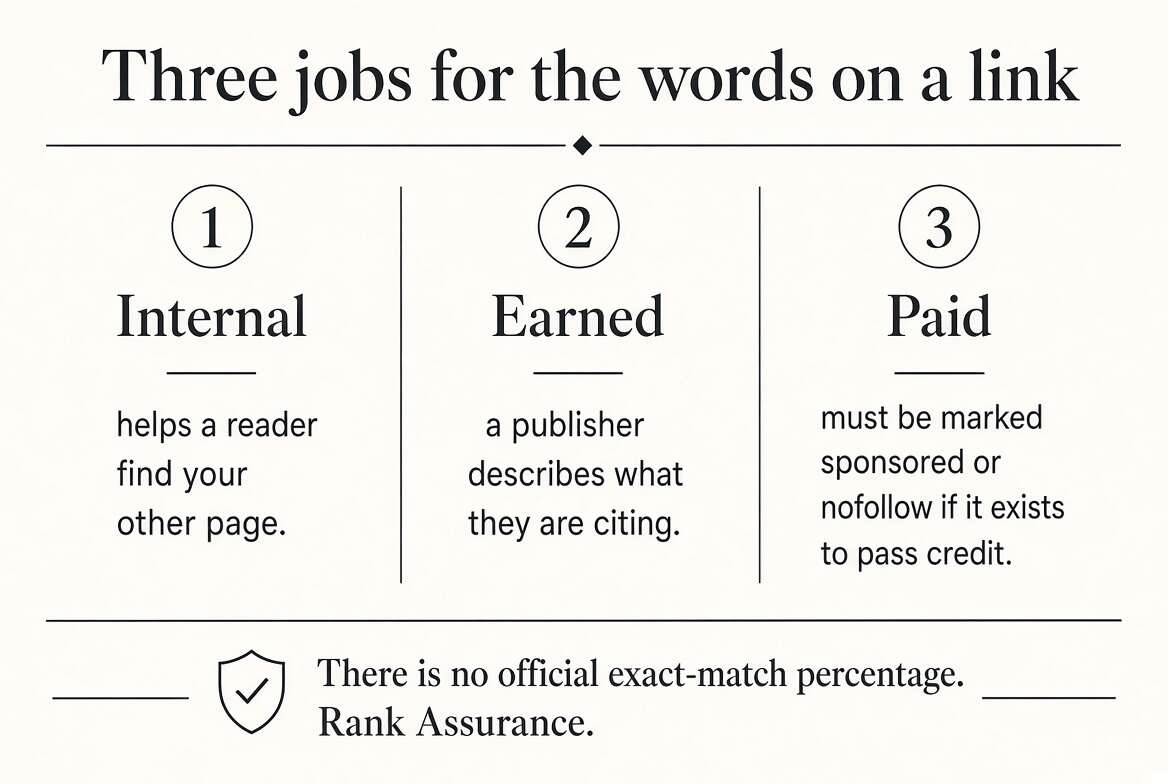
Anchor text is the visible words on a link. Official guidance is short: make them descriptive, reasonably concise, and true to the destination. There is no published exact-match percentage. A placed article stuffed with keyword follows is the named spam example. This page is not a recipe for ranking any site for any word.
The Question This Article Answers
Is there a safe exact-match anchor percentage? None is published — no five-to-ten-percent rule, no cap. The Anchor-Text Test asks whether a reader would know the destination from the clickable words alone, and whether any paid, optimized anchor is marked.
The clickable words tell a person — and a crawler — what they are about to open. That is useful. It is not a cheat that ranks a page for a phrase the page does not discuss. Folklore still sells a cap (five to ten percent exact match) and a recipe (use “click here” for the rest so the graph looks natural). Official link guidance says the opposite of that second half: avoid “click here,” “read more,” “website.”
What the Documents Say
| Label | Official Line | Use |
|---|---|---|
| Descriptive, concise | Tells people and Google about the destination. Relates to both pages. | Default for internal and earned |
| “Click here,” “read more” | Too generic. Rewrite. | Do not use as a camouflage mix |
| A whole paragraph as the link | Too long. Tighten. | Do not stuff the sentence |
| Chained one-word links | The docs’ own example: do not split their sample phrase “so many times this year” into five separate links | One thought, one link |
| Image link | Descriptive alt is the label | Not “no anchor” |
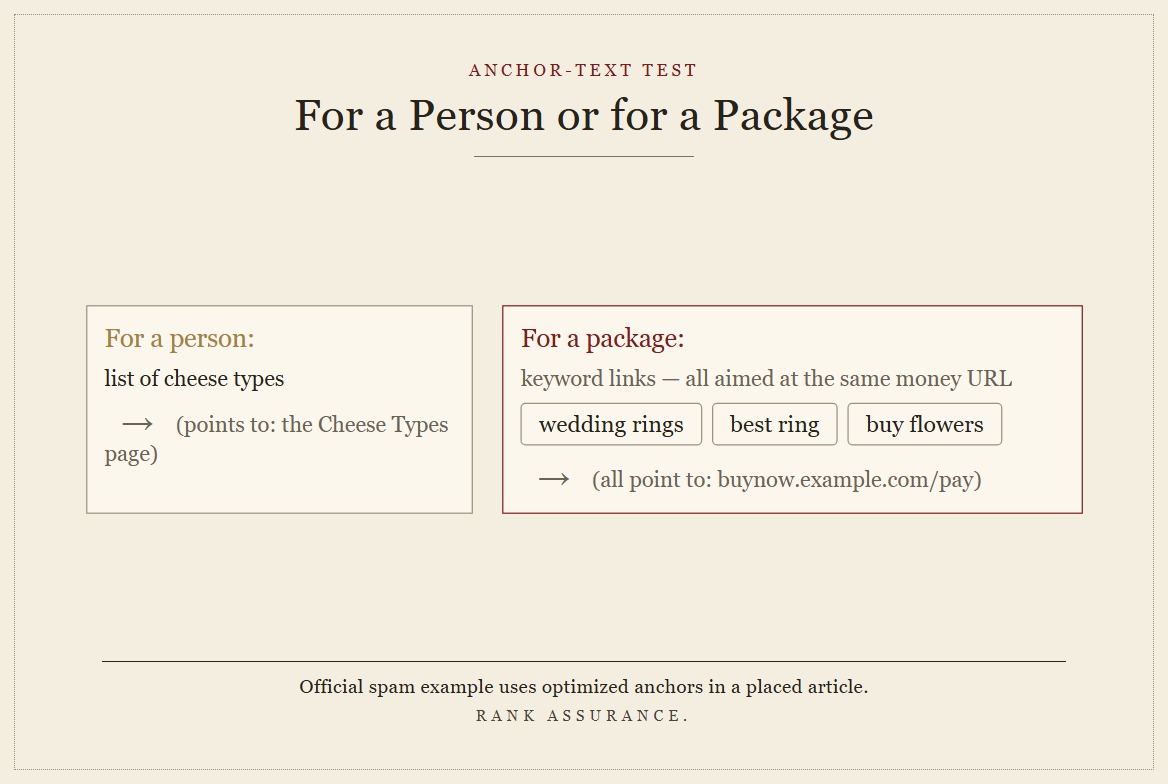
| Paid follow, optimized words | Named spam example in guest posts and press releases | Mark sponsored / nofollow or do not buy the credit |
| Forum signature keyword pile | Named spam example | Do not do it |
The good-practice example in Google’s own link documentation is a cheese shop: the recommended anchor names the list of cheeses you are about to open, so a person can predict the page from the words alone. That is the whole standard. The named spam example is its mirror — a placed article whose keyword-stuffed follow links are the product being sold.
Negative-SEO dumps of junk anchors exist. Google’s December 2022 link spam update announcement says its spam systems work to neutralize the impact of unnatural links. A pile of weird labels is not, by itself, a reason to buy a disavow package. If a manual action is in Search Console, that is the Suppression Type Test.
Three Generic Links, Rewritten
| Before | After | Why |
|---|---|---|
| “click here”…to see our service area | “our service area map” | The destination is in the words |
| “read more”…after a boiler-guide teaser | “the full boiler-replacement guide” | Predictable before the click |
| “website”…pointing at a permit office | “the Springfield permit office” | Names the source being cited |
A Small Anchor Audit, Executed
Six links from one page, each read with the table above. This is the whole method — no percentage was computed at any step.
| The Clickable Words | What It Is | The Call |
|---|---|---|
| “our wiring safety checklist” | Internal, descriptive | Keep |
| “click here” | Internal, generic | Rewrite so the words name the page |
| “Acme Electric” | A publisher named the brand in a news cite | Normal earned language. Not yours to edit |
| “emergency electrician dallas” | Exact-match follow in a placed article you paid for | The named spam example. Mark sponsored or decline |
| A logo image, empty alt | Image link with no label | Add descriptive alt — that is the anchor |
| A three-line sentence, all linked | Too long to predict | Tighten to the phrase that names the destination |
Labels on the AI Surface
Answer engines quote labels. A descriptive anchor survives quotation into an AI answer and still names the destination; “click here” carries nothing anywhere. The words that help a reader predict a page are the same words that let an engine describe and route to it — one more reason the label’s job is description, not keyword placement. Aboutness itself is a different test: anchors do not make a page about a query it does not cover — Topic-Fit.
Calculator
Anchor-Text Calculator
Official-Path Next Step
- Rewrite internal labels so a person can predict the page. That also helps crawl.
- When you cite a source, name the source. That is normal outbound writing, not a juice leak.
- If someone else mentioned you, you do not control their words. Earned-Mention Test.
- If you paid for the follow, mark it. Qualify outbound links.
- If the question is whether the linking page itself is worth being on, that is the Link-Quality Test; a row of your own hosts holding the anchors is Sister-Site.
Questions
Is There an Official Exact-Match Percentage?
No. Optimized anchors in paid guest posts and press releases that pass credit are the named problem — not a 5–10 percent recipe.
Can Anchors Rank a Page for a Word That Is Not on the Page?
Do not plan on it. The page still has to be about the query. Mentions are evidence. They are not a substitute for the First-Index relevancy gate.
Do Internal Anchors Matter as Much as Inbound?
They are the half you fully control. The official guidance covers both, and descriptive internal labels also help crawl and help a reader move. Start there — it costs nothing and needs nobody’s permission.
Is a Branded Anchor Wasted?
No. A publisher naming the brand or the article title is normal earned language — it is what honest citation looks like. Wanting keywords there instead is how the named spam example gets ordered.
Should I Vary Anchors to Look Natural?
Managing a ratio is the folklore this page opened with. Earned words are the publisher’s choice; yours only need to be descriptive. A pattern you have to engineer to look natural is not natural.
Do Nofollow Anchors Do Anything?
The rel attribute qualifies the credit; official docs treat those attributes as hints about how to handle the link. The words still do their human job either way — a reader follows a clear label regardless of rel.
Sources
- SEO link best practices (updated 10 December 2025) — descriptive labels; avoid “click here”; the cheese-shop example; the chained-links example; image alt; internal links.
- Qualify outbound links — sponsored, ugc, nofollow as hints.
- Spam policies (updated 28 August 2026) — optimized anchors in guest posts and press releases; forum signatures.
- Google Search Central Blog, December 2022 link spam update — spam systems neutralize the impact of unnatural links.
- Adobe, “Click here” writing note — public-record example of a vague label, not a ranking formula.