
The Topic-Fit Test.
What a Page Is About Is Not the Same as Who Mentions It — and Neither Is a Vendor Score
The Topic-Fit Test asks whether a page is genuinely about the query — separately from who mentions it, and from any vendor's domain score.
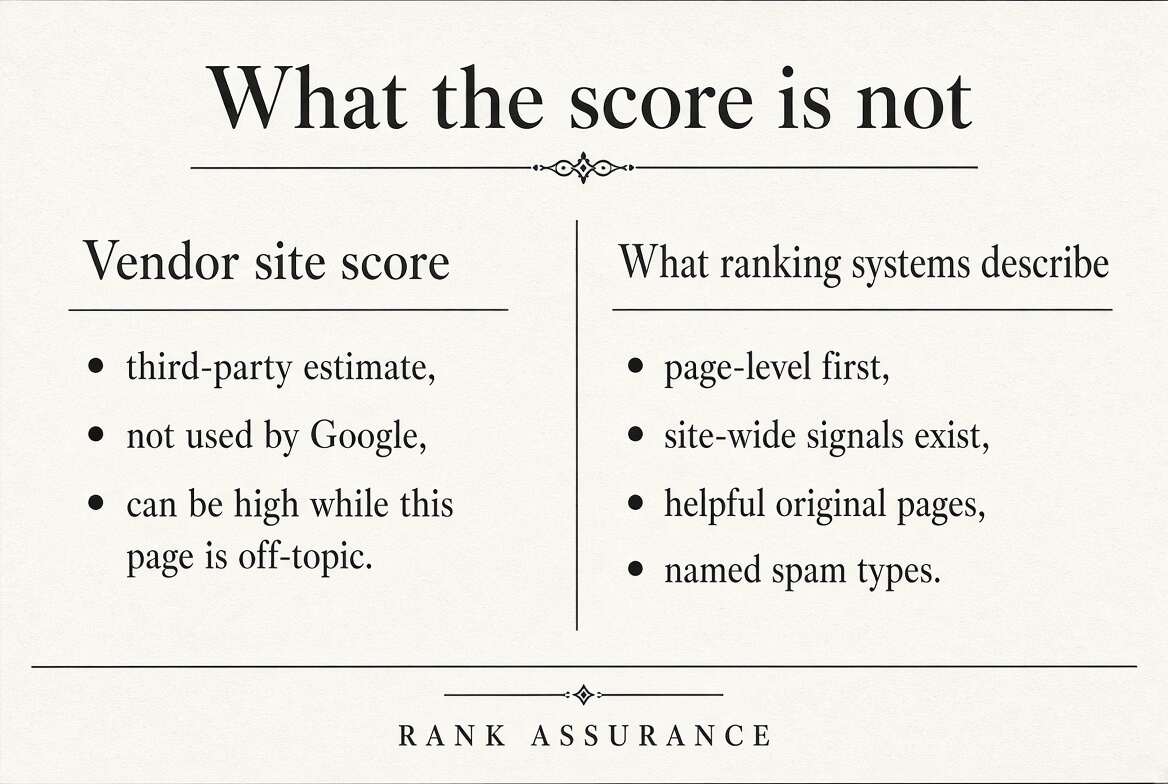
“Topical authority” is a course name. The jobs underneath it are real. First the page has to be about the query. Then other people can mention that page. Ranking systems work at the page level and also use site-wide signals. They do not publish a topical-authority number, and they do not use a third-party domain score.
The Question This Article Answers
Is “topical authority” a Google metric? No. Google publishes no topical-authority score, and it does not use a vendor’s domain score either. The Topic-Fit Test asks whether a page is genuinely about the query — separately from who mentions it, and from any vendor’s number.
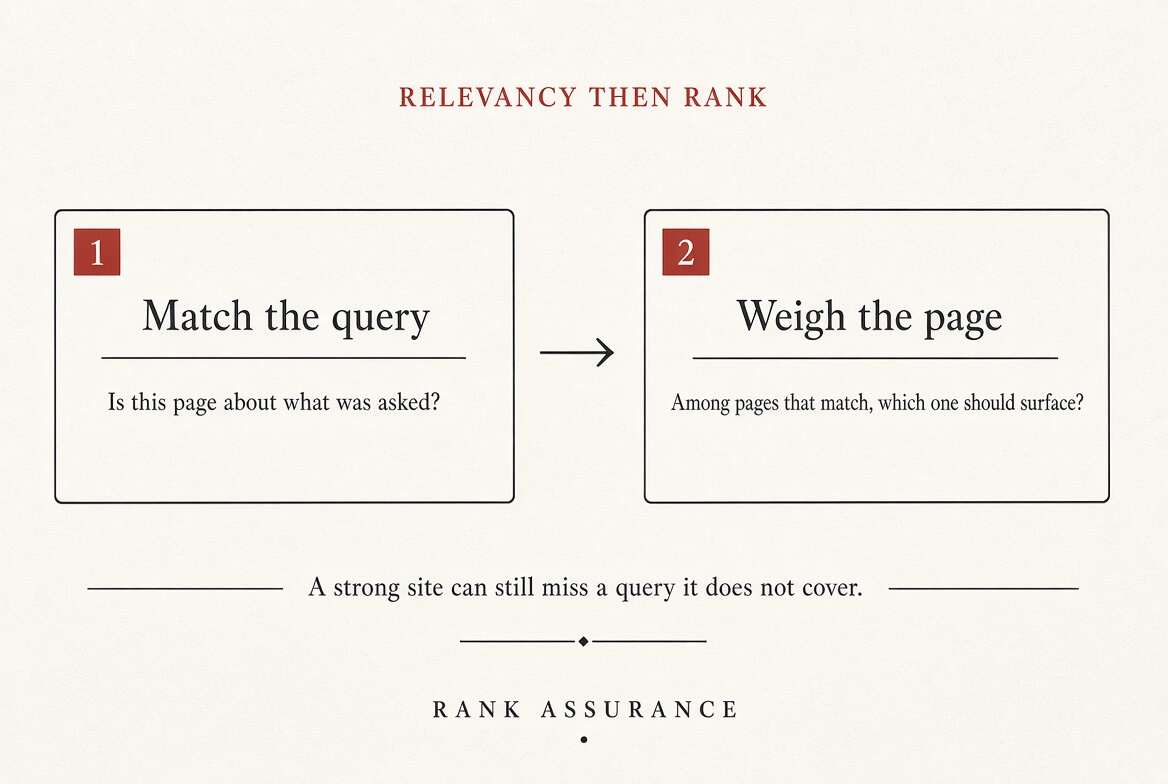
People buy a phrase — “topical authority.” The useful split is older than the phrase. A page can be about the query and still lose. A well-known host can miss a query it does not cover. Those are two different jobs. Gluing them into one score you can purchase is the marketing step. Aboutness — whether the page actually answers the query’s job, in a form a person can use — is the gate. Mentions sort the pages that already passed it.
The Four Rooms a Page Can Be In
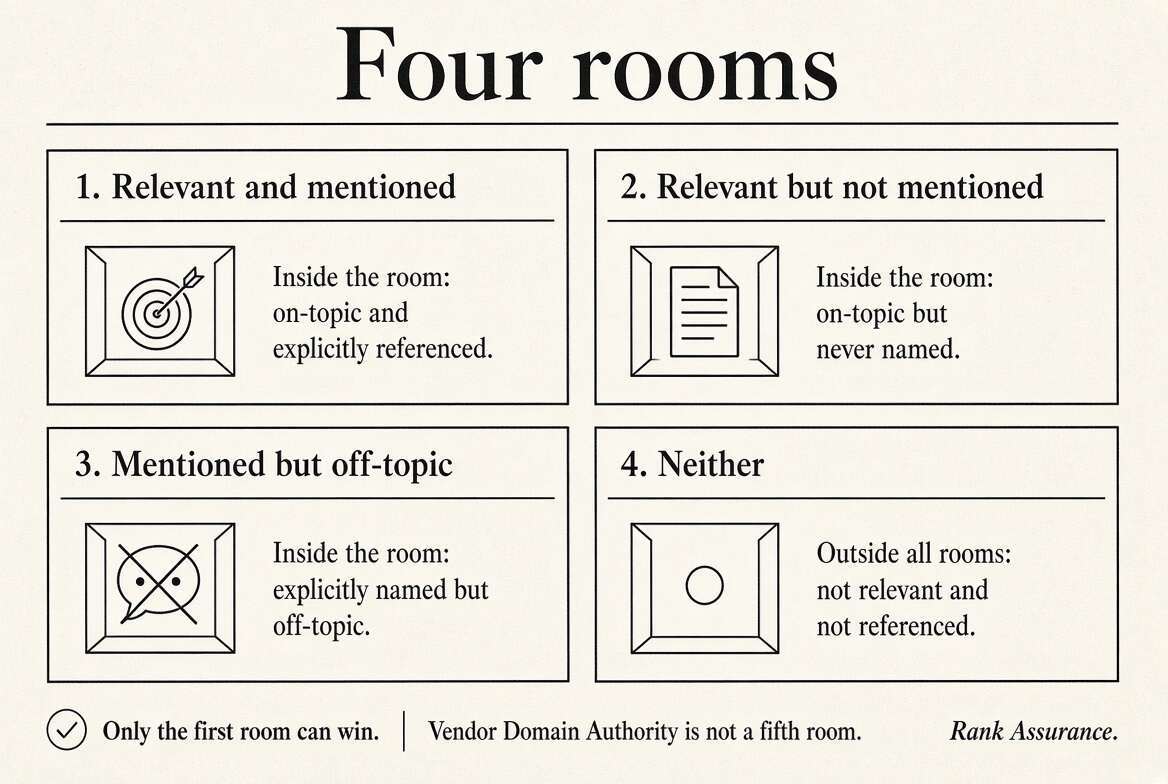
Cross relevant with mentioned and every page lands in one of four rooms. Only the first room can win.
| Room | The Page | The Lever |
|---|---|---|
| 1. Relevant + mentioned | About the query, and independent pages treat it as a source | The winning room. Keep the page current. |
| 2. Relevant, unmentioned | About the query; nobody independent cites it | Authority Gap · Earned-Mention |
| 3. Mentioned, off-topic | A famous host on a query it does not cover | Write the page that covers the job |
| 4. Neither | No matching page, no independent record | First-Index |
A worked pass at one query — “tankless water heater installation springfield”: the local plumber’s dedicated installation page with two independent supplier mentions sits in room one. A specialist’s thorough page that no outside page has ever cited is room two — in the race, invisible among peers. The national brand whose only nearby URL is a category page that never says “tankless” is room three. The remodeler with no page containing the phrase at all is room four. The observable evidence is the same in every case: does one URL answer the question, and does any page you do not control point at it?
A vendor domain score is not a fifth room. It does not move a page between rooms, and it is not how the rooms are judged.
What Is Official
YMYL queries have a higher quality bar. That is rater-guideline language and lived experience on health, money, and safety. It is not a ban, and it is not solved by buying a cluster package.
The Same Split on the AI Surface
Answer engines enforce the two jobs harder, not softer. An engine includes a business when the page covers the question and sources the engine trusts mention it — both, not either. A page that passes aboutness while the independent record is missing shows up the way room two always shows up: rarely named, rarely cited, invisible among peers that are believed. Measured runs on the AI surface make that split visible per market — the AI Answer explainer describes how those runs read, and the Citation-Surface Test is the owner’s walk of it.
Calculator
Topic-Fit Calculator
Official-Path Next Step
- Write the query in one sentence. Does this URL answer that sentence? If no, First-Index.
- If yes, is a smaller specialist beating you because they actually covered the job? Write the missing piece. Do not publish forty near-copies.
- If the page is complete and still invisible among peers, Authority Gap / Earned-Mention.
- Ignore the vendor site score as a ranking product. It can still be a rough research hint. It is not the test.
Questions
Can a Small Site Beat a Large One?
Yes, on a query the large site does not actually cover. That is relevancy and usefulness, not a secret score.
Should We Build Topic Clusters?
Build the pages a person needs and link them so a person can move. That is architecture. It is not a ranking-system name.
Does Covering a Topic Completely Guarantee Ranking?
No. Coverage opens the gate; independent mentions sort the pages that got through. Complete-and-unmentioned is room two — the Authority Gap, not a coverage problem.
Do AI Engines Have Their Own Topical-Authority Score?
None is published there either. What the measured behavior shows is the same two jobs: the page must cover the question, and sources the engine trusts must mention you. A vendor number is not part of either job.
Sources
- A guide to Google Search ranking systems (updated 10 December 2025) — page-level first; site-wide signals exist; helpful original pages.
- SEO Starter Guide (updated 10 December 2025) — relevant, useful content.
- Creating helpful, reliable, people-first content.
- Spam policies (updated 28 August 2026) — scaled content; optimized paid anchors.