
The Domain-Score Test.
A Vendor Number Is Not Google’s Score — Compare the Ranking Pages
The Domain-Score Test compares the two URLs actually ranking for a query instead of two vendor authority numbers.
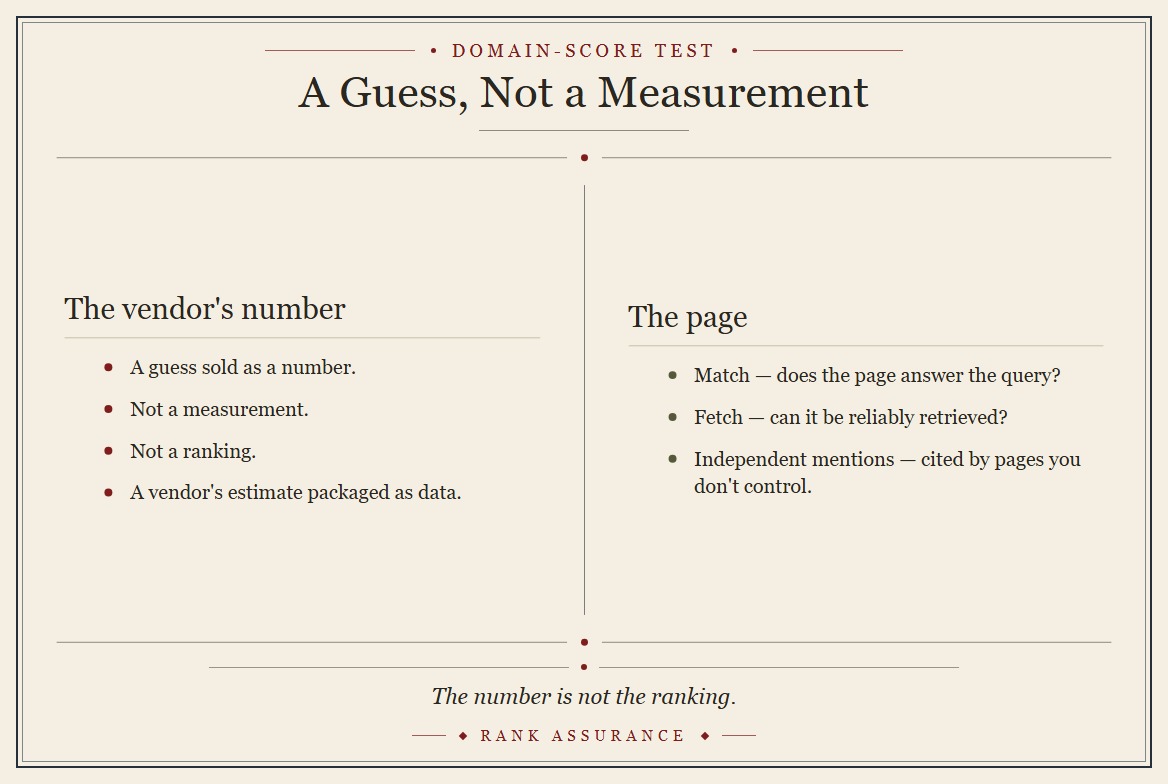
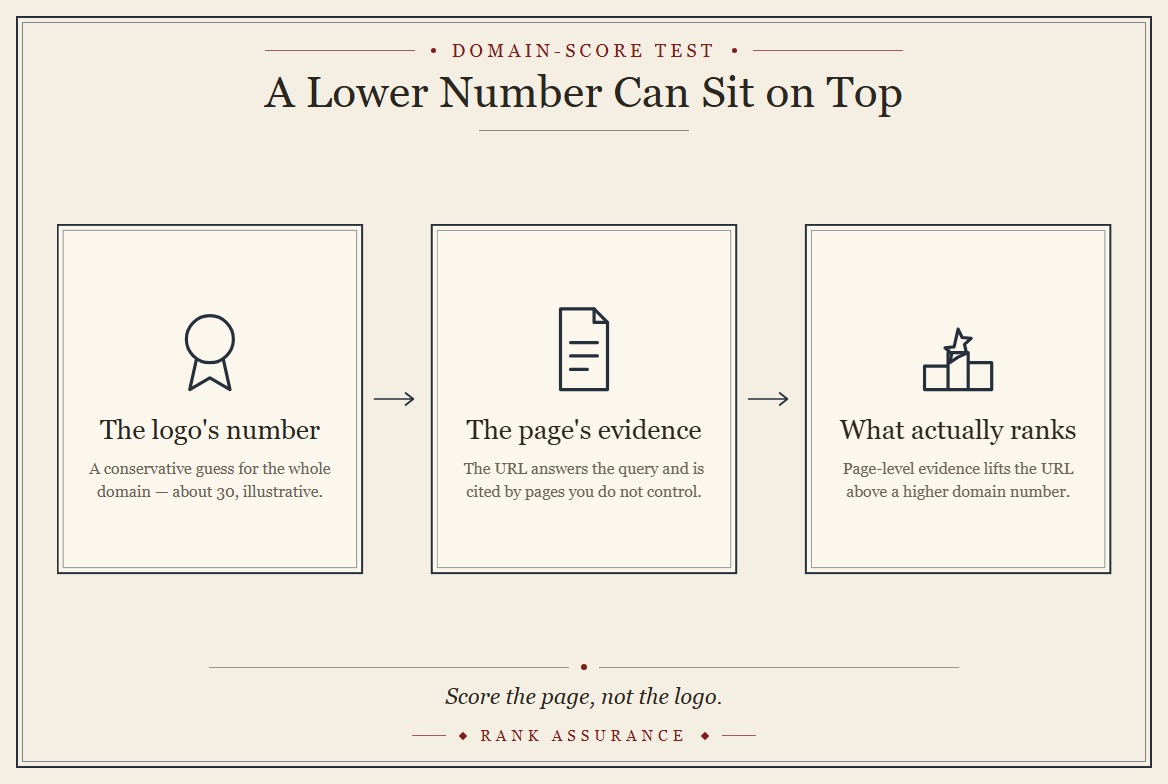
A smaller vendor score can sit above a larger one. That is not a paradox. Third-party domain scores are estimates. They are not a published Google ranking factor. Ranking is the page against the query. Compare the two ranking URLs. Do not crown the homepage number.
The Question This Article Answers
No — a vendor domain score is not a Google ranking factor. So how can a “lower authority” site sit above a “higher authority” site? First ask whether you compared vendor scores or ranking pages. A domain-wide guess is not the system. A focused page that answers the query can beat a generalist with a bigger number.
Four Objects
Page-level mentions are references you do not control: independent pages that point at the specific URL, not at the brand’s homepage. How Search Works describes weighing whether other prominent sites refer to the work — it does not describe reading a vendor’s homepage number.
Two-Site still applies when the question is “their writing is worse.” When the question is the score itself, this page is the test. Authority Gap still applies when the useful page has no independent mentions. None of those pages uses a vendor score as Google’s authority.
“How much of that number do I need?” is the same wrong object. There is no official threshold. A quiet phrase can surface a useful first page (First-Index). A contested query is scored against the URLs that already sit there — page-level mentions and match, the Four Gates in order — not against a homepage guess. A retainer whose only KPI is “we will get you to 50” is Vendor Claim.
What Separates Ranking Pages in a Measured Sample
This library keeps a measured counterpoint to the score conversation. Our benchmarks corpus reads real local-service sites — pages ranked at the top of their market and pages at the bottom of the same queries — on one 58-signal catalog, with every aggregate published behind an anonymity floor. What separates the winners in that sample is not any vendor number. The clearest separator is a boring completeness signal — a privacy-policy link — while the security and indexability basics sit on nearly everyone, top and bottom alike. The live figures, exact sample size, and dates are in the measured study. Correlation in a measured sample, never cause — and still a better conversation than two homepage scores.
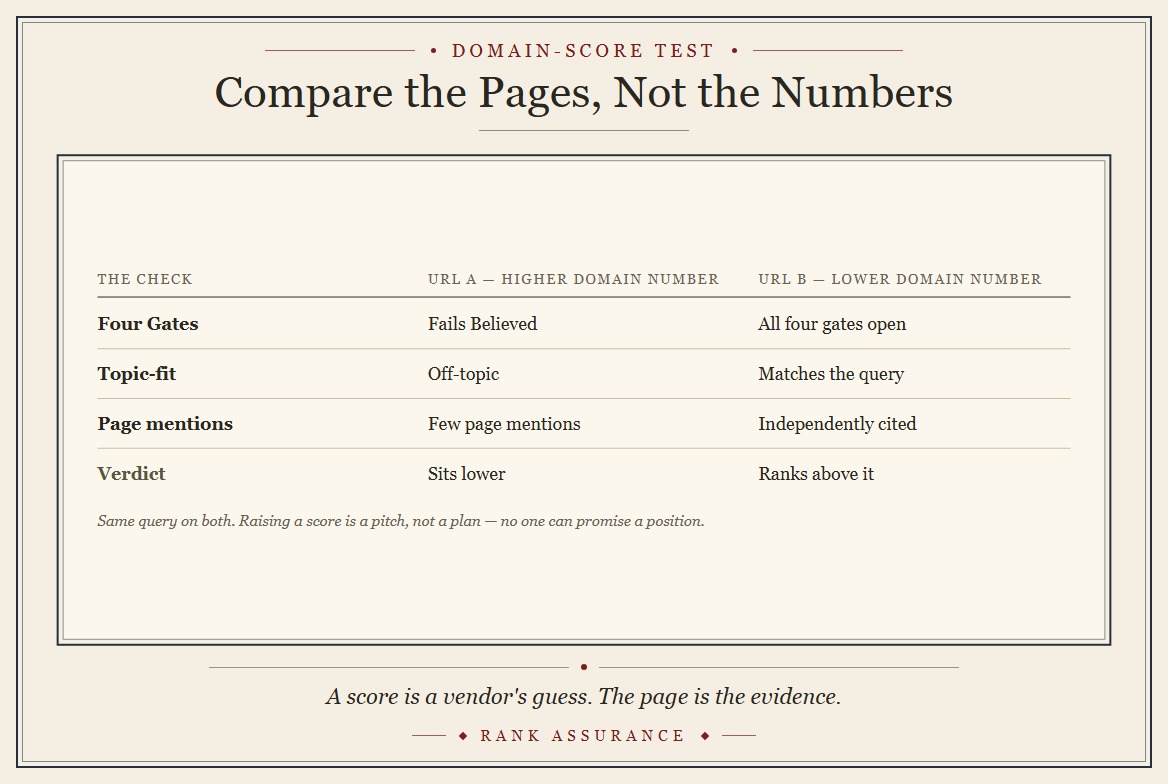
The test, run once — an invented pair, the real method. Query: “sump pump installation” in one town. Their URL: a five-year-old service page that fetches clean, answers the phrase head-on, and carries two independent mentions — a local supplier’s write-up and a trade association’s member page. Your URL: newer, backed by a bigger homepage number, thin on the phrase, zero mentions pointing at the page itself. Fetch: both pass. Match: theirs. Mentions: theirs. Suppression: neither. The vendor scoreboard said you should win. All four gates said you should not. That is the whole test.
The next vendor number is already on sale: “your AI visibility is 34.” Run the same test on it. Ask which answer, on which engine, on which date, named which page — the Citation-Surface Test reads that surface. A dashboard score with no named query is the same object with a newer name.
Calculator
Domain-Score Calculator
Official-Path Next Step
- Name one query. Open the two ranking URLs — not the homepages.
- Score fetch, match, independent mentions, and suppression on both — the Four Gates, in order. Two-Site.
- If your page is the better match and empty on mentions, Authority Gap.
- If the only KPI on the invoice is a vendor score, Vendor Claim. The SEO Pitch Test reads the rest of that deck.
Questions
Can a lower vendor score sit above a higher one?
Yes. The number is an estimate. The query can prefer the better-matching page. Page-level mentions can disagree with a domain-wide guess.
Why did my domain score drop while rankings did not move?
Because the score is a vendor’s estimate, recalculated on the vendor’s schedule from the vendor’s index. If the named query, the impressions, and the clicks held, nothing that ranks changed. Check the query row, not the dashboard.
Are AI-visibility scores the next vendor number?
Same object, newer surface. A single score summarizing “how visible you are to AI” is a vendor estimate, not an engine’s published metric. Ask for the named answer, the engine, and the date — Citation-Surface.
What should a monthly report show instead of a score?
Named queries with impressions, clicks, and position from Search Console; the work shipped against dates (Work-Log); and which surface showed. A single number only the vendor can compute is not a report.
Should I ignore those scores entirely?
Use them as a rough inventory if you must. Do not use them as the ranking. Do not pay a retainer whose only job is to raise the number.
Sources
- How Search Works — ranking results.
- A guide to Google Search ranking systems.
- What Separates Page-One Local-Service Sites — the measured study behind the benchmarks page.
- Two-Site Test · Topic-Fit Test · Vendor Claim Test · Link-Quality Test · The Four Gates.