
The Vendor Claim Test.
How to Check an SEO Case Study Before You Sign
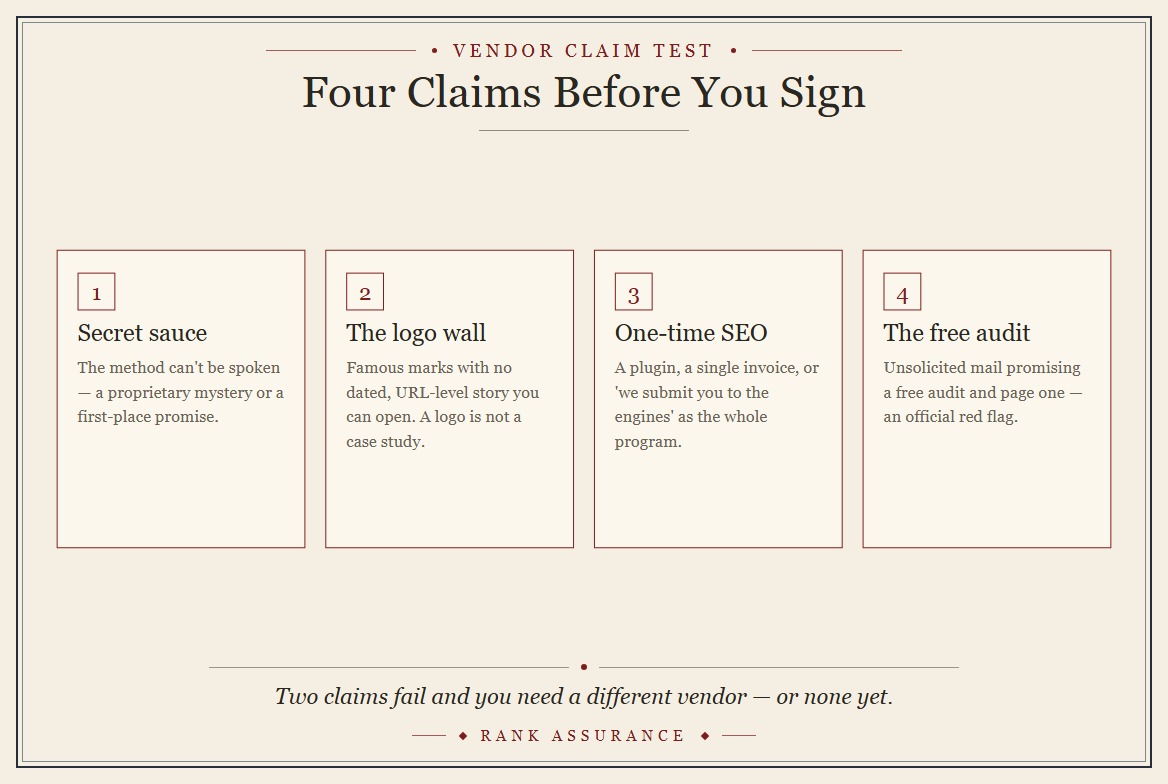
The Vendor Claim Test is a four-part pre-hire check — spoken method, verifiable clients, ongoing program, solicited contact — an SEO pitch passes before write access.
There is no license for calling yourself an SEO. That is not a scandal. It is why a pitch has to survive four checks: the method they will say out loud, the clients they can prove, whether the work is ongoing, and how they found you. This article is the pre-hire test. The Retainer Fit Test is what you run after the invoice starts.
The Question This Article Answers
Four claims decide a pitch before any contract: a method they can say out loud, clients you can verify, a program rather than a one-time pass, and a first contact that was not a cold page-one promise. Anyone can put “SEO agency” on a site. There is no bar exam. Google does not license consultants. The filter is the buyer’s. A pitch fails when the method cannot be spoken, the proof cannot be checked, the work is sold as a one-time pass, or the first contact was a guaranteed first-place email.
That is a different question from “is my current retainer working?” Run this test first. Run the Retainer Fit Test after you have a contract.
The Four Claims
Two or more failed claims and you do not need a longer call. You need a different vendor or no vendor yet.
Calculator
Vendor Claim Calculator
“Secret Sauce”
What it is. The pitch that the method cannot be explained because it is proprietary, because they have a relationship with Google, or because the work is “too advanced to put in a scope.” Google’s hiring page is the opposite document: ask what they will do, how they will measure it, and whether they follow Search Essentials. Secrecy is listed as a reason to be careful. A first-place guarantee is listed as a reason to leave.
How it hurts. You cannot audit work you are not allowed to see. If the “sauce” is a private network of sites they control, you also inherit a sister-site problem. If it is nothing, you have paid for theater.
Official-path fix. Ask them to write the first 90 days: queries, technical access, content, earned mentions, and the Search Console report you will both open. If they cannot, you do not have a vendor. You have a slogan.
The 2026 Version: Guaranteed AI Placement
“We will get you into AI Overviews” and “we will make ChatGPT recommend you” are the first-place guarantee in this year’s costume. No engine sells that placement either — not Google, not the AI assistants. The demand is the same as for claim one: name the mechanism, name the buyer questions, and name how it will be measured.
The only evidence shape an AI-placement claim can take is a dated run: which engine, which question, which date, and what the answer said — reproducible by you, not a screenshot from their deck. Answers also change between runs, so a single capture proves even less than a SERP screenshot does. What being named in AI answers actually requires is the subject of the Citation-Surface Test and the Generative-Impression Test.
Named Clients and Logo Walls
Google tells you to ask for examples of previous work and to check references with past clients. That is not the same as a homepage row of famous marks.
Public logos with permission are normal. Absence of logos is also normal. Neither is a score. Unverifiable names are unverified. Do not treat a wall as fraud by default, and do not treat it as evidence.
One-Time SEO and the Plugin
A plugin can help titles, sitemaps, schema, and speed. Those are eligibility and page-experience jobs. They do not close an authority gap on a competitive query. Core updates, spam updates, competitors, and AI Overviews keep moving after the invoice for the plugin is paid.
A one-time fee for “SEO” is usually a one-time on-page pass. Sometimes that is all a small local site needs, and Google says small local businesses can do much of that work themselves with the Starter Guide. A national or competitive query is a program. Sell it that way, or do not buy it that way.
The Unsolicited Free Audit
Google’s hiring page warns you about firms that email you out of the blue and about anyone who guarantees first place. The template is old: complimentary analysis, award-winning agency, Gmail, page one in weeks. The official tell is the guarantee and the cold promise — not the sender’s grammar and not their country.
A free audit you requested, on read-only Search Console, with no first-place promise, is the process Google describes. The difference is who started the conversation and what they guaranteed.
One Cold Pitch, Scored
The Specimen — a Composed Example
“Hi, I visited your website and noticed you are not ranking on Google. We are an award-winning agency with a special relationship with Google. Our proprietary process gets clients to page one in 30 days — we have done it for several household brands. Reply for your complimentary audit.”
Score it against the four claims. Claim one fails: “proprietary process” plus “special relationship” plus a page-one promise — three phrasings of the same secret. Claim two fails: “household brands” with no URL, no dates, no person to call. Claim three fails: a 30-day product is a pass, not a program. Claim four fails: they found you, cold, with a free audit and a deadline. Four failures. Per the test, the reply writes itself: none.
The Content-Only Pitch
The adjacent-niche package — a coach selling “SEO for coaches,” a plugin vendor selling “content is king” — fails because it names one gate and ignores the rest. Content is how a page becomes relevant to a query. Google’s Starter Guide and ranking-systems documentation treat that as real work. It is not the whole job on a competitive term. Authority among relevant pages still has to be earned. A content-only pitch and a links-only pitch are the same error from opposite sides.
If a landing page is not ranking, do not start with “rewrite the copy harder” and do not start with “we will add ten links.” Run the Authority Gap Test. Then write the scope. The slogan itself — what “content is king” is usually covering — is dissected in the Content-King Test, and the proof to demand from a “we rank with words alone” claim is the Live-URL Test.
What Google Already Told You to Ask
From “Do you need an SEO?”:
- Examples of previous work. Do they follow Search Essentials?
- What results, on what timeline, measured how?
- How will we communicate, and will every change be explained?
- Are they interested in the business, the customer, and how search is supposed to help?
- References you can call.
- An audit on read-only Search Console. No first-place guarantee.
Those six questions are the Vendor Claim Test in official language. A twenty-minute call that cannot answer them is finished.
Official-Path Next Step
- Score the four claims. Two fails and you stop.
- Take the Google questions. Write the answers down.
- If you hire, grant read access first. Write access after the scope is signed.
- Baseline the money URLs in Search Console before anyone touches them, then run the Authority Gap Test.
- Ninety days later, run the Retainer Fit Test on the same scope.
Questions
They List Well-Known Brands. Is That Enough?
No. Ask for the URL, the dates, the queries, and a person you can call. A logo is not a case study.
They Will Not Name Clients Because of NDAs. Are They Hiding?
Not necessarily. Take the private reference. If there is no one you can speak to and no dated URLs either, you have no proof.
Is a Plugin a Waste of Money?
No. It can help crawl, titles, and schema. It is not a substitute for relevancy, authority, or a program that survives the next core update.
They Say They Will Get Us Recommended by AI. Is That Verifiable?
Only as a dated run: the engine, the question, the date, and the answer text — reproducible by you. A guaranteed AI placement fails the same way a guaranteed #1 does. No engine sells the spot.
The Case-Study Site Has Since Been Redesigned. How Do I Check the Claim?
Ask for evidence from the period the claim covers: the dated Search Console export, the queries, and a person who was there. If every trace of the work is gone and nobody will take a call, the claim stays unverified.
Is White-Label Work — Reselling Another Firm — a Red Flag?
Not automatically. Reselling is common. The four claims apply to whoever actually does the work. Ask who ships it, and whether the monthly log will name them.
If We Are Not #1 in Three Months, Should We Fire Them?
Not automatically. Positions below one still convert. Time-to-rank depends on the authority gap. Fire them if they guaranteed first place, cannot show the work, or fail the Retainer Fit Test.
Sources
- Google Search Central, “Do you need an SEO? Tips for hiring an SEO” (updated June 2026) — interview questions, references, read-only audits, unsolicited email, first-place guarantees, secrecy.
- Google Search Central, “Google Search Essentials” — the document a vendor should say they follow.
- Google Search Central, “SEO Starter Guide” — content and on-page work as real gates, not the whole job.
- Google Search Central, “A guide to Google Search ranking systems” (updated December 2025).
- “The Retainer Fit Test” — after the work starts.
- “The Authority Gap Test” — why a content-only or links-only pitch is incomplete.