
The Affiliate-Page Test.
A Commission Link Is Allowed — A Copy of the Merchant Page Is Thin Affiliation
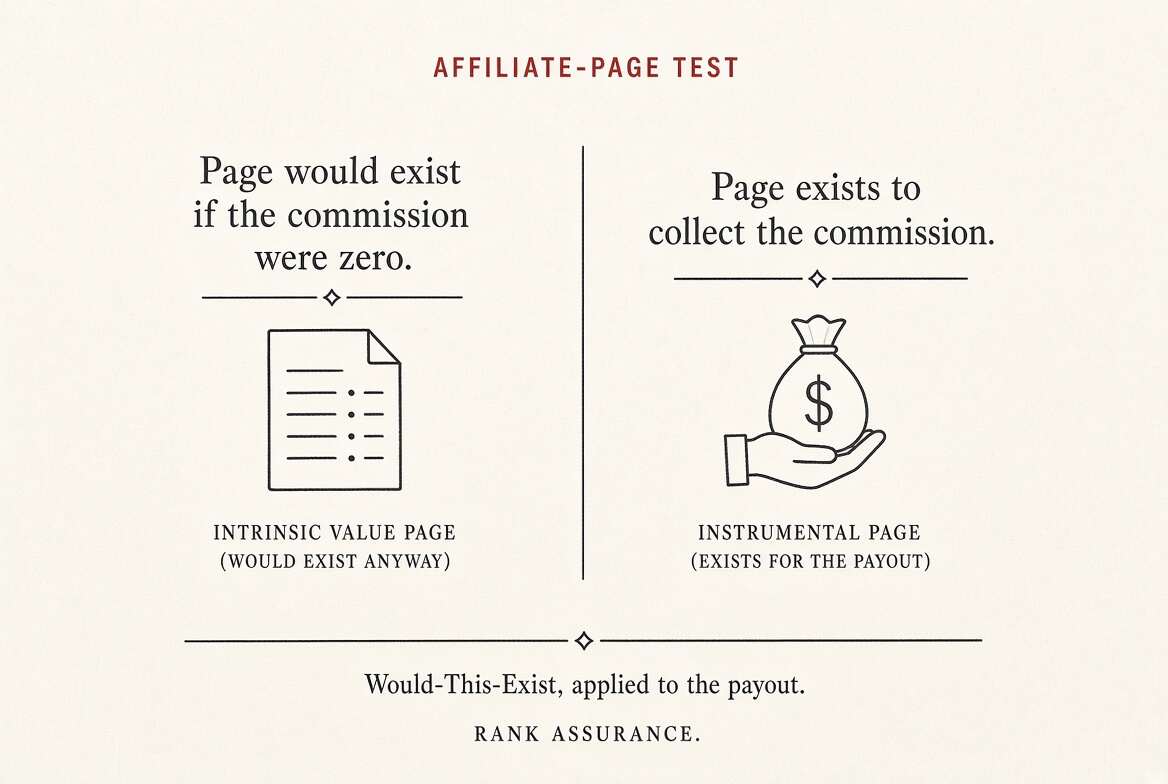
The Affiliate-Page Test asks whether a page would exist at zero payout: original testing with a marked referral is allowed; a merchant-page copy is thin affiliation.
An affiliate link can sit on a useful page. Official spam policy names thin affiliation: cookie-cutter pages that copy the merchant and add nothing a searcher cannot get on the product site. Mark paid referrals sponsored. If the page would vanish without the payout, it is not a review.
The Question This Article Answers
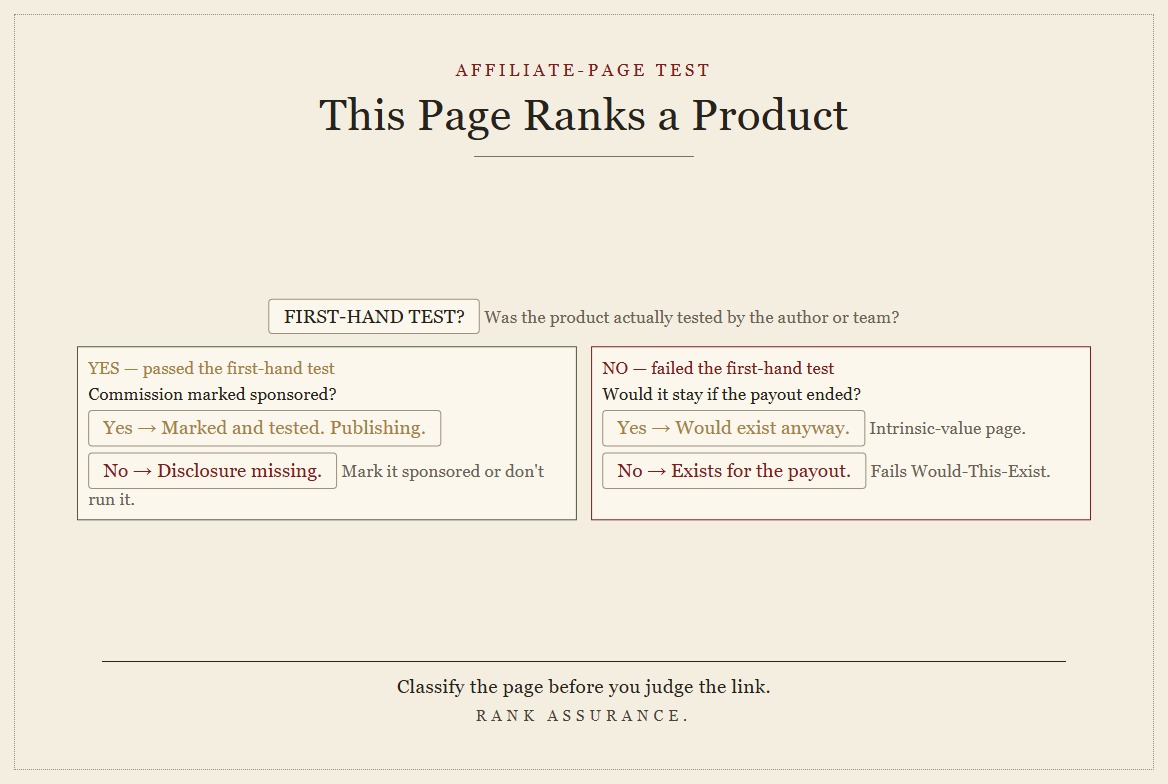
This page ranks a product. Is it a review, or a cart with extra words? This page does not reprint Helpful-Content or Paid-Placement. It is Would-This-Exist applied to the payout.
The answer in one box. A commission link is allowed. A copy of the merchant page is thin affiliation. If the page would vanish without the payout, it is not a review.
What Thin Affiliation Officially Is
Google’s spam policies name the object: pages carrying affiliate links on which the product descriptions and reviews are copied from the merchant, with no original content and no added value. Two boundaries matter as much as the definition. It is not “any page with a referral” — the same policies say original content that adds value can carry affiliate links. And it is not about the money — commission size appears nowhere as a ranking input; the copied page is the violation, paid or not.
What “adds value” looks like, in the documents’ own spirit:
- Original testing — the thing was used, and the page shows it.
- First-hand comparison against the alternatives a buyer is actually weighing.
- Use-over-time notes: what changed, wore out, or surprised after weeks, not minutes.
- The things the merchant will not print — who should not buy it, what failed, what the listing oversells.
One Product, Two Pages
A composite illustration. The product is a mid-priced blender; the two pages both carry the same referral link.
Page A restates the merchant listing: the wattage, the jar capacity, the marketing copy lightly rephrased, five stars, a button. Every fact on it already exists one click away, written by the people selling the thing. Subtract the commission and there is no reason for the page — that is thin affiliation, whatever the disclosure says.
Page B opens with what six weeks of daily use changed: the blade dulled against frozen fruit, the seal needed reordering, the loud setting empties a room. It compares the jar against the model it replaced, photographs the actual scratched unit, and ends with who should buy the cheaper machine instead. A person on the fence gets something the merchant will not print. The referral is marked, and the page would survive the payout going to zero.
The judgment readers struggle with sits exactly here: Page A is not “low quality writing” — it may be fluent — it is redundant. The test is subtraction, not style.
Four Objects
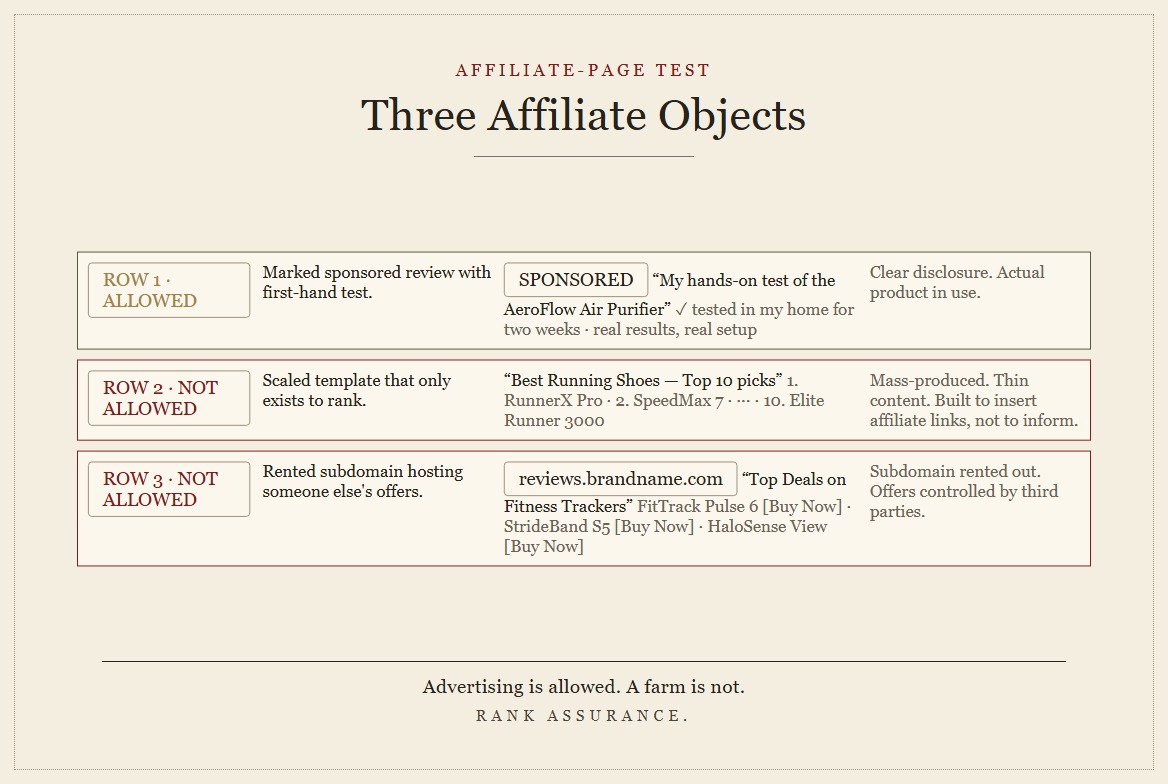
| Object | What it is | Official path |
|---|---|---|
| Original test + marked referral | A page a person would still publish | Allowed. rel="sponsored" |
| Copy of the merchant + commission | Thin affiliation | Rewrite or remove |
| Cookie-cutter network template | Scaled unhelpful pages | Helpful-Content · Content-Quota |
| Host rented to someone else’s offers | Site reputation abuse | Do not rent the name |
Tracking tricks that steal credit without a reader choosing you — hidden cookies, fake leads — are fraud, not a ranking tactic. They are not described here.
Marking for Machines, Disclosing for Readers
Two audiences, two mechanisms, and one does not substitute for the other. rel="sponsored" is machine-readable: it tells crawlers the link is commercial so it is not treated as an editorial vote. Readers never see it. The reader-facing half is the visible disclosure convention — a plain line near the top saying the page earns a commission on purchases. Review pages that people trust carry both: the attribute for the crawler, the sentence for the person. A page with the attribute and no visible disclosure has marked the link and still left its readers unbriefed; that is a trust decision, and trust is the axis affiliate pages live or die on.
Why This Matters More in AI Answers
AI shopping answers already summarize merchant data for free — specs, prices, availability arrive in the answer without anyone clicking a review. A page that copies the merchant offers a summarizer nothing it does not already have, so there is nothing on it to cite. What remains citable is exactly the material the merchant cannot produce: the six-weeks-later paragraph, the failure note, the who-should-not-buy call. Original testing was always the policy’s test; on the answer surface it is also the only inventory left. How engines pick what to cite is the AI Answer explainer’s subject.
Calculator
Affiliate-Page Calculator
Official-Path Next Step
- Open the URL next to the merchant page. What did you add that a searcher cannot get there?
- If money or a cookie is the reason the link exists, mark
rel="sponsored"— and say so visibly for readers. - If the page would vanish without the payout, rewrite it as a real test or take it down. Would-This-Exist.
- If the host is a storefront for other people’s offers, that is site reputation abuse — not a content calendar.
- If the pattern already drew a thin-content manual action, the cleanup and review order lives in the Suppression Type Test.
Questions
Are all affiliate sites thin?
No. Official policy says the opposite: original reviews, tests, ratings, and extra information can be useful. The fail is the page that adds nothing.
Does a high commission prove a scam?
No. Commission size is not a ranking factor. Purpose and first-hand value are. If a vendor’s whole pitch is “this payout ranks,” that pitch is a claim to test — the Vendor Claim Test.
Do I need to have used the product to publish a review?
Google’s review guidance asks for evidence of first-hand experience — what you measured, photographed, or wore out. A roundup assembled from other people’s reviews is aggregation; it can be honest, but it is competing against pages that held the thing.
Will AI shopping answers cite my affiliate page?
Only if it says something the merchant does not. Spec tables and listing copy are already in the answer for free. The citable remainder is original testing — the exact material the thin page lacks by definition.
Is a comparison page with affiliate links to every option thin?
Not automatically. Linking every option does not decide it; the comparison does. If the page ranks the options on criteria the merchants do not publish, it adds value. If it re-sorts marketing copy so every row ends in a cart, run the subtraction test.
Does rel=sponsored stop the link from counting?
It tells Google the link is commercial, and qualified links are generally not used to pass ranking credit. That is the point: the referral keeps paying commissions while withdrawing from the ranking vote, which is exactly the arrangement the policies ask for.
Sources
- Spam policies — thin affiliation; scaled content abuse; site reputation abuse.
- Qualify outbound links — affiliate and paid links use
sponsored. - Write high quality reviews — first-hand evidence, original comparison, expertise.
- Creating helpful, reliable, people-first content.
- Helpful-Content Test · Paid-Placement Test · Would-This-Exist Test · Topic-Fit Test.