
The Paid-Placement Test.
If Money Bought the Mention, the Honest Mark Is Sponsored
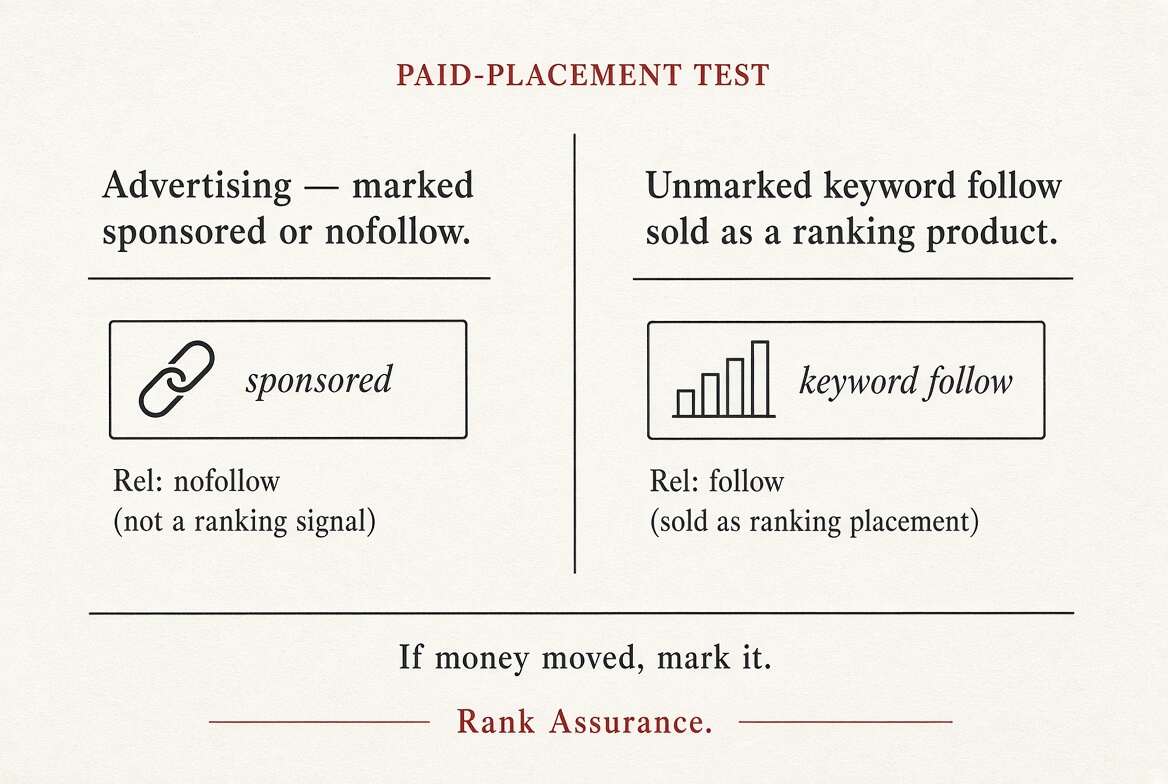
The Paid-Placement Test asks whether money, goods, or services bought a mention; if so, the link must be marked sponsored or nofollow, or it is named link spam.
You can sell an advertisement. You cannot sell an unmarked ranking vote. Official policy is short: if money, goods, or services bought the link, mark it rel="sponsored" or rel="nofollow" . People can still click. A page that exists to hold paid outbound keyword follows is a farm, not a citation.
The Question This Article Answers
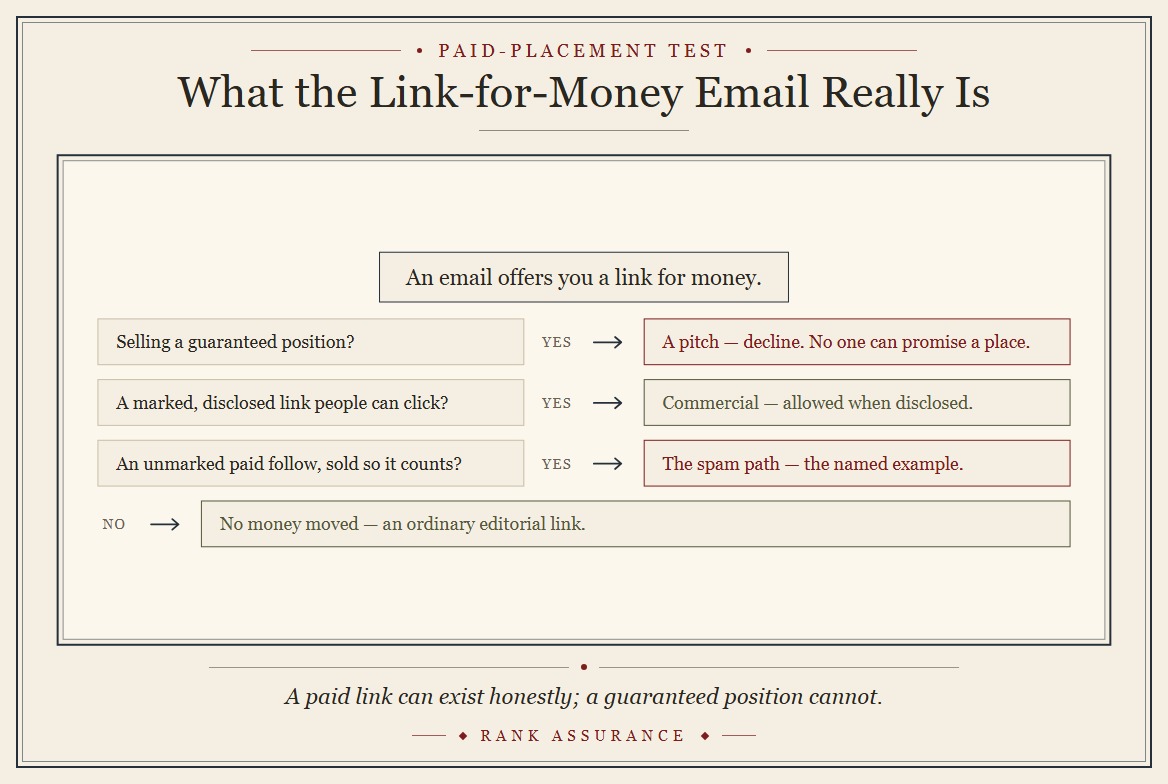
You can sell an advertisement. You cannot sell an unmarked ranking vote. Someone emailed to pay for a mention on a site you own. Is that proof the site is trusted — or a market for votes? An inbox request is not an earned citation. Advertising is allowed. Selling an unmarked follow so the buyer can rank is the named spam example on both sides of the invoice.
Four Objects
| Object | What it is | Honest next step |
|---|---|---|
| Marked advertisement | Money moved. The sentence can still help a reader | rel="sponsored" (or nofollow). People can click |
| Unmarked keyword follow sold as rank | The named paid-link example | Do not buy. Do not sell. Link-Attribute |
| Public placement menu“sites we will place you on” | A productized vote list | Vendor Claim. Would-This-Exist on each host |
| Independent citation | The page would exist without the invoice | Earned-Mention. That is the other family |
This page does not publish prices, insertion methods, or buyer screens. Those are sales manuals. Official policy already names the only required publisher action when money moved: qualify the outbound link.
A public catalog is a map of the network — the Network-Footprint Test. Taking the same catalog private, or redacting the domains until after payment, does not make the mention editorial. Building a graph you control so the list never publishes is Sister-Site — not a safer product.
A “stays forever for one payment” pitch is a vendor claim about hosting, not a Google law — the Contract-Term Test. Recurring billing does not make an unmarked vote editorial.
Four Questions, Not a Price List
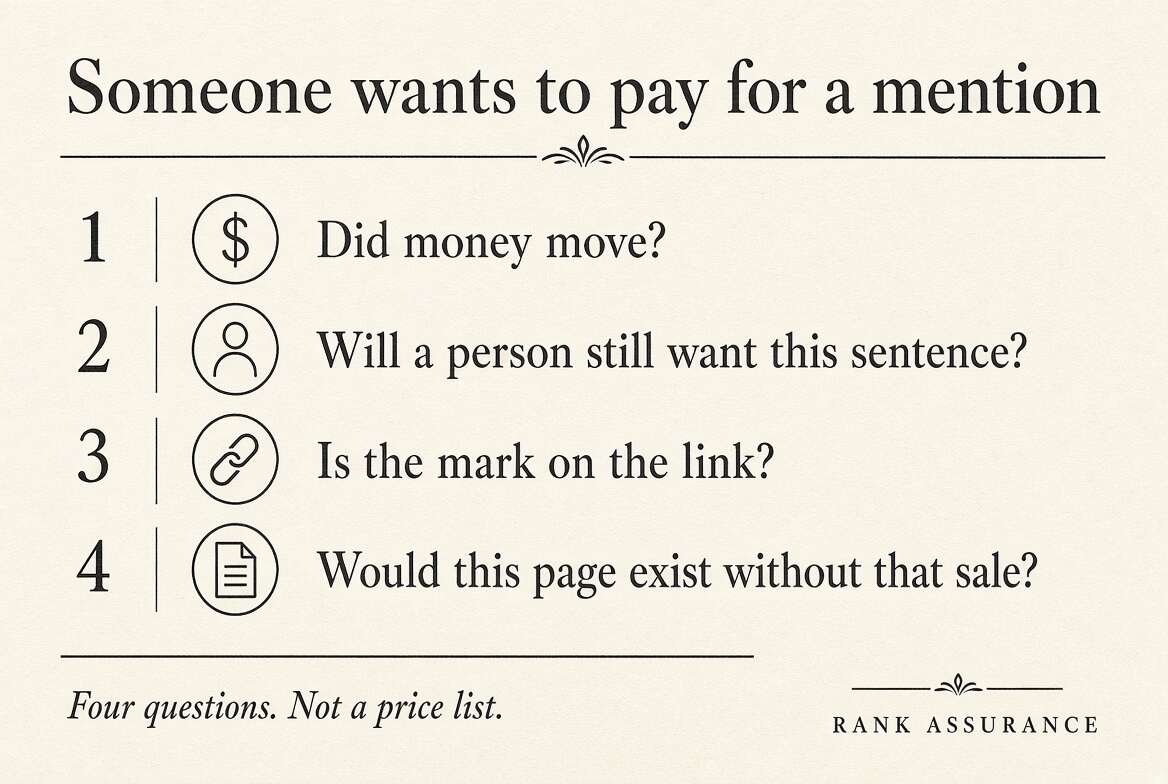
- Did money, goods, or services move?
- Will a person still want this sentence?
- Is the mark on the link?
- Would this page exist without that sale?
That is the whole screen, from either side of the invoice. A yes on the first question does not end the conversation — it only decides the mark. A no on the last one does end it: a page that exists only because someone paid is a vehicle, not a venue. Would-This-Exist still applies to the host page — a URL whose job is holding paid outbound follows is a farm.
Two Emails, Annotated
Both arrive in the same inbox. Details changed — the grammar is the tell.
The ad request. “We would like to sponsor your maintenance guide for six months — our logo, a link to our store, labeled however you require.” Money moves, so it gets the mark. The sentence is wanted — a sponsor card readers can see. The mark is accepted up front, and the page existed first. Every question passes: that is advertising.
The vote purchase. “We pay a flat rate for placement in existing posts. The link must be dofollow, anchor text of our choosing, no sponsored tag or the deal is off.” The refusal of the mark is the product being bought. That is the named spam example — the money is for the missing attribute, not for your audience.
The Invoice Does Not Reach the Answer
A paid post with no readers earns no answer-engine citations. Assistants cite pages people already treat as sources; a recurring invoice keeps a link live, but there is no billing relationship with the model — the invoice does not transfer authority into an AI answer. The Citation-Surface Test reads that surface directly.
Calculator
Paid-Placement Calculator
Official-Path Next Step
- Did money, goods, or services move? If yes, mark
rel="sponsored"(nofollow is acceptable). - Would this sentence exist if no one paid? If no, it is an ad. Mark it. Would-This-Exist.
- If the site’s job is becoming a rack of paid outbound follows, stop. Network-Footprint from the publisher side.
- If you are the buyer and the pitch is “we will insert your keyword so it counts,” that is a paid vote. Pitch + Link-Quality. Do not copy it.
Questions
Is selling any link against the rules?
No. Selling advertising is allowed when the link is qualified. Buying or selling links that pass ranking credit is the named problem.
Do people still reach the destination if the link is sponsored?
Yes. The attribute is for Search. Humans can click. Referral traffic is a real product. Ranking credit is not what you sold.
Is “partner content” labeling enough, or does the link need rel=sponsored?
The label is for readers; the attribute is for crawlers. Honest paid content carries both. A visible “partner content” banner over an unmarked follow link is still the named example.
Is free product for a review a paid link?
Goods or services exchanged for a link sits in the policy text beside money. If the review links the product because the product arrived with expectations, mark it. The Affiliate-Page Test covers the commission cousin.
I sold unmarked links in the past — what now?
Mark or remove them where you control the pages. If a manual action already names the pattern, the Suppression Type Test is the ordered path.
Do paid directory listings count as paid links?
A listing fee for a directory people actually use is a business expense, and the link should still be qualified when the pitch is ranking credit. A “directory” whose real product is follow links is a catalog. The Local-Citation Test covers the local version.
Sources
- Qualify outbound links (updated 10 December 2025) —
sponsored,ugc,nofollow. - Spam policies (updated 27 August 2026) — link spam, including buying or selling links that pass PageRank.
- SEO Starter Guide.