
The Earned-Mention Test.
When a Guest Post Is Publishing — and When It Is Link Spam
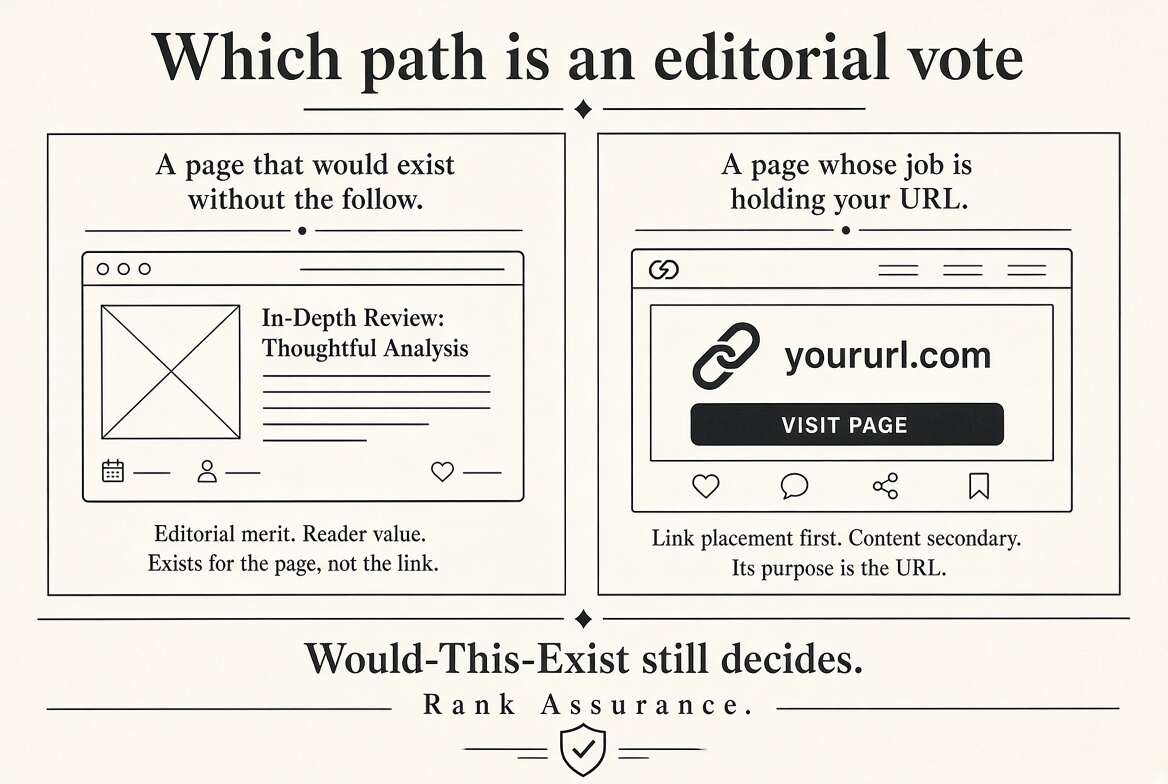
The Earned-Mention Test asks whether a page mentioning you would exist if it could not pass a link. If yes, the mention is earned; if no, it is link spam.
A link on a site you do not control is the vote the Authority Gap Test is looking for — if it is a mention. The same object is link spam when the page exists to pass ranking credit. This article is the four-question test for guest posts, outreach, and advertorials. The alternative is not a portfolio of domains you own. That is the Sister-Site Test failing.
The Question This Article Answers
A guest post is publishing when the host would run it without the link. It is link spam when the page, the pitch, or the package exists so a keyword-rich follow link can pass ranking credit — the shape Google’s spam policies name. This article is the four-question test that separates the two, for guest posts, outreach, and advertorials.
Call that the existence question — it is the Would-This-Exist Test pointed at someone else’s page. If yes, you are publishing, or advertising if you paid and marked it. If no, you are buying ranking credit. Google’s current spam policies list that shape by name: advertorials and guest posts that pass ranking credit, including optimized anchors in articles and press releases on other sites.
Outreach is slow. Editors say no. A placed mention can come down. Those complaints are true, and they are not a reason to replace other people’s sites with a graph you control. Independence is the point of the vote — and the honest version of waiting is not “do nothing.” It is building a page worth citing: original data, a working tool, the guide someone actually needed.
“Ethical” is not a fifth class, either. Official policy is about manipulation of ranking credit, not a hat color. Waiting for a mention is ordinary. Paying and marking sponsored is advertising. An owned graph is the Sister-Site Test. Harming a competitor’s graph is the Negative-SEO Test — also named in policy, and an attack rather than a path. “Only that last one is wrong” is too narrow a reading of all four.
Vendors sell those same objects as a “four ways to get backlinks” menu. So start where the menu starts: name the path a mention traveled before you count it as a vote.
Name the Path Before You Count the Vote
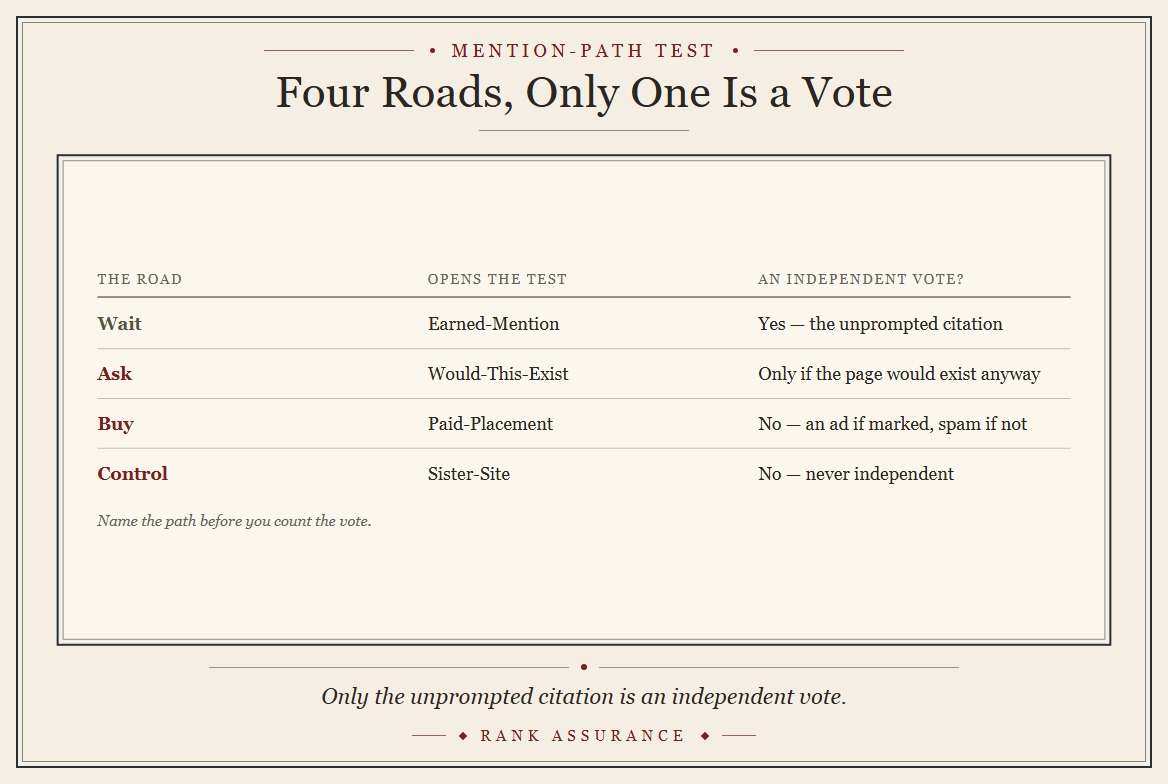
A mention got onto another URL somehow, and how it arrived decides what it is. Mentions travel four roads — wait, buy, ask, control — and only a road that ends on an independent page that would exist without the follow ends in a vote. This is a map, not a menu.
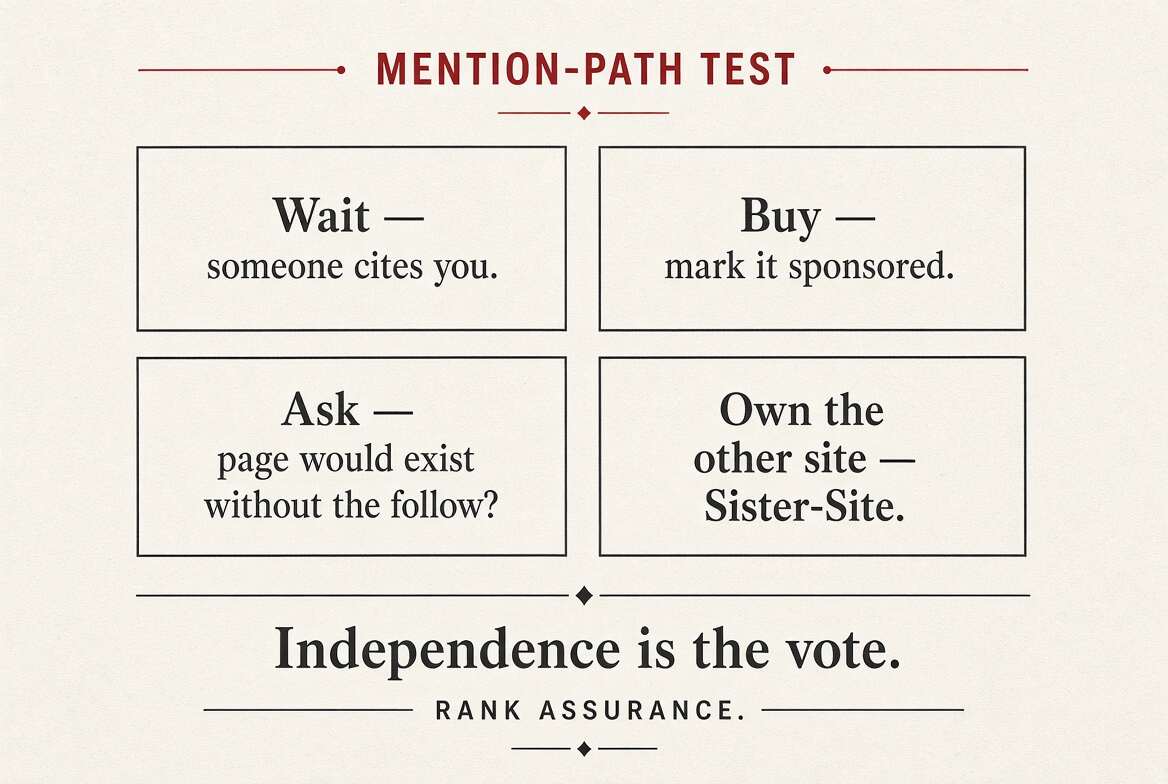
Wait looks like nothing happening, which is why vendors sell against it. Its real cost is publishing work — the citable page — and its real failure mode is a new domain nobody has a reason to name yet. That is the Cold-Start Test, not a broken strategy.
Buy arrives as an invoice. Money moved, so the honest product is an advertisement with a marked link — people can still click it. Sold as an unmarked keyword follow “so it counts,” the same placement is the named spam example. A marked advertising placement is the honest variant of this road, not a fifth road.
Ask is outreach: a pitch, a story offered, a request for a mention. Asking is fine. The host page still has to pass the existence question — an editor who wanted the story is publishing; a page that exists to park your follow is not, however politely you asked.
Control means you also own or direct the host. Sites you control cannot vote for you — that is the Sister-Site Test, and when many “different” hosts share one costume it is the Network-Footprint Test.
Mention-Path Calculator
A new site is not broken because waiting is slow — open Cold-Start and First-Index before concluding anything. And this page does not describe how to buy placements, how to insert links, or how to assemble a portfolio of blogs. Those are construction manuals for the object the policy names.
Three Kinds of Mention — and One That Is Not
rel="sponsored" or nofollow. People can still click.Calculator
Earned-Mention Calculator
One Pitch and One Mention, Classified
The four questions are easier to trust after they run on something. Here is the shape both objects take in an owner’s inbox — details changed, the grammar exactly as it arrives.
The pitch. “We can place a 500-word article on a high-authority site in any niche. Dofollow guaranteed, exact-match anchor of your choice, live in 48 hours.” Run the questions: the page would not exist without the link, value is exchanged for a ranking-credit follow, the host is a catalog rather than a publication. Three fails before the fourth question is needed — this is the policy’s own example with an invoice attached.
The mention. A regional trade journal covers a pricing dispute and quotes your published repair-cost table, linking it as the source. The article would run without the link, nothing was exchanged, the journal has its own readers, and you do not control it. Four passes — an earned mention, and nothing about its attributes needs improving.
What the Spam Policies Actually Name
Updated 27 August 2026, the link-spam section still includes:
- Buying or selling links that pass ranking credit.
- Goods or services exchanged for a ranking-credit link.
- Advertorials and native ads that include links passing credit, or optimized anchors in articles, guest posts, or press releases on other sites.
- Automated programs that create links to your site.
Paid mentions are allowed when they are qualified. That is the official escape hatch. It is not “guest posting is illegal.” It is “do not hide a sale as an editorial vote.”
What “Guest Blogging Is Dead” Meant
In January 2014 Matt Cutts wrote that guest blogging as a way to gain links had decayed into spam, and that you should be skeptical of cold pitches offering an article. He also wrote the part most summaries drop: exposure, branding, reach, and community were still good reasons, and they existed before Google.
That split is still the test. A piece written for a trade journal’s readers is publishing. A piece whose brief is “dofollow, exact match, 500 words, any niche” is the 2014 problem with a 2026 policy number on it.
Nofollow Is Not Worthless
Google’s qualify-outbound-links page (updated 10 December 2025) says paid placements should use rel="sponsored". Use nofollow when the other values do not apply. Links with those attributes are generally not followed for ranking. They can still send a person. Calling them “worthless” is how a package seller talks you into an unmarked dofollow.
site: on the host URL tells you whether that page is in Google’s index. An unindexed host cannot vote. That is a diagnostic, not a juice tap, and it is not a complete picture of indexing.
Outbound Links Are Not a Leak You Must Plug
Linking out to a source your reader needs is normal writing. Google’s own link guidance wants crawlable, descriptive anchors. A policy of “never link out so we keep the juice” is folklore. It is also how pages start to look like they have no sources.
Citing Harvard or a primary document does not make your page rank. Hiding every outbound link does not make it rank either.
Why “Own the Linking Site” Is the Wrong Fix
Outreach is slow because someone else has to want the story. That friction is the signal. A portfolio you host so the link can never come down is a ranking vehicle. Control is the opposite of an independent mention. Run the Sister-Site Test on that plan instead of upgrading to it.
An independent publisher can also take a mention down. That risk is the cost of independence — not a reason to replace publishers with hosts you own.
What Answer Engines Cite
Answer engines did not open a fifth road. An assistant that cites sources still needs a page worth citing, written for readers who exist — the same object the existence question finds. A farm page has no audience and gives a model no reason to quote it; a real trade-journal mention is exactly the kind of sentence an AI answer lifts. The Citation-Surface Test reads your own pages on that surface, and the Recognition-Mention Test covers mentions that name you without linking — on the AI surface, being named is a result in itself.
There is no purchasable shortcut into an answer engine’s sources. The reach-read-cite chain is walked in Is Your Website Visible to AI? — every step in that chain runs on pages that would exist anyway.
Official-Path Next Step
- Name the path the offer is on — the map above. An offer that will not name its path is a sales tactic.
- Put a citable asset on your own site — original data, a tool, a public-record table. That is what this library is built to be.
- Pitch the story to publications whose readers would want it if the link did nothing.
- If you pay for a mention, mark it
sponsoredornofollow. - Qualify leftover scheme links you control. Open the Suppression Type Test if a manual action is already showing.
- Measure the money URL with the Authority Gap Test. Independent referring domains are the gap. Owned hosts are not.
Questions
Is guest posting dead?
Writing for another site’s readers is not dead. Guest posting whose purpose is an unmarked ranking-credit link is the practice Cutts called done in 2014 and that the spam policies still list.
Are guest posts always a scheme?
No. A host that would publish the piece anyway can still be a citation. A page that exists to park an exact-match follow is the official example.
The vendor says outreach is too slow so they will use sites they own.
That is a Sister-Site plan. Slow is not a policy exception.
Is waiting a strategy?
It is a real path, and it is slow on a new domain — that is Cold-Start, not failure. It is not a reason to buy a graph.
Should every outbound link be nofollow?
No. Cite sources normally. Qualify the ones you were paid to place or that you do not trust.
Do unlinked brand mentions help SEO or AI visibility?
For AI answers, directly: engines quote pages that name you whether or not they link. For Google Search, links remain the documented vote — an unlinked mention is recognition, not ranking credit. The Recognition-Mention Test is that split.
Does a nofollow guest post still have value?
Yes. Readers click it, and the byline is real exposure — the reasons Cutts said survived 2014. What it does not do is pass ranking credit, which is the honest state for anything you asked or paid for.
Can old guest posts I wrote years ago hurt me now?
A real piece on a real publication is publishing, whatever its age. A campaign of exact-match paid anchors is worth qualifying at the source where you still can; the Suppression Type Test covers the case where a manual action already names it.
How should I reply to a guest-post pitch email?
With the existence question. Ask what the page will be and who reads the host. If the answer is an anchor-text order form, it is a placement offer — treat it as advertising to be marked, or decline.
Sources
- Google Search Central, spam policies (updated 27 August 2026) — buying ranking credit; guest posts and advertorials with optimized anchors.
- Google Search Central, “Qualify outbound links” (updated 10 December 2025) —
sponsoredandnofollow. - Matt Cutts, “The decay and fall of guest blogging for SEO,” January 2014 — SEO-for-links vs exposure and community.
- Google Search Central Blog, 25 May 2017 — large-scale contributor / guest campaigns whose main intent is links.
- Rank Assurance, “The Authority Gap Test” — why independent mentions matter and content is still a gate.
- Rank Assurance, “The Sister-Site Test” — extra domains whose job is to pass credit.