
The Recognition-vs-Mention Test.
An Engine Can Describe You and Still Never Name You in a Category Answer
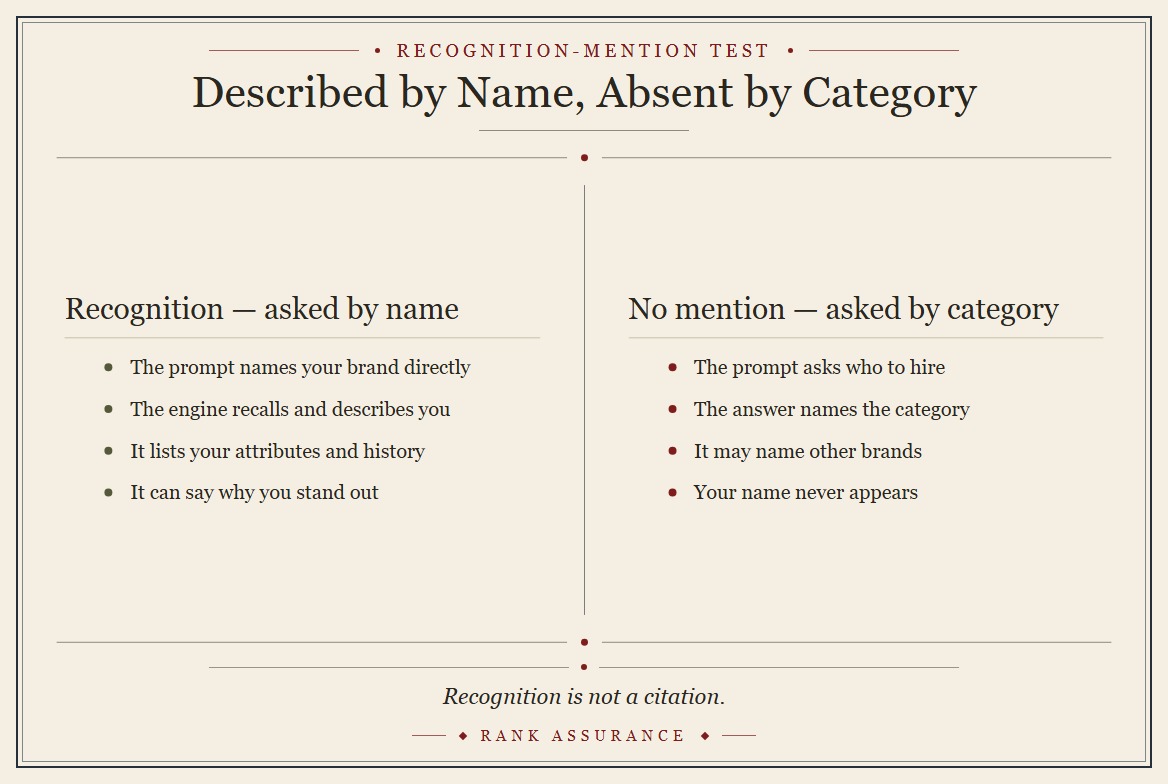
The Recognition-vs-Mention Test separates two objects: an engine can describe you on a branded prompt yet never name you in a category answer.
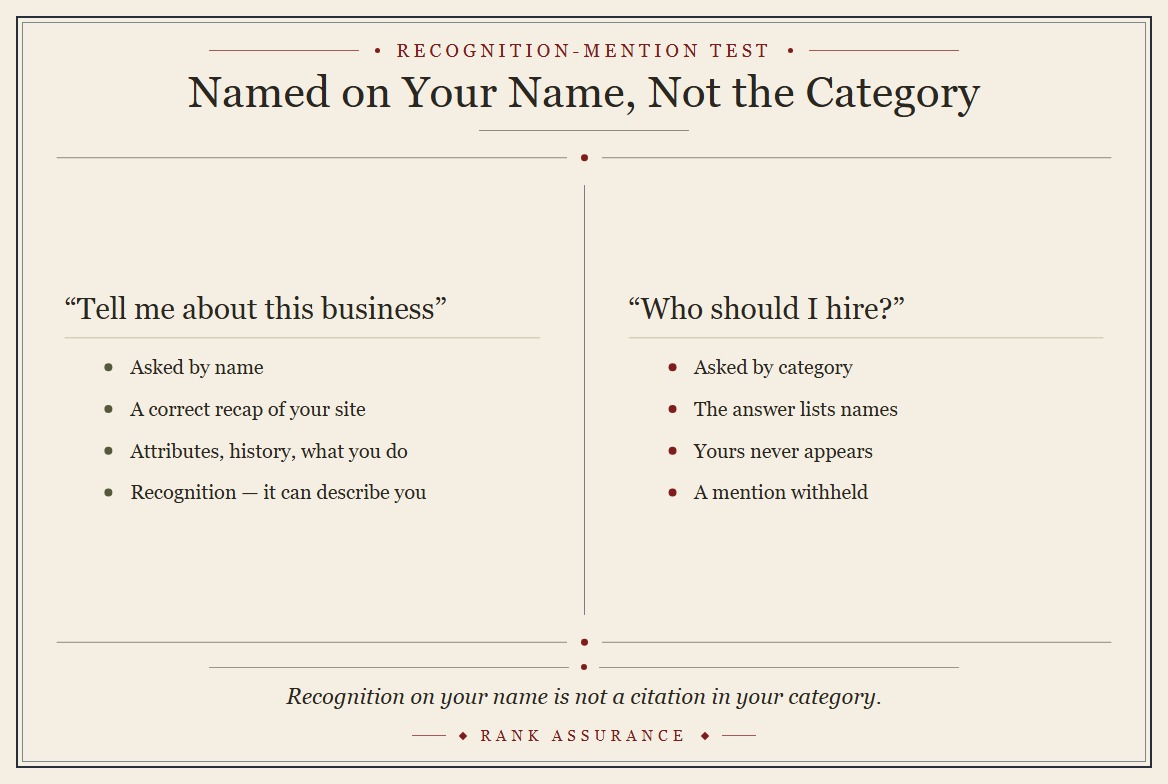
Ask an assistant who you are and it can recap the site. Ask who to hire in your category and your name never appears. Those are two objects. This page is the second one.
The question this article answers
Retrieval-augmented generation pulls pages from the same index that powers classic results, then writes an answer. Being in that index is eligibility. Being the entity the answer names is a different job. Citation-Surface is eligibility and uniqueness. This test is whether the category answer uses your name.
A branded query that produces a correct description is not proof you own the category. Measure both. Search Console’s generative AI report shows impressions in AI Overviews and AI Mode — presence, not whether you were the recommended name.
This page is the classification test: deciding which of the two objects you actually observed, on Google’s surfaces, with the generative report as the evidence log. The assistant-side differential diagnosis — which sourcing layer failed and what fixes each — is the live piece Why ChatGPT Doesn’t Recommend My Business. Run this test first; read that piece to trace the layer.
The Two-Prompt Check
The test is two prompts, run cold, recorded as a pair.
- Prompt one, branded: the business name and city. A fluent, accurate description is recognition — the engine can retrieve you when you are the query.
- Prompt two, category: the category and city, with no brand token anywhere in the wording. The phrasing matters — one brand word in the prompt and you have measured recognition twice.
- Read the second answer only for names: which businesses are named, which URLs are cited.
- Record both answers verbatim. Description in prompt one plus absence in prompt two is the finding this test names — recognition without mention.
The failing pair has a recognizable shape. The branded answer reads like a capsule of your own site — services, city, sometimes staff — because you were the retrieval target. The category answer names two or three rivals, often cites a directory, and nothing in it acknowledges you exist. Both halves are correct behavior from the engine’s side; the gap between them is the object. The AI Answer report records exactly this object across live answer engines — whether each one names a business for its category question — and keeps the answers verbatim.
What is official
The shared official model — same index, foundational SEO, the ignore-list for special AI files — is kept once, dated, at the Citation-Surface Test. The two lines this test leans on: generative answers retrieve from the index that already ranks you, so eligibility is never the difference between recognition and mention; and the Generative AI report records presence (impressions), never whether yours was the recommended name — the Generative-Impression Test reads that report properly.
Calculator
The Recognition-vs-Mention Test Calculator
Official-path next step
- Run the two-prompt check and keep both answers — the pair is the evidence, not either half alone.
- Confirm the URL is indexed and snippet-eligible — the First-Index Test. An engine cannot mention a page it cannot retrieve.
- Open the Generative AI performance report next to classic Performance: impressions say a URL appeared, not that you were the name.
- If the category answer keeps citing pages that hold something yours does not, the problem is the Commodity-Page Test’s, not a mention campaign’s.
Questions
If the model describes us, are we winning AI search?
No. Description on a branded prompt is recognition. A category mention is a different object.
Does an llms.txt file fix a missing mention?
No. Official 2026 guidance: Search does not use that file.
Does being in the training data mean we will be recommended?
No. Description proves your own story is retrievable. A recommendation is a choice among category candidates made at answer time — different evidence, different failure.
How many engines before we conclude we are invisible?
More than one. Engines answer the same category question differently; a single engine’s silence is an observation about that engine, not about the field.
Sources
- Optimizing for generative AI features on Google Search.
- Search Generative AI performance reports (3 June 2026; worldwide 31 August 2026).
- Rank Assurance, “Why ChatGPT Doesn’t Recommend My Business” — the assistant-side differential diagnosis.
- Citation-Surface Test (hub) · SERP-Surface Test · Helpful-Content Test.