
The Citation-Surface Test.
What Still Works When an Overview Sits Above the Blue Links
The Citation-Surface Test asks whether a URL is indexed, snippet-eligible, and holds something a model cannot summarize from ten other pages.
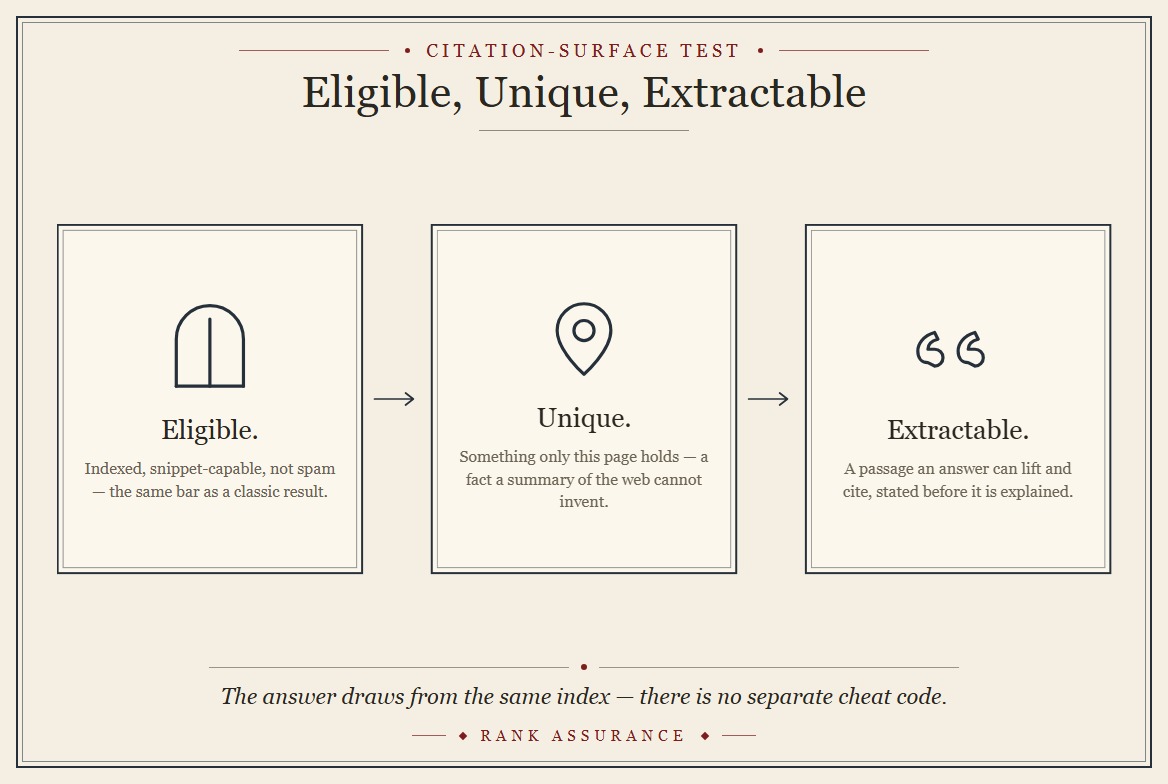
Search still has a first page. It also has an answer written above that page. Future-proofing is not a new cheat code and it is not “never use a model.” It is whether this URL is eligible, unique enough to name, and extractable enough to quote. That is the test.
The question this article answers
Industry talk still future-proofs the wrong object: hide from detection, rebuild on a new domain, or vote from sites you own. Those lines are not published here. The live documents say generative features use the same ranking and quality systems as Search. A page that cannot appear as a snippet cannot appear as a citation.
AI answers change some clicks. They do not retire crawl, index, or rank. Origin of the draft — human or model — is not the official test. Scaled unhelpful pages are — that is the Helpful-Content Test's object. If sessions moved while the query still showed you, start with the Traffic-Metric Test.
Three Surfaces and a Setting
The sample library shows this split on real masked runs — the same market read as a classic result, an answer citation, and a pack entry, side by side.
The Nine Tests Under This One
This page is the frame: eligible, unique, extractable. Each branch test isolates one symptom. Open the row that matches what you observed.
| The symptom | The test to open |
|---|---|
| Described by namenever named in the category answer | Recognition-vs-Mention Test |
| In the map pack, missing from the answer | Local-Citation Test |
| Our list cited, a rival recommended | Self-List Test |
| A pitch sells “Preferred Sources” | Preferred-Source Test |
| Search drew our tool in the answer | Generated-UI Test |
| AI impressions up, clicks down | Generative-Impression Test |
| Cited for a query we never targeted | Fan-Out Test |
| Preview or index settings in doubt | Preview-Control Test |
| We rank; answers never cite us | Commodity-Page Test |
Calculator
Citation-Surface Calculator
What Google published in 2026
On 15 May 2026 Search Central published a dedicated guide for generative AI features. The 10 July 2026 fundamentals page is the working copy. Its own summary line is the whole ruling: from Google Search’s perspective, optimizing for generative AI search is still SEO. Every branch test under this one leans on that document — it is kept here once, dated, instead of being restated on each page.
- There are no extra technical requirements beyond being indexed and eligible to show in Search with a snippet.
- Foundational SEO still applies to AI features.
- The content Google emphasizes is unique, non-commodity, people-first — a first-hand review beats a summary of the web.
- If you use a generative tool to assist, the page still has to meet Search Essentials and the spam policies.
- Watch the Generative AI performance report in Search Console (worldwide as of 31 August 2026). That report currently emphasizes impressions, not a full click curve.
Preferred Sources can now surface inside AI Overviews and AI Mode. That is a reader preference, not a vendor badge.
Last re-checked against the AI-optimization guide: 19 September 2026. The guide is a living document — read the dated original before acting on any summary, including this one.
AEO / GEO hacks the official guide says to ignore
Google’s own mythbusting section, July 2026:
Answer-first headings and short paragraphs still help a human. Keep them because a person can use the page — not because a blog called it AEO.
What actually got banned (history, not a method)
The useful part of “SEO history” is the list Search already wrote down. Each row is a current spam-policy object, not a tactic to revive.
| Old trick | What it is now |
|---|---|
| Keyword stuffing / hidden text | Named spam. Cloaking and stuffed pages. |
| Automated comment / profile links | Link spam. Automated programs that create links. |
| Spun articles and scaled sameness | Scaled content abuse — including AI volume with no added value. |
| Exact-match guest-post packs | Guest posts / advertorials that pass ranking credit. See the Earned-Mention Test. |
| A graph of hosts you control | Sister-Site Test / link spam / expired-domain abuse. |
Anything automatable was never the rule. Anything that is scaled, unhelpful, or created to manipulate rank is the rule. The Suppression Type Test already covers disavow and domain-change folklore. It is not repeated here.
AI-assisted pages
Google does not publish a penalty for “a model touched this file.” It publishes a penalty class for scaled content that does not help. A draft that restates page one without a first-hand fact, a dataset, or a decision you actually made is commodity content — whether a person or a model typed it.
The honest use of a model is research and a first pass. The part that future-proofs is the thing only you can add: the measurement, the case, the table with a date. That is why every article in this library is required to carry a defensible citation asset.
What to measure
- Search Console: classic queries, plus the Generative AI performance report for Overview / AI Mode impressions.
- Whether the money URL is still snippet-eligible.
- Whether independent publications name the asset — the Earned-Mention Test — not whether you placed an unmarked follow.
- Local pack separately, if the query is local. The Local Pack Test is a different surface.
Industry decks talk about mention rate and share of voice in answer engines. Those can be useful internal metrics. They are not a Google ranking report. Do not replace GSC with a vendor dashboard.
The assistant side of the same object has its own instrument: the AI Answer report records whether live answer engines name a business for its category question, with the answer text kept.
Official-path next step
- Confirm the URL is indexed and snippet-eligible.
- Put the answer in the first screen. Then the proof.
- Add one thing a summary of the web cannot invent — data, a tool, a dated table, a first-hand result.
- Keep author, Organization, and Article structured data for the page you already publish. Do not invent an AI schema.
- Read the Generative AI report next to the classic Search report. Decide from both.
- If the page fails uniqueness, do not scale it. That is scaled content, not AEO.
Questions
Do I need a separate AEO program?
Not as a Google product. The official guide says foundational SEO plus non-commodity content. Treat “AEO” as a nickname for being citable, not as a second algorithm you buy.
Will AI content be detected and devalued?
Unhelpful scaled content is already in the spam policies. “A model drafted this” is not the published test.
I rank #1 and I am not in the Overview — why?
Possible and common. Fan-out can cite pages outside the classic top ten — the Fan-Out Test is the deep dive. Make the page extractable and unique. Do not assume a penalty.
Do AI Overviews use different ranking factors than the blue links?
Google’s documents say the same ranking and quality systems and the same index. Eligibility is identical: indexed, snippet-capable, not spam. What changes is assembly — one answer can draw from a wider set of pages than the classic top ten.
Does turning off AI-training crawling change Google AI Overviews?
Different systems, different controls. Google’s AI features in Search follow Search’s own switches — index status, snippet settings, and the Search Console generative AI control. Robots rules aimed at model-training crawlers govern a separate set of systems. The Preview-Control Test maps which switch does what.
How do I know which surface my query shows?
Open the live query and look: a classic result, an Overview, an AI Mode panel, a local pack — the SERP-Surface Test is that classification, and the Generative AI report in Search Console is the log of where your URLs appeared.
Sources
- Google Search Central, “AI features and your website” — indexed + snippet-eligible; no extra requirements; query fan-out.
- Google Search Central, “Optimizing for generative AI features” (updated 10 July 2026) — non-commodity content; AEO/GEO mythbusting; GSC generative report.
- Search Central Blog, 15 May 2026 — announcement of that guide.
- Spam policies (updated 28 August 2026) — scaled content abuse; link spam.
- Google blog, 27 May 2026 — Preferred Sources inside AI Overviews and AI Mode.
- Search Engine Journal, 31 August 2026 — Generative AI reports worldwide; impressions, not full clicks at launch.
- Rank Assurance, “The Authority Gap Test” — Four Gates still apply under the overview.