
The Self-List Test.
Being Used as a Source Is Not the Same as Being Named as the Pick
The Self-List Test asks whether a best-of list would exist if it could not rank its own publisher first — and what a live answer engine does with that list.
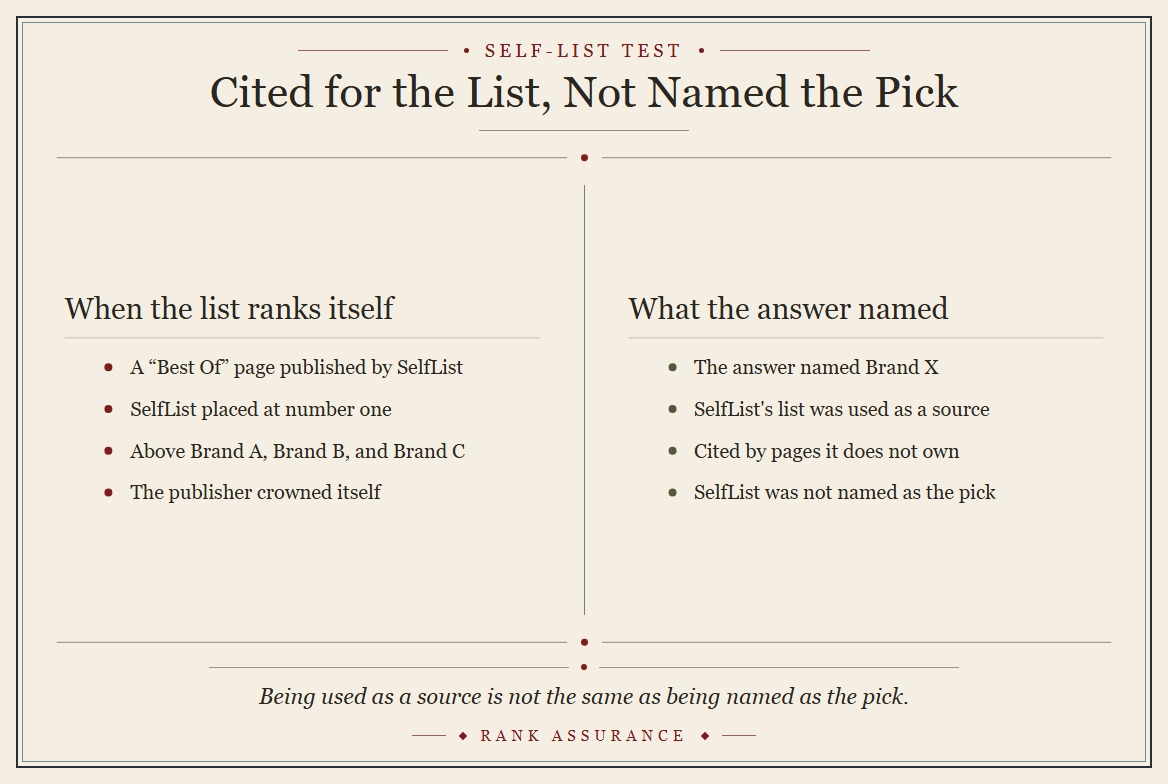
A “best [category]” article that ranks you number one is a common publishing pattern. An answer engine can borrow the list and leave your name out of the recommendation. Cited is not chosen.
The question this article answers
The Would-This-Exist Test already asks whether the page would run without a ranking job. The Affiliate-Page Test asks whether the page exists to rank a product. This test is narrower: a self-crowning list that an answer engine treats as raw material while naming a different entity.
Official line: inauthentic mentions are not a path into generative features. Unique, first-hand comparisons with a method a reader can repeat are publishing. A list that exists to crown the publisher is commodity plus a vote you cast for yourself.
Anatomy: Self-Crowning vs Defensible
The two page types look identical in a template. They separate on five attributes a reader — or an extractor — can check in a minute.
| Attribute | Self-crowning list | Defensible comparison |
|---|---|---|
| Named method | None — the order is the point | Stated before the ranking, repeatable |
| Dates | Undated, evergreen by design | Dated runs and dated claims |
| Limits admitted | None | What was not tested, said plainly |
| The rivals | Padding under your #1 | Linked and fairly described |
| Without the vote | The page has no reason to exist | The comparison still stands |
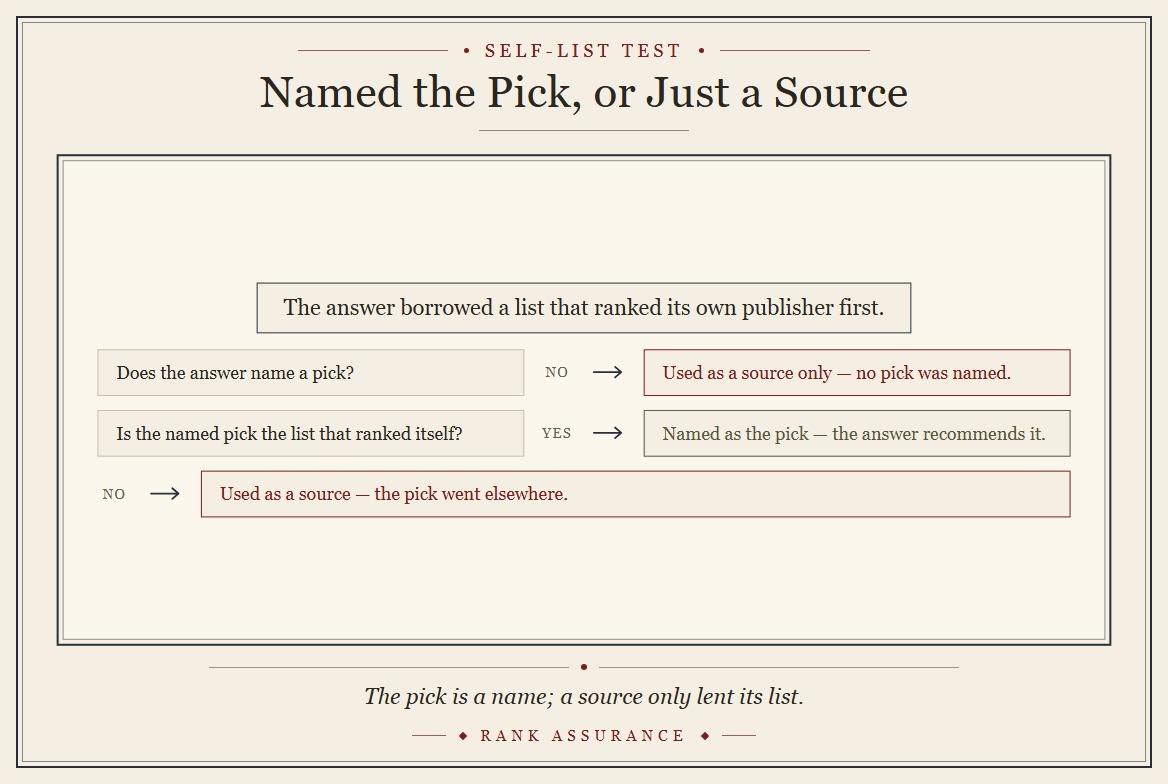
The moment this test detects reads the same way in every live answer: the answer’s source list includes your “best in [city]” page, and its recommendation paragraph names a business that is not you. The list was raw material — a set of category candidates — and the vote you cast for yourself carried no weight in the choice. The AI Answer report keeps each engine’s answer text beside its sources, so what an engine did with a list — used it, ignored it, named someone else from it — is recorded rather than guessed.
What is official
The shared official model — same index, foundational SEO, the ignore-list for special AI files — is kept once, dated, at the Citation-Surface Test. The line that governs this page: inauthentic mentions are on Google’s own ignore-for-Search list, and a list that exists to crown its publisher is the self-cast version of the same vote — material an engine may read without endorsing.
Calculator
The Self-List Test Calculator
Official-path next step
- Read the live answer twice: once for its source list, once for its recommendation. Record whether your list appears in the first and your name in the second.
- Score your list against the anatomy table — method, dates, limits, rivals, would-it-exist.
- Rewrite it as a method-first comparison, or retire it — the Would-This-Exist Test is the retirement hearing.
- Build the independent path: mentions other people publish about you — the Earned-Mention Test.
Questions
Should we delete every best-of page?
No. Delete or rewrite the ones that exist only to crown you. Keep first-hand tests with a method.
Is this a penalty?
Usually a quality and independence miss, not a manual action. The Suppression Type Test applies if Search Console shows a row.
Should the list include competitors — and does linking them hurt us?
A defensible comparison links what it ranks; that is what makes it a comparison rather than a vote. No published guidance treats a fair outbound link as a cost. The page that cannot afford to name rivals is telling you which column of the anatomy table it lives in.
Sources
- Creating helpful, reliable, people-first content.
- Optimizing for generative AI features (inauthentic mentions listed as ignore-for-Search).
- Would-This-Exist Test · Affiliate-Page Test · Earned-Mention Test.
- Citation-Surface Test (hub) · Recognition-vs-Mention Test.