
The Preferred-Source Test.
A User Pin Is Not a Ranking Package You Buy
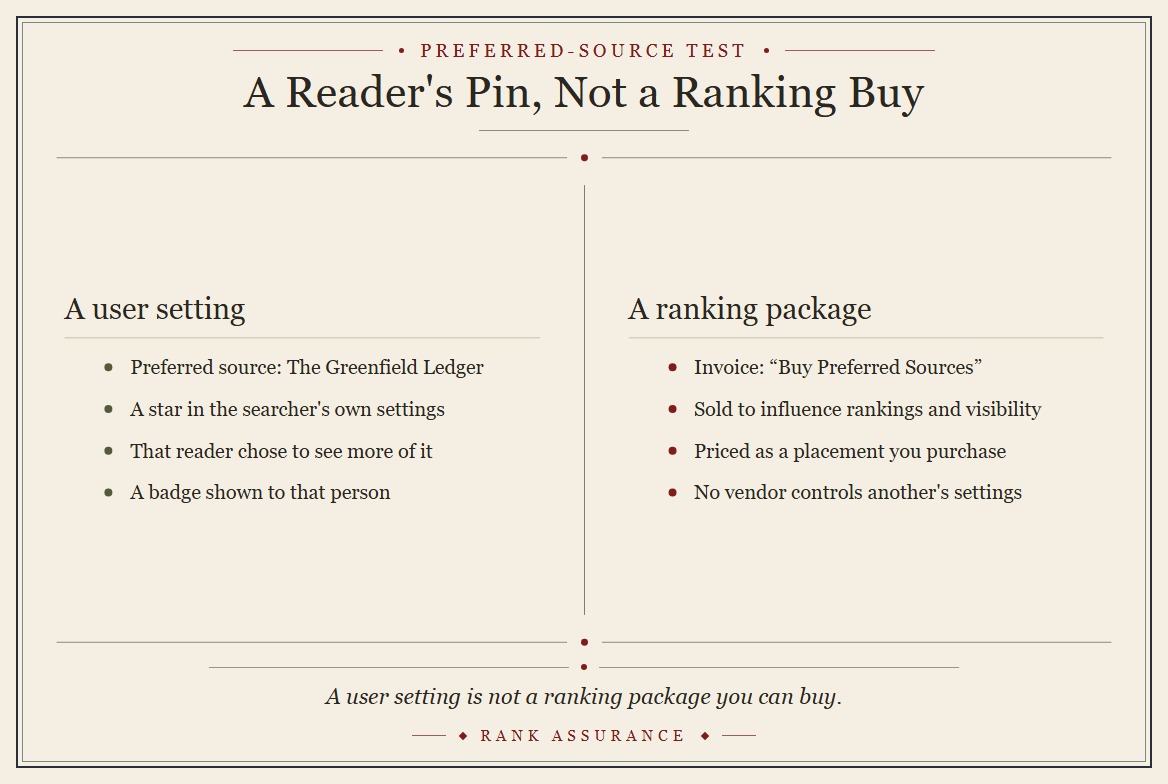
The Preferred-Source Test separates Google's user-side pin — a reader choosing to see more of a publisher — from any pitch selling the feature as a placement you can buy.
People can tell Search which publishers they want highlighted in Top Stories, AI Overviews, and AI Mode. That is a pin. It is not a backlink, a citation buy, or a Search Console switch you purchase.
The question this article answers
Official publisher documentation: a domain or subdomain can be eligible; a subdirectory is not. Users who selected you can see a badge on those sources in Top Stories and in AI experiences. Publishers may add a documented button so readers can pin the site. None of that is a paid ranking credit.
Google has published that people who use Preferred Sources are more likely to click those sources. That is a published product note about users who already chose you. It is not a reason to buy a “Preferred Sources campaign.” If an invoice names the feature as a deliverable — something no vendor can control inside other people’s accounts — that pitch belongs to the SEO Pitch Test and the Vendor Claim Test.
Pitch Anatomy: The Offer Against the Document
The lines below are a composite of the pitch pattern, scored against Google’s own publisher document. Every row is the same failure: a user-side setting resold as a vendor-side deliverable.
What a Reader Actually Does
Google’s user help documents the whole flow, and it is three of the reader’s own clicks: search a topic, open the preferred-sources control beside the news results, select the sites to see more of. From then on that reader sees more of those sources — badged — in Top Stories and in AI experiences. Nothing in the flow has a vendor in it.
The one documented thing a publisher can do: place the official link inviting readers to pin the site. An invitation to people who already trust you — that is the entire owner-side lever the document grants.
What is official
The shared official model — same index, foundational SEO, the ignore-list for special AI files — is kept once, dated, at the Citation-Surface Test. What matters on this page is narrower: Preferred Sources is documented as a user-side setting that changes what the person who pinned you sees — and changes nothing for anyone else. Everything a pitch adds beyond that sentence is the pitch’s own invention.
Calculator
The Preferred-Source Test Calculator
Official-path next step
- Read the publisher document yourself — it is linked below and one page long. Every pitch claim should survive it.
- Check eligibility: is the property a domain or subdomain? A subdirectory ends the conversation.
- If you want pins, add the documented invitation for readers — the only owner-side lever that exists.
- If someone sold the feature as a slot, run the invoice through the SEO Pitch Test and the Vendor Claim Test.
Questions
Can we buy Preferred Sources placements?
No. It is a user setting. You can invite readers to pin you with the documented control.
Does pinning replace citations?
No. The Citation-Surface Test still applies for everyone who did not pin you — and that un-pinned public is what the AI Answer report measures: what engines say to a person with no preferences set.
How would we know how many people pinned us?
You would not. No owner-side count exists, on Google’s side or anyone’s. A vendor report that claims to measure it is measuring something else.
Sources
- Preferred sources (publisher guide).
- Preferred Sources in Google Search (user help).
- Citation-Surface Test (hub) · SEO Pitch Test · Vendor Claim Test.