
The Generated-UI Test.
When Search Builds the Tool in the Results, Your Page Is No Longer the Only Interface
The Generated-UI Test asks, when Search draws the tool in the results, what job remains that only your URL can finish — payment, booking, or first-party data.
Some queries no longer need your widget page to finish the thought. Search can draw the sliders in the answer. Clicks can fall while the question still exists. That is a surface change, not automatically a penalty.
The question this article answers
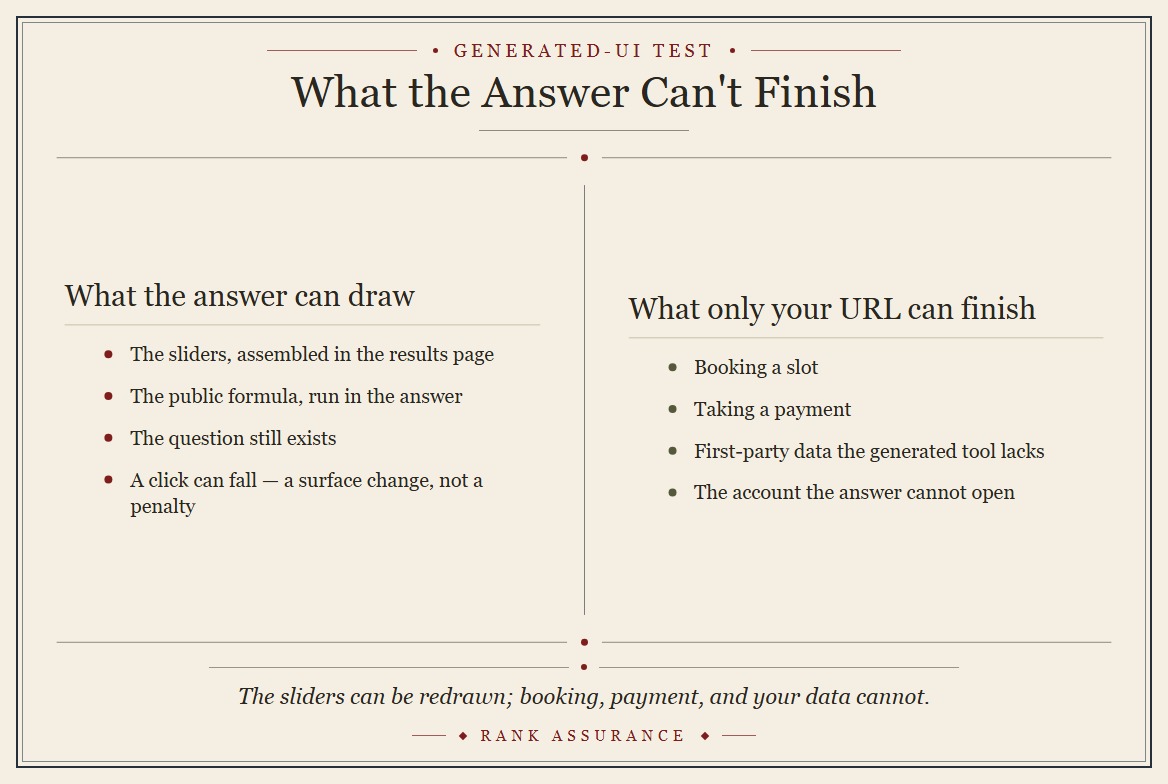
Official product direction: generative UI can put interactive tools and simulations in the response. That competes with pages whose only job was the widget. It does not retire crawl, index, or a URL that can take payment, book a slot, or hold a dataset the generated tool does not have.
Owner move: make the page the completion step or the first-party source. A commodity calculator with no account, no booking, and no unique data is the page most likely to be replaced on the results page — the Would-This-Exist Test already has a chair waiting for it.
Widget-Page Triage
| Page type | What the results page can do | Verdict |
|---|---|---|
| Pure widgetpublic formula, no data of yours | Draw the same tool in the answer | Replaceable |
| Widget + first-party data | Draw the sliders, but not your numbers | Citable — the data is the reason |
| Widget + completion step | Neither pay, book, nor open the account | Survives — changed, not killed |
One Case, Walked
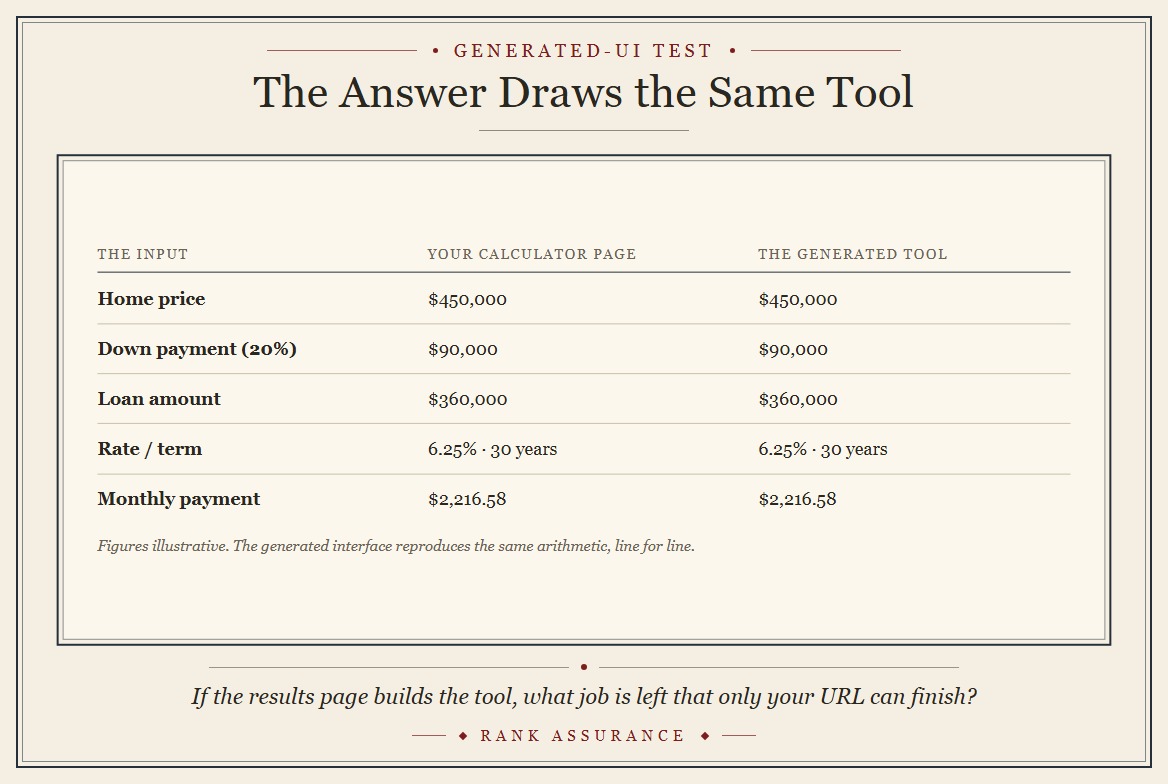
Take a payment-calculator query. The generated tool can draw the sliders and run the public formula — that part of your page stops being a differentiator the moment the results page can render it. What it cannot do: quote your actual rates, open an account, book the appointment, or hold the dataset only you publish. If the URL’s whole job was the sliders, the click had no remaining reason. If the URL is where the answer’s numbers get checked or the transaction finishes, the click survives with a different meaning.
Telling generated-UI click loss apart from a ranking drop is a two-log read: impressions held while clicks fell points at the surface; both falling together points at rank. The Generative-Impression Test is the instrument for that split.
What is official
The shared official model — same index, foundational SEO, the ignore-list for special AI files — is kept once, dated, at the Citation-Surface Test. What this test leans on is direction rather than myth: Google’s 2026 product posts describe generative UI drawing interactive tools and simulations in the response, and the optimization guide’s agentic-experiences section is the part to watch. Eligibility is unchanged — indexed, snippet-capable, not spam.
Calculator
The Generated-UI Test Calculator
Official-path next step
- Triage the page against the table above: pure widget, first-party data, or completion step.
- Run the two-log read — impressions next to clicks for the same 28 days — before any rebuild decision.
- Strengthen the two jobs a generated tool cannot take: the completion step and the first-party dataset.
- A pure widget with no data of yours: the Would-This-Exist Test before another dollar goes into it.
Questions
Should we noindex tool pages?
No. Make them the completion step or the unique dataset. The First-Index Test still applies.
Is a click drop after generative UI a penalty?
Not by itself. The Traffic-Metric Test and the SERP-Surface Test classify it. Open Search Console before any story hardens.
Should we put the calculator behind an email gate?
Gating removes the citation reason along with the copying risk: an extractor cannot read what a form hides, and the person the form bounced was your remaining click. If the tool is worth gating, the part worth citing should stay outside the gate.
Sources
- Search at I/O 2026.
- Optimizing for generative AI features (agentic experiences section).
- SERP-Surface Test · Traffic-Metric Test.
- Citation-Surface Test (hub) · Would-This-Exist Test.