
The Traffic-Metric Test.
Sessions Mix Rank, Demand, and Clicks — A Drop Is Not Automatically an SEO Failure
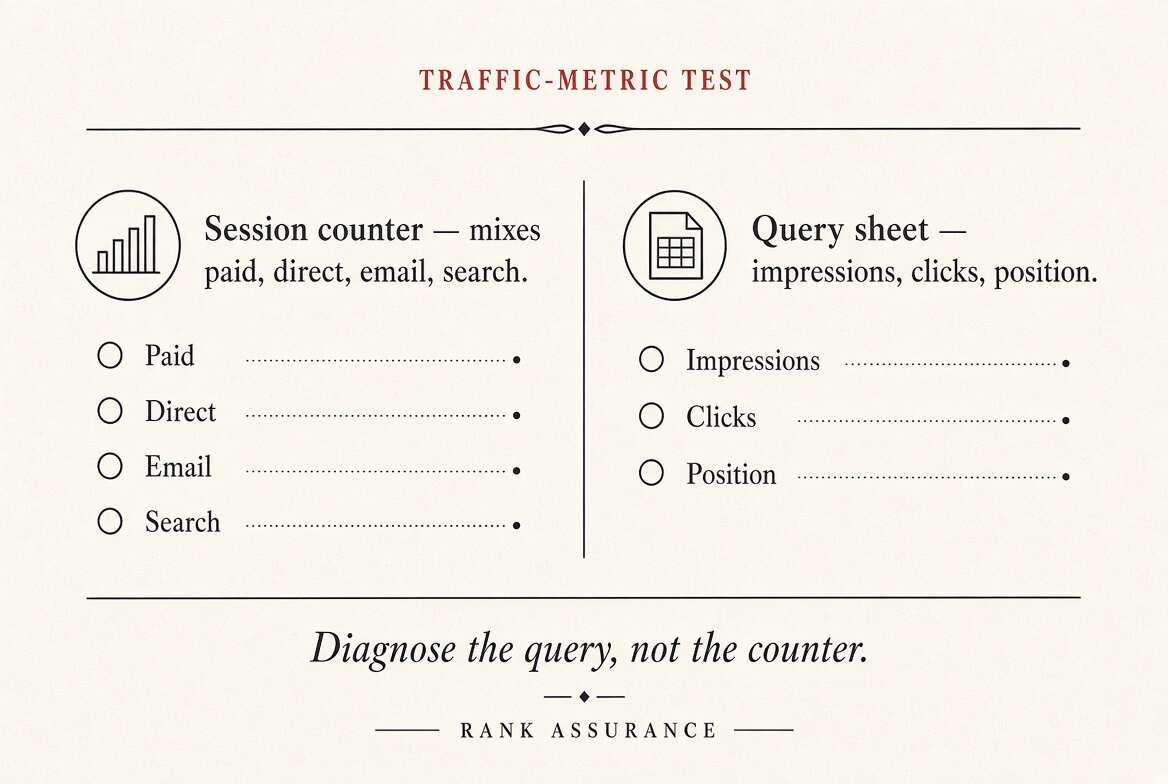
The Traffic-Metric Test splits a mixed session counter into query-level impressions, clicks, and position before any SEO verdict.
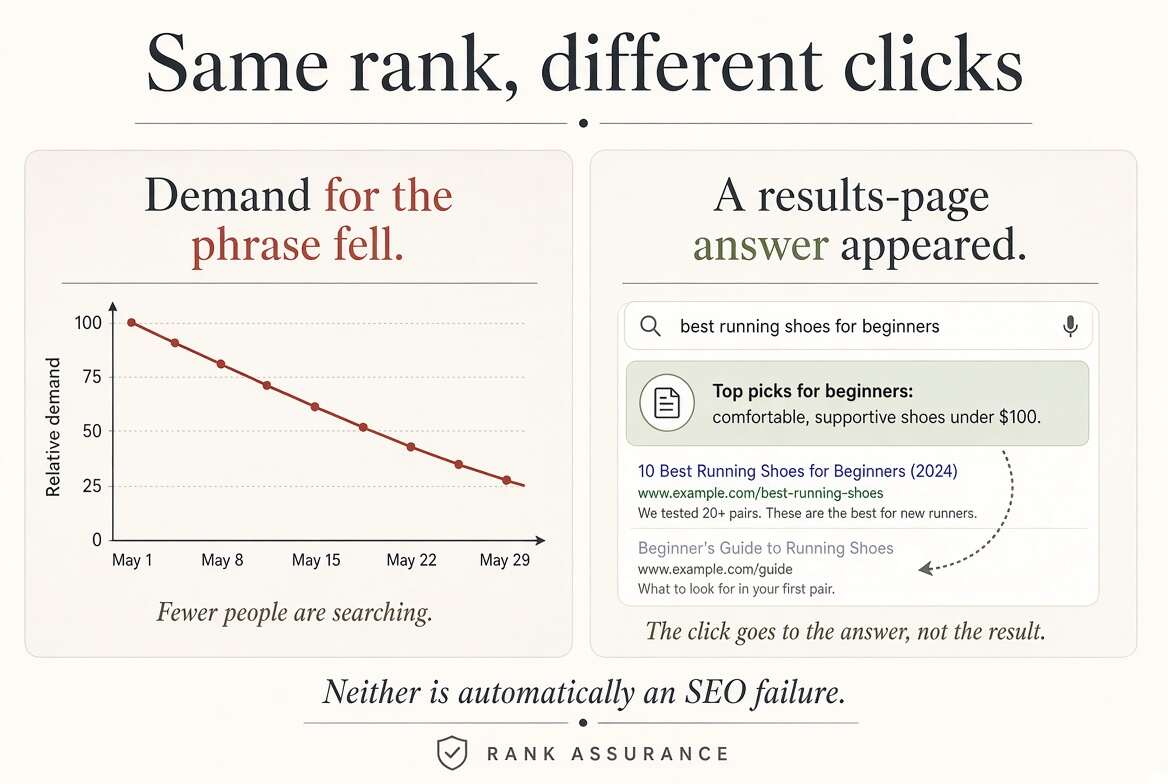
A session counter mixes paid, direct, email, and search. Search Console splits the query: impressions, clicks, position. Rank can hold while fewer people type the phrase, or while the results page answers on the screen. Diagnose the query, not the counter. A retainer whose only chart is “traffic up” is Vendor Claim.
The Question This Article Answers
Traffic fell. Did SEO fail? Not always. Sessions are an output. They move when people search less, when the results page answers them without a click, or when your URL slipped. This page does not reprint Position-Value or SERP-Surface. It is the parent chart those pages sit under.
Five Objects
| Object | What moved | Open |
|---|---|---|
| Analytics sessions | A mixed counter | Split source before you blame Search |
| GSC query row | Impressions, clicks, position for one phrase | The working sheet |
| Average-position blob | Many queries mashed into one number | Position-Value |
| Demand change, rank unchanged | Fewer searches, same slot | Not an SEO failure |
| AI answer names someone else | The surface answered without you | Citation-Surface |
Clicks still tend to concentrate on the first few results. Exact percentages change by query and by year as features change the page. Do not treat a 2010-style CTR table as a law. Position-Value.
Since June 2026, Search Console also logs appearances inside AI Overviews and AI Mode in a dedicated generative AI view. Check that report before you blame rank for a click drop — the page may be answering on the screen with your URL inside the answer. Generative-Impression. And if answer engines start naming someone else, that is Citation-Surface — a sibling, not a replacement for the Search Console sheet.
How to Split the Source in Five Minutes
- Open Analytics. Compare the organic-search channel against total sessions for the drop window. If the drop lives in paid, email, direct, or referral, Search is not the suspect.
- Open Search Console → Performance for the same dates. Filter one money query and one URL. Write three numbers: impressions, clicks, position.
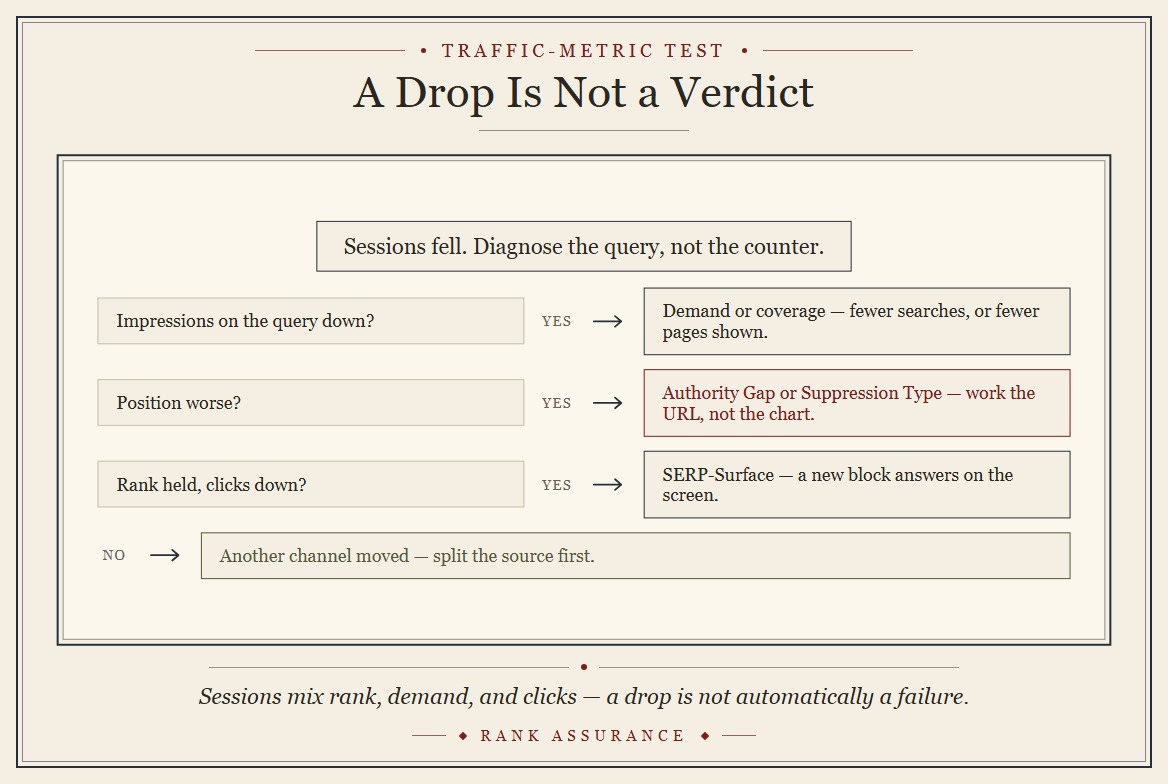
- Impressions down, position steady: put the phrase in Google Trends. Fewer searches is demand, not failure.
- Impressions steady, clicks down: open the live results page and the generative AI report. A block may now answer on the screen. SERP-Surface.
- Position down: the ranking moved. Rank-Drop, and Work-Log the URL against the dates.
A worked read — invented numbers, real method. Sessions fell 22% month over month and the meeting wants a rewrite. The split says organic held — a paused ad campaign is the missing quarter. Search Console for the three money queries: impressions level, clicks level, position unchanged. Verdict: the counter mixed channels; nothing on the search side moved, and the rewrite would have torn up pages that were doing their job.
The Divergence Matrix
The mixed counter can only fall in a handful of shapes. Each shape has one owner. This is the whole triage the calculator below automates.
| What fell | What held | Verdict | Open |
|---|---|---|---|
| Sessions only | Impressions, clicks, position | The drop is not Search — another channel moved | Split the source first |
| Sessions + impressions | Position | Demand fell; the slot held | Trends beside GSC — not an SEO failure |
| Sessions + clicks | Impressions, position | The results page changed around you | SERP-Surface |
| Sessions + position | — | The ranking moved | Rank-Drop · Authority Gap |
| Nothing in GSC | Everything official | An answer surface may be naming someone else | Citation-Surface · Generative-Impression |
Calculator
Traffic-Metric Calculator
Official-Path Next Step
- Open Search Console → Performance. Filter one money query and one URL.
- Compare impressions, clicks, and position for the same dates as the session drop.
- If impressions held and clicks fell, open the live SERP and the generative AI report. SERP-Surface.
- If position slipped, Authority Gap or Suppression Type — not another traffic dashboard.
Questions
Is rank the only SEO metric?
No. Rank is the feedback loop. Impressions and clicks are the official Search Console pair. Revenue is the business loop. Features can hold rank and cut clicks.
How do I tell a demand drop from a rank drop?
Pair the phrase in Google Trends with the query row in Search Console. Demand falling reads as impressions down while position holds. Rank falling reads as position down while the demand curve stays flat.
Can traffic fall while rankings improve?
Yes. Fewer searches, a surface that answers on the screen, or a lost paid or referral channel can outweigh a better slot. That is the whole reason to split the counter before judging the campaign.
Do AI Overviews cut traffic even at #1?
Published panel and keyword studies measure fewer clicks when a summary is present — the Position-Value Test carries the studies and their dates. A #1 blue link under a full-width answer is not the first thing on the screen.
Which report do I open first after a drop?
Search Console → Performance, filtered to the same dates as the drop, one money query at a time. The session chart is the alarm, not the diagnosis.
Should I ignore traffic entirely?
No. Use it as an output after you split source. Do not use a mixed session line as the diagnosis.
Sources
- Search Console Performance report — queries, pages, impressions, clicks, position.
- How Search Works — ranking results.
- Search generative AI performance reports (3 June 2026) — the dedicated view for AI Overview and AI Mode appearances.
- SparkToro 2024 zero-click search study (Datos clickstream panel) — 58.5% of US Google searches ended without a click.
- Position-Value Test · SERP-Surface Test · Citation-Surface Test · Rank-Drop Test · Generative-Impression Test.