
The Rank-Drop Test.
Separate a System Change, a Stronger Competitor, a Lost URL, and a Penalty Before You Rewrite the Site
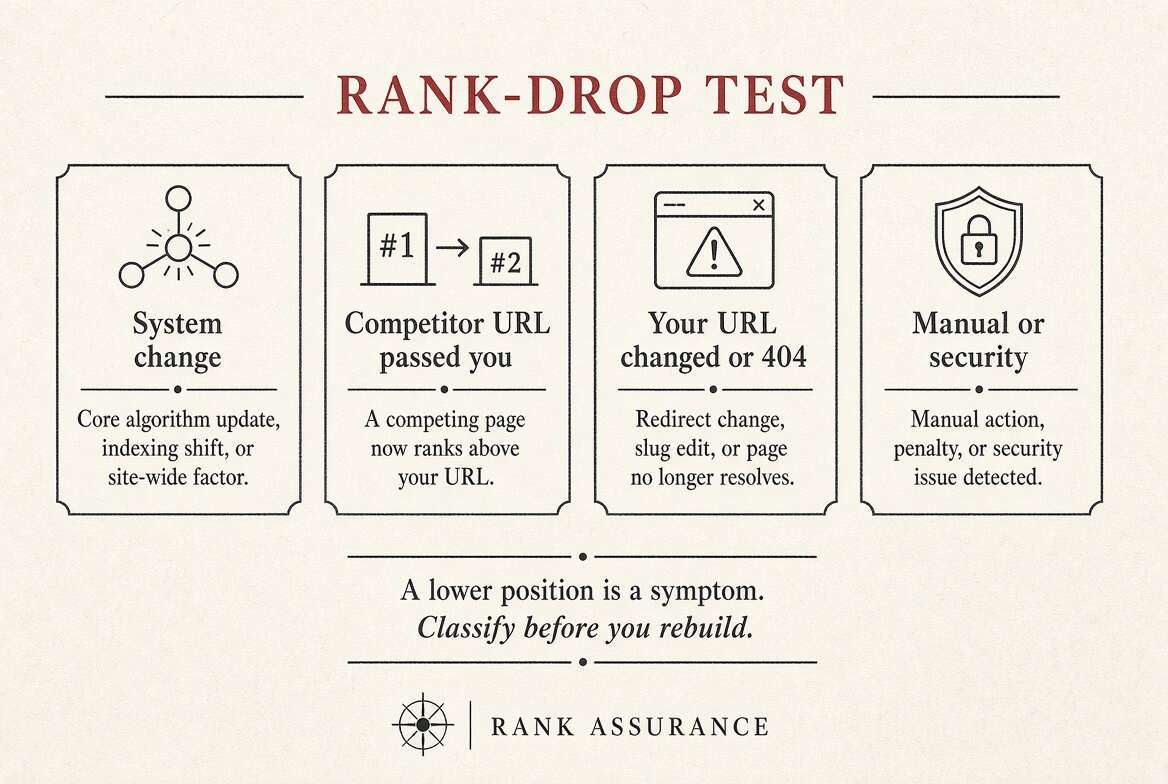
The Rank-Drop Test classifies a lower position: a system window, a competitor URL, a change you shipped, manual/security, or a changed results page — before any rebuild.
A lower position is a symptom. Open Search Console and the live SERP before you rebuild. Classify: a named system window, a competitor URL that passed you, a URL you changed or 404’d, or a manual/security issue. Chart-shape folklore is not official.
The Question This Article Answers
Position fell. Is that a penalty, a competitor, something you shipped, or a system window? This page does not reprint Suppression Type or Two-Site. It is the classifier you run first.
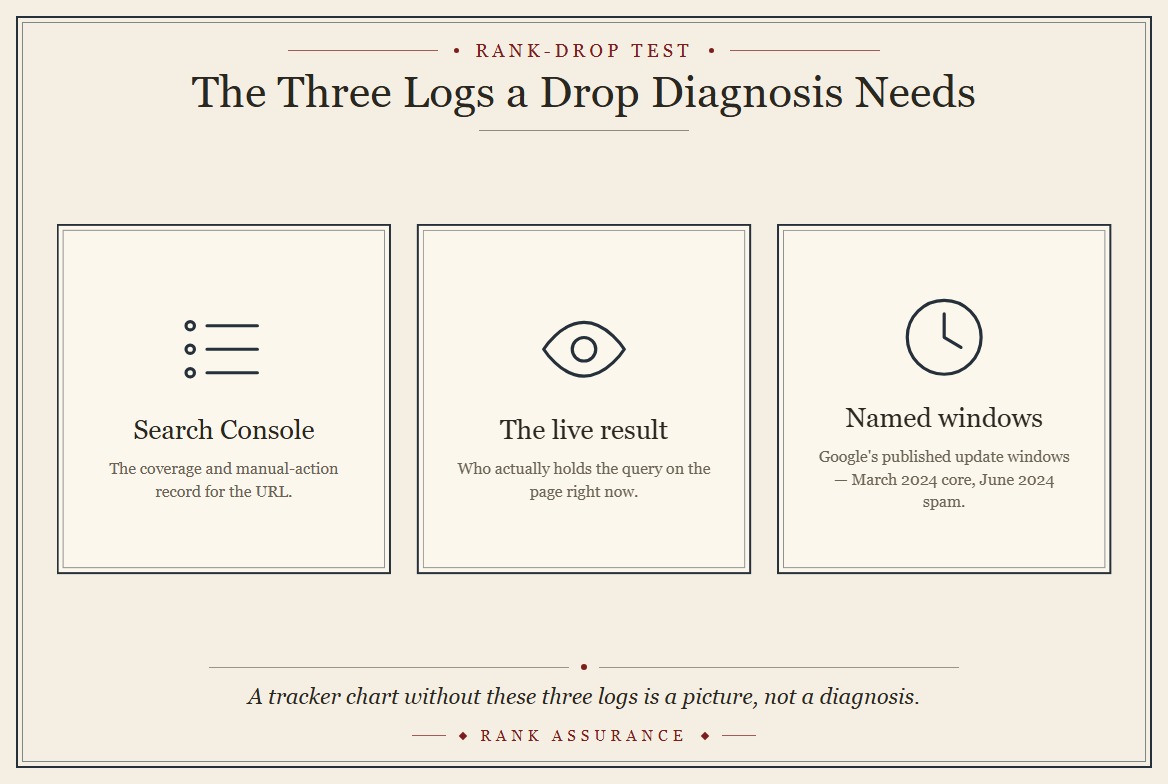
The diagnosis needs three logs:
- the Search Console coverage and indexing log for the URL;
- the live result for the query — who actually holds it now;
- the named-update window log — what Google announced for those dates.
Five Causes
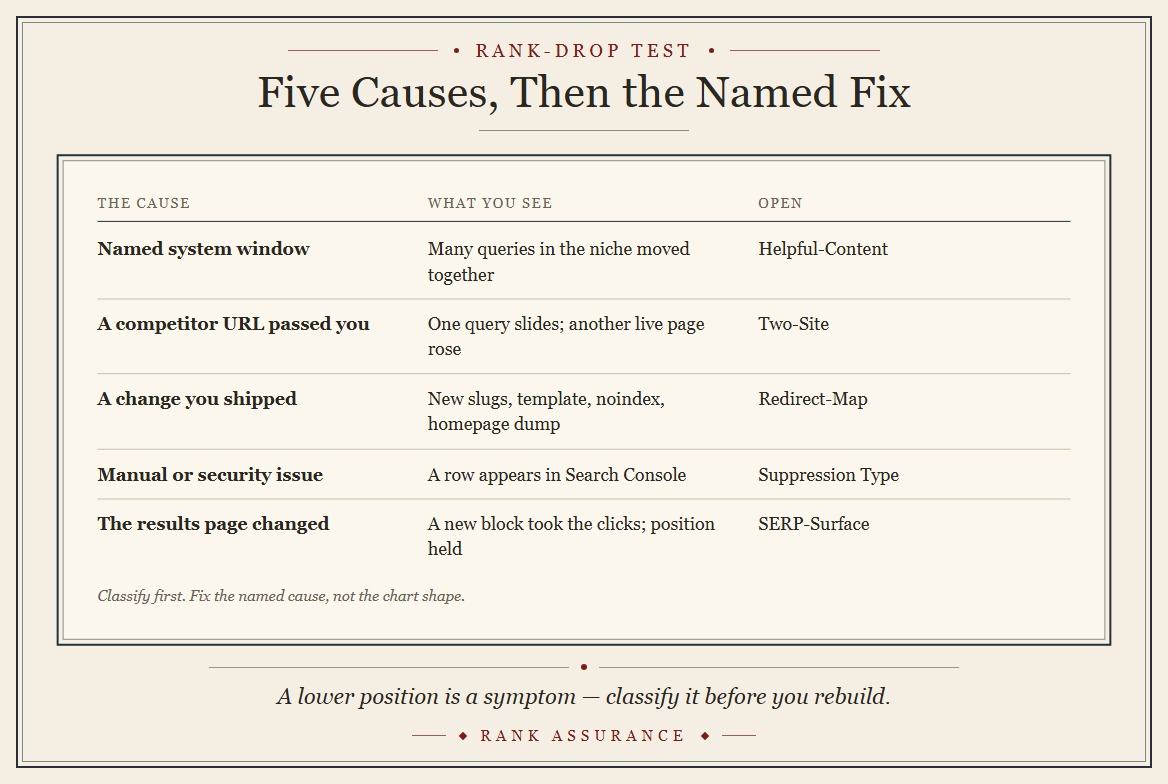
| Cause | What you see | Open |
|---|---|---|
| Named system window | Many queries in the niche moved together (Google publishes update windows on its Search Status Dashboard) | Ranking-systems list · Helpful-Content |
| Competitor URL passed you | One query slides; another live page rose | Two-Site |
| You shipped a change | New slugs, template, noindex, homepage dump | Redirect-Map · First-Index |
| Manual / security / coverage collapse | A row in Search Console | Suppression Type |
| The results page changed | An AI Overview or a new block took the clicks while your position held | the SERP-Surface Test · the Generative-Impression Test |
A lost mention can look like “the competitor got stronger.” Check the linking URL still exists and still points at you. Link-Quality. Traffic-Metric if impressions held and clicks fell — that can be a surface change, not a penalty.
Calculator
Rank-Drop Calculator
Official-Path Next Step
- Open Search Console: Performance for that query, Indexing for that URL, Manual actions, Security issues.
- Open the live results. Who sits there now? Two-Site.
- If you changed addresses, map old to equivalent new, one hop. Redirect-Map.
- If many sites in the niche moved together, treat it as a system window. Helpful-Content. Do not file a reconsideration for a core update.
Questions
Does a 20–50 Position Bounce Prove a Penalty?
No. That chart shape is not an official test. Open Search Console.
We Redesigned and Traffic Fell. Did Google Hate the Design?
Usually the map, the crawl, or the content stack changed. Redirect-Map and First-Index first. Site-move docs say temporary fluctuation is expected while recrawl happens.
Sources
- Debug Search traffic drops.
- Site moves and URL changes.
- Manual actions report.
- Ranking systems guide.
- Google Search Status Dashboard — published update windows.
- Suppression Type Test · Two-Site Test · Redirect-Map Test.