
The Name-SERP Test.
What You Can Change About Results for a Person or Brand — and What You Cannot
The Name-SERP Test classifies every result on page one of a name — removal-eligible, publisher-owned, official, or news that stays — before anyone buys a campaign.
Someone searched a name and the first page is ugly. That is not one problem. It is a mix of personal information Google will sometimes delist, journalism it will usually keep, reviews that live on a platform, official properties you already control, and — too often — a vendor offering ten hollow sites to occupy the query. This article classifies each result before anyone buys a campaign.
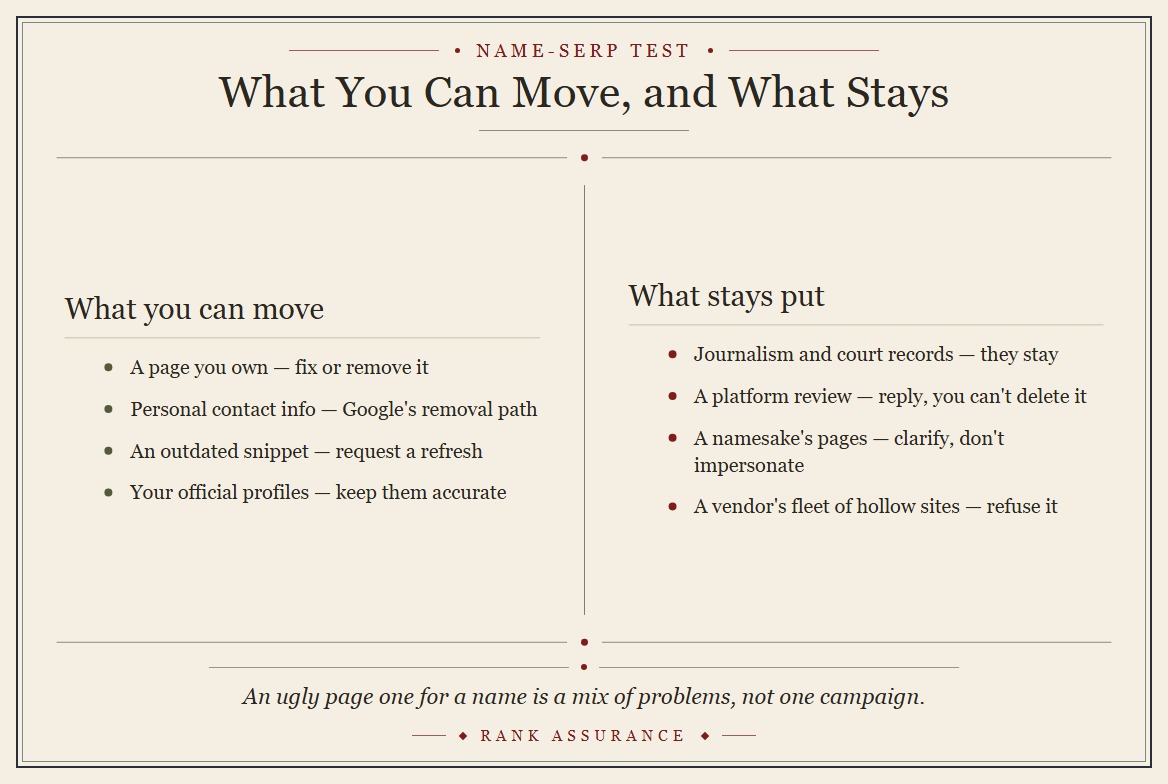
The Question This Article Answers
Industry talk still treats reputation work as “SEO on ten sites.” Rank the extra properties, the criticism falls off page one, nobody looks further. That pitch skips every official tool Google added for personal information, treats news as a ranking problem, and funds the same extra-domain pattern the Sister-Site Test already fails.
Knowledge Panels, review packs, News, People Also Ask, and AI Overviews sit above or beside the ten blue links. “Off page one” is not the whole surface anymore. When an assistant’s answer repeats one of these results, classify that URL the same way — the Citation-Surface Test reads the answer block itself.
Eight Classes of a Name Result
Calculator
Name-SERP Calculator
Run this once per URL on the first page, including panels.
What Google Will Actually Take Down
Google will consider delisting certain personal information from Search. That is not the same as deleting the page from the web, and it is not a reputation product for bad press.
Use Results about you for contact information (phone, home address, email) and to watch for new hits. Use Remove my private info for government IDs, financial numbers, signatures, medical records, credentials, doxxing, and non-consensual explicit imagery. In February 2026 Google expanded Results about you to cover more identity documents and made non-consensual-image requests easier to track.
Google often denies requests when the page is a newspaper, a school, a government site, or other information it treats as valuable to the public. That line is the whole difference between privacy removal and “make the article disappear.”
What Only the Publisher Can Change
If you own the page, change or delete the content, then use Search Console removers or noindex. Temporary removals expire; the page has to stop existing or stop being indexed.
If you do not own it, ask the publisher. If they edit or take it down, use the outdated-content / recrawl path so the snippet catches up. A legal process — copyright, a court order, or a data-protection delisting where that law applies — is a lawyer’s job, not an SEO package.
What Usually Stays
News, interviews, lawsuits, arrest reports, and public records are the results people most want gone and the results Google is least likely to delist as “reputation.” Embarrassing is not a removal category. Inaccurate can be a correction at the publisher. Defamatory can be counsel. None of those are “rank ten other sites until the URL falls to page two.”
Reviews live on the platform. Reply. Document fakes and use that platform’s policy. Buying a counter-network of stars is a different kind of scheme.
Official Properties That Are Real
The legitimate occupation of a name query is properties a searcher would trust: the company site, an About page with Organization or Person schema, a claimed Business Profile, a professional profile people actually use. Those pages have users even if the ugly URL vanished. That is the Sister-Site question pointed at a name instead of a money page.
Same-name consistency helps the Knowledge Panel. Fake extra “Bob Smith” biographies do not.
Dummy Sites Built to Occupy the Query
A campaign that stands up a row of new hosts, spreads IPs, and builds links so the criticism drops is a ranking vehicle. Google’s doorway and scaled-content language is about sites created to funnel or fill results, not about a person answering their own name with a real site.
If a vendor’s plan is “we will occupy page one with properties we host,” run the Sister-Site Test and the Vendor Claim Test. Do not add more hosts to hide the pattern. Do not invent other people with the same name.
Official-Path Next Step
- Search the exact name in a private window. Capture the whole SERP, including panels and AI Overviews.
- Classify every URL with the calculator.
- File eligible personal-info and safety removals. Watch Results about you for new hits.
- Fix or noindex pages you own. Ask publishers. Refresh outdated snippets.
- Claim and correct official profiles. Strengthen the real site that should answer this query.
- For news and public records, decide on correction or counsel. Do not fund a dummy fleet.
- If a vendor already built occupiers, stop adding them. Treat leftover scheme links as Sister-Site cleanup.
Questions
Can I Get a News Article Off Page One by Ranking Other Sites?
You can try to earn stronger official properties. You cannot honestly promise the article will vanish. Google does not delist journalism because it is inconvenient, and a dummy fleet is a scheme.
The Page Was Taken Down but the Snippet Is Still There.
Request a refresh / outdated-content recrawl. Temporary removal in Search Console is only for pages you control.
Is “Success” a Clean Page One?
Success is fewer eligible private-data hits, accurate official properties, and a truthful answer to reviews. A guaranteed blank first page is the same red flag as a first-place guarantee.
Someone Else Has My Name.
Clarify the entity on your own site. Do not build lookalike pages that pretend to be them or to be extra versions of you.
Sources
- Google Search Help, “Find and remove personal contact info in Google Search results” — Results about you.
- Google Search Help, “Remove my private info from Google Search” — IDs, financial data, doxxing, NCII.
- Google Search Central, “Remove information from Google” — pages you host; link to personal-info help for pages you do not.
- Google Legal Help, right-to-be-forgotten / delisting overview — name-query delisting where that law applies; the page can remain for other queries.
- TechCrunch, 10 February 2026 — Results about you expanded to more identity documents; NCII requests tracked in one hub.
- Google Search Central, spam policies (updated 28 August 2026) — scaled content, doorways, link spam.
- The Sister-Site Test — extra domains whose job is to occupy a query.