
The Two-Site Test.
The Better Article Still Has to Be Found, Matched, and Believed
The Two-Site Test scores two URLs on the same query across four gates — fetchable, matched, independently mentioned, not suppressed — instead of crowning either column.
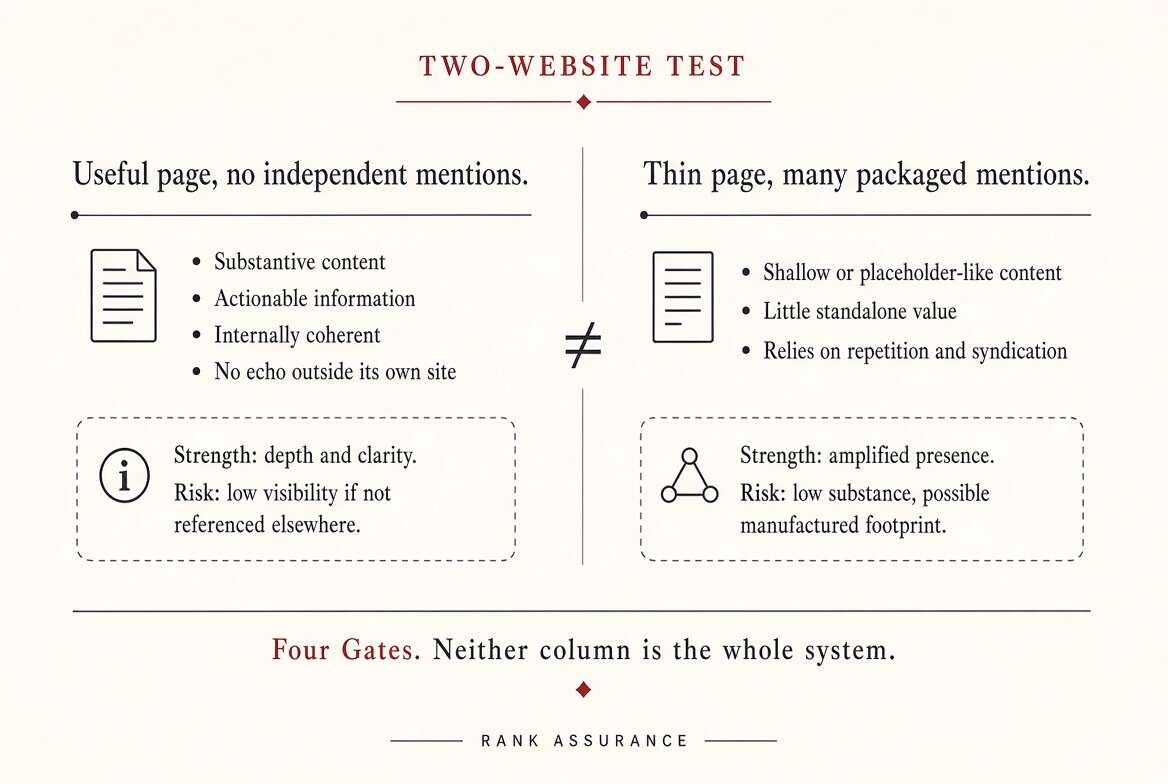
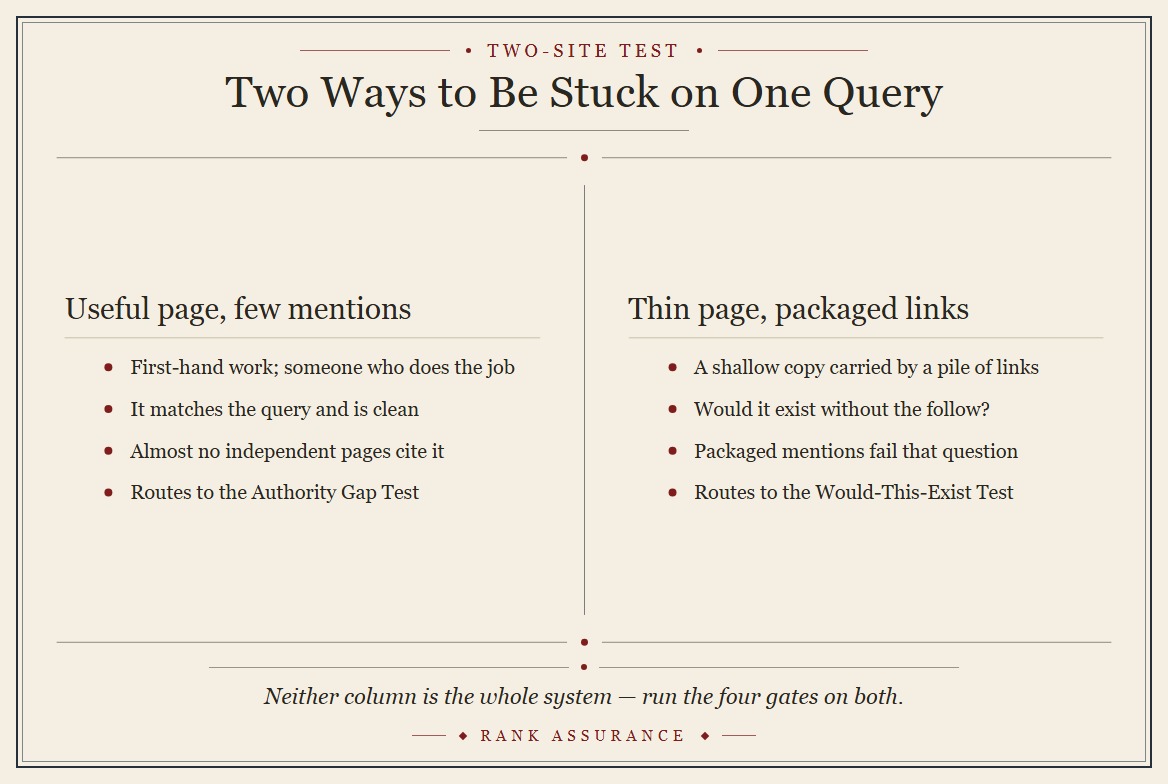
Put two URLs on the same query. One is written by someone who actually does the work. One is thinner and has a pile of mentions. The thought experiment that crowns the pile every time leaves rooms out. Search evaluates people-first pages. Packaged mentions fail Would-This-Exist. A vendor domain-count is not a ranking system. Run the same four gates on both.
The Question This Article Answers
When two pages target the same query, which one is actually stuck? A beautifully written page that nobody independent points to, that does not match the query, or that cannot be crawled can lose. That is not proof that writing is worthless. It is proof that writing is one room.
A finished on-page checklist is not a win. Rank is relative to the other live URLs on that query. If every competitor already did the same titles and headings, the list is no longer scarce. Open the results. Compare your URL to the URL that already sits there. A vendor “keyword difficulty” number is an estimate, not Google’s — the Domain-Score Test covers the whole species.
The Sheet
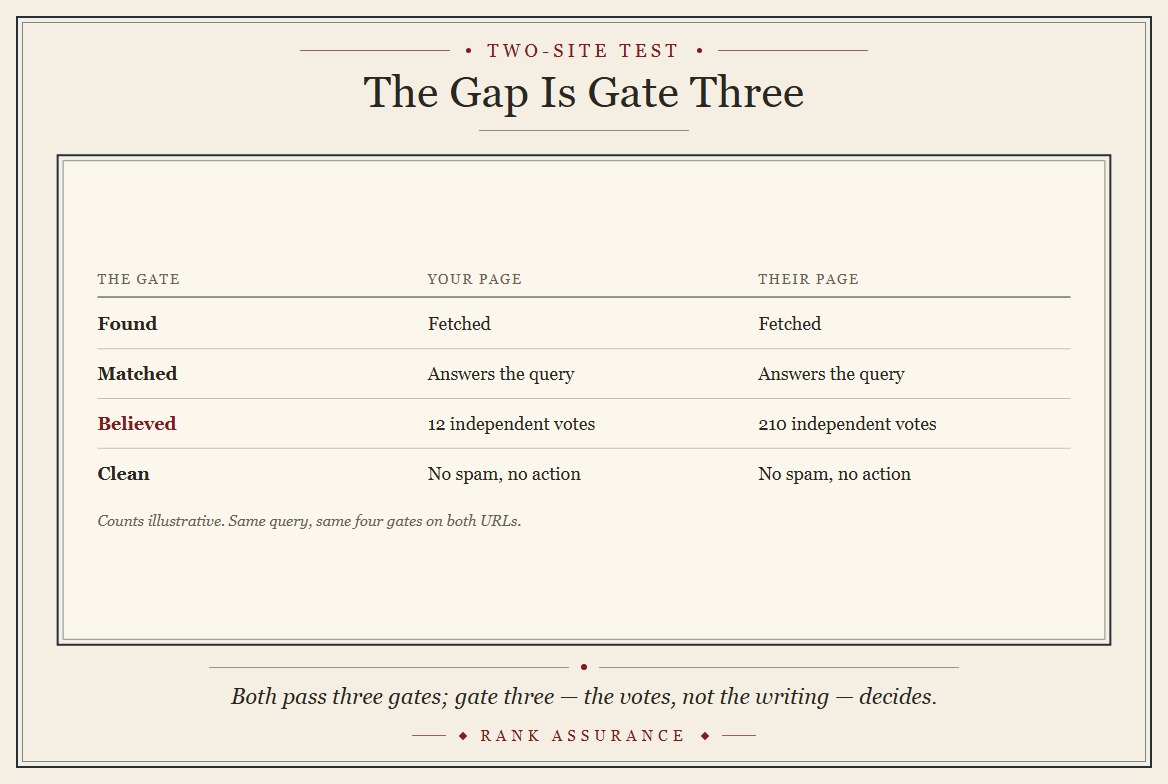
| Gate | Site A — yours (illustrative) | Site B — theirs (illustrative) |
|---|---|---|
| FoundCan Search Console fetch it? | Yes | Yes |
| MatchedWould a person calling that phrase stay? | Yes | Yes |
| BelievedIndependent mentions | 12 referring domains | 210 referring domains |
| CleanManual action? Scaled content? | Yes | Yes |
| Verdict | The gap is gate 3. A referring-domain count is shorthand here, not the test — the gate still asks whether those 210 pages would exist without the follow. | |
The same four gates now decide a second prize: which of the two pages an AI answer names or cites. Score the pair once and you have read both races — the Citation-Surface Test runs the second one on its own surface.
Exact-match anchors on an unrelated destination do not make that destination about the query. Topic-Fit still reads the page. Scaled exact-match packages are a scheme, not a relevancy hack.
Reviews and ratings live on a different surface than the organic blue link. Local Pack. Ten times the reviews does not automatically win the web result if the page does not match the query or cannot be fetched.
The Older Domain
When the question is “my competitor outranks me even though my page is better,” this is still the same sheet. Write your URL in column A and theirs in column B. Domain age and a vendor authority score are not Google ranking systems. An older domain that is crawlable, on-topic, independently mentioned, and not suppressed can win. An older domain that is a packaged graph can lose. Score the gates. Do not crown “they have been online longer.”
The Vendor Grade
Fetch is not a vendor grade. Official technical work is crawlable HTTPS pages that work on a phone. Speed and mobile usability are documented. They do not replace match or mentions. First-Index.
The Quiet Phrase
A quiet phrase is a different race. A new or long specific query with almost no results can surface a useful first page. That is Cold-Start / First-Index. It is not proof that an expert page beats a packaged graph on a competitive head term without the other gates.
The Page, the Graph, and the Block on Screen
The sheet assumes both URLs are racing in the same block of the results page. Check that before you re-score anything. A first page is several blocks now — organic links, a local pack, news, a Knowledge Panel, an AI Overview — and the prize you are losing may not live in the block you have been studying. If the query draws a map pack, the race is the Local Pack Test. If an answer block took the clicks while both positions held, that is the SERP-Surface Test. Scoring two organic URLs while the clicks live in a different block is a precise answer to the wrong question.
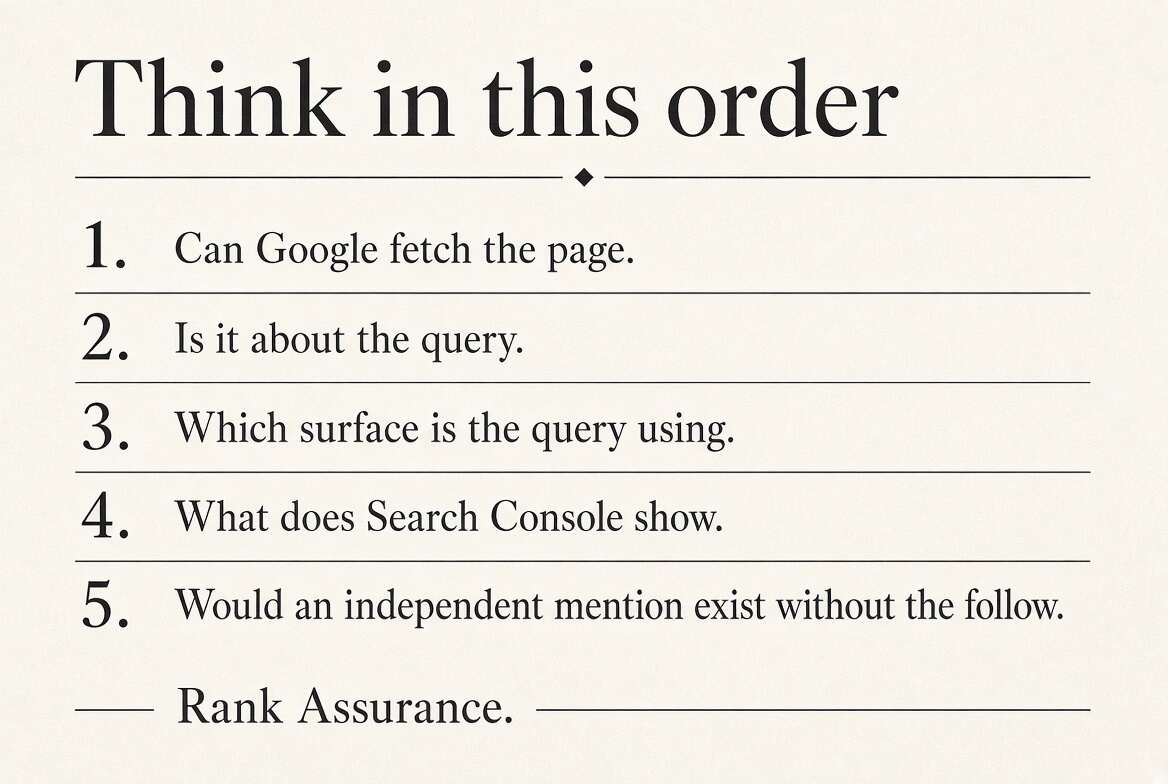
Written out, the order is: can Google fetch the page; is it about the query; which surface is the query using; what does Search Console show; would an independent mention exist without the follow. The first two live on the page. The third lives on the screen. The last two live in the graph — the honest half of it. A URL still has to work alone; mentions only change who believes it. That one sentence settles most page-versus-links arguments before they start.
Two folk models dissolve under that order. The first treats the page as a plugin setting. Plugins do not rank — they can block crawlers or emit junk markup, which is a fetch problem, not proof that pages do not matter. Titles and snippets still change whether a person clicks; Google’s guidance on debugging traffic drops says as much. The second treats the graph as physics — “authority flow across five hops,” “the top one percent think in graphs.” That is a sales frame, not a dataset. Linking out to a destination you do not trust is a reason to mark the outbound link, not an official inherited penalty from every neighbor — and buying an unknown package of follows is still link spam, whatever hop count the deck promised.
Calculator
Two-Site Calculator
Official-Path Next Step
- Write your URL and one competitor URL on the same query.
- Score fetch, match, independent mentions, suppression on both.
- If your page is useful and empty on mentions, Authority Gap — not another quota of posts.
- If their mentions look packaged, Would-This-Exist and Network-Footprint. Do not copy the costume.
Two Rooms and a Costume
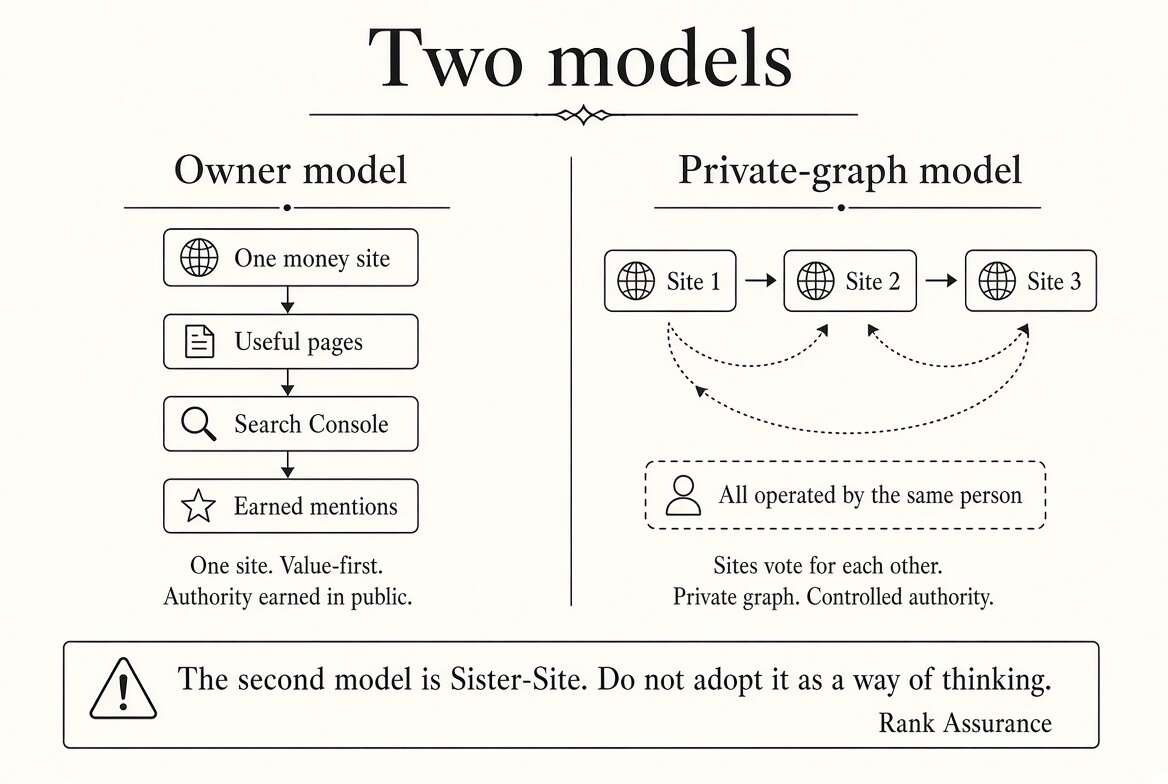
The sheet keeps sending you into one of two rooms. The first is the page you publish: fetch, aboutness, titles, usefulness — everything a person and a crawler meet at the URL. The second is the mentions you do not control: you can ask a publisher who already knows you; you cannot command the follow. Site A and Site B both live in both rooms, and the four gates simply ask how each site is doing in each.
Treating the page as a waste of time is how URLs stay unindexed. Treating mentions as a product you buy is how sites purchase an object Google’s spam policies already name — link spam. Neither shortcut survives the sheet.
There is a tempting third room: a graph of sites you also operate, voting for the money URL. It is not a room. It is a costume — a policy object with an official spam-policy name, not a way of thinking. If the competitor’s column looks like that costume, score it with the Sister-Site Test instead of copying it.
Questions
Does the Expert Page Always Lose?
No. A useful matching page can win when the other graph is packaged, off-topic, or suppressed. It often loses a competitive query when nobody independent points to it.
Can Search Tell the Expert Page Is Better?
Systems exist to reward people-first pages. “Search cannot read content” is not the official line.
Does On-Page Work Even Matter?
Yes. The official Starter Guide is almost entirely what you do to your own site. Ranking systems work at the page level first.
Will Linking to a Penalized Site Infect Us?
Mark outbound links you were paid for or do not trust. Do not buy mystery packages. That is not the same as an automatic inherited penalty from every neighbor.
Sources
- A guide to Google Search ranking systems — page-level first; site-wide signals exist and do not lift every URL.
- Creating helpful, reliable, people-first content.
- SEO Starter Guide (updated 10 December 2025).
- Spam policies — link spam; site reputation abuse.
- Qualify outbound links.
- Debug Search traffic drops — presentation still moves clicks.
- Authority Gap Test · Would-This-Exist Test · Content-Quota Test.