
The Local Pack Test.
Why a City Page and a Map Listing Are Not the Same Job
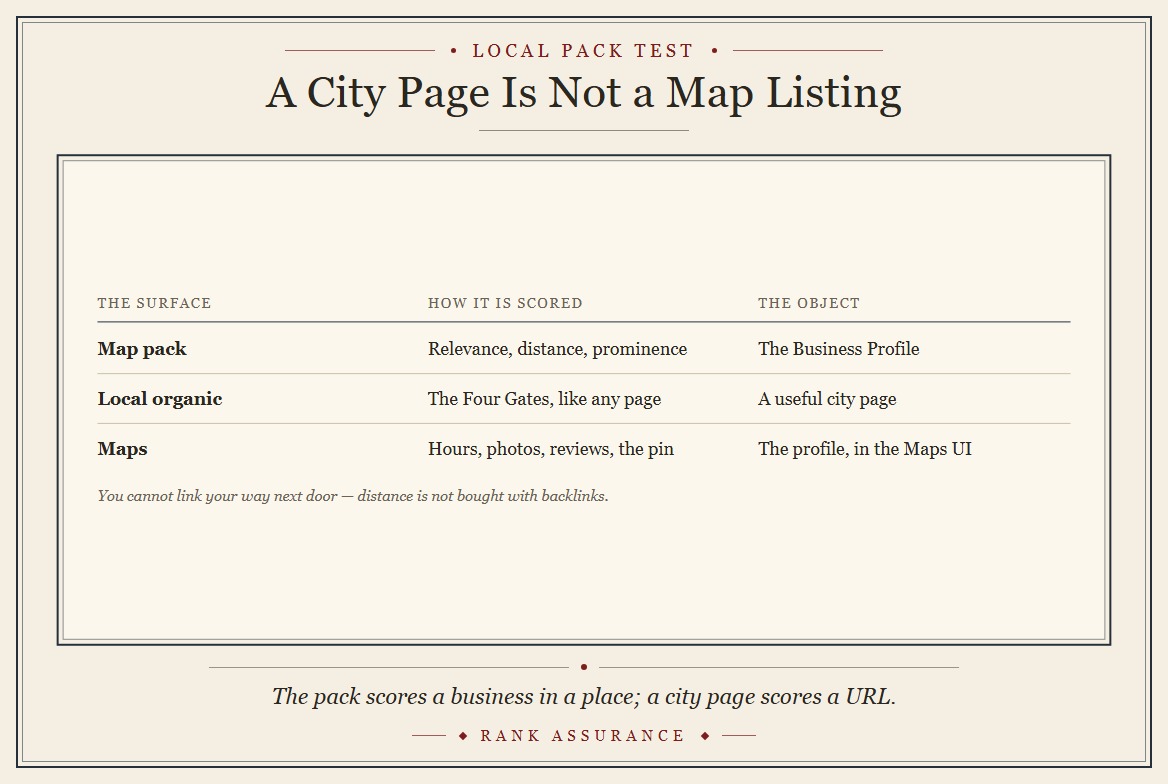
The Local Pack Test asks which surface a local query uses — map pack, local organic, or Maps — because the pack scores a business in a place, not a URL.
A city URL and a Google Business Profile can both show up when someone types a town and a service. They are not scored the same way. This article is the test for which surface you are actually losing — the map pack, local organic, or Maps itself — before anyone builds fifty near-identical city pages or treats local search as “national SEO with a city in the anchor.”
The Question This Article Answers
If you rank in the blue links but not in the three-pack, the fix usually lives in the profile — category, distance, reviews — not in more backlinks. Name which surface the query uses before spending anything on it.
Industry memory still treats local search as the 2011 version: make a page for every city, point location-keyword links at it, watch the pack fill. That model is incomplete. The map pack is a different surface from the blue links under it. Distance to the searcher is not something a backlink buys. A claimed profile with the wrong primary category will lose to a closer, correctly categorized competitor even if your website is stronger.
The Surfaces a Local Query Can Use
Calculator
Local Pack Calculator
Relevance, Distance, Prominence
Google’s local-ranking help still groups the pack around three ideas.
Vendor surveys publish percentage weights for those pillars. Those weights are not Google’s. Use the three names. Do not treat a survey as a ranking formula.
An August 2026 analysis of about 1.8 million Business Profiles found a more specific primary category and a more complete profile associated with better local ranks than a generic category and an empty listing. That is a public-record correlation, not a guarantee. It matches the official advice: pick the category that is true, fill the profile, add photos that are real.
What the Profile Actually Has to Be
Read each line as a pass/fail check — stop at the first fail and fix it before the next.
- Claimed and verified? A fail here means nothing else on this list runs.
- Primary category what a customer would type? Specific beat generic in the 2026 profile study.
- Hours, phone, website, and service area true? A wrong hour is a broken promise to a person standing outside.
- Photos and posts a customer would actually use? Stock tiles fail this check.
- Reviews none of which you bought, all of which you answered?
LocalBusiness structured data on the site should match the profile. Conflicting NAP — name, address, phone — is a prominence leak, not a reason to blast hundreds of directories as the whole strategy; the Local-Citation Test is the honest version of that job.
Completeness separating winners from the rest is not unique to profiles. In our measured local-service sample, the clearest on-page separator between top-band and bottom-band sites is the same boring kind of item — a privacy-policy link leads the list. The measured shares are published on the benchmarks page, and the reading is the same as the profile study’s: correlation, not a formula.
When a City Page Is Real — and When It Is a Doorway
A location page earns its URL when a visitor from that place gets something they cannot get on the homepage: the address they will drive to, the crew that covers that city, unique proof you work there, hours that differ. That page can compete in local organic and can support prominence.
A doorway page is the other object: the same three paragraphs, a city name swapped in the title, a map embed, no one who answers the phone in that town. Google’s spam policies still list doorways — pages built to rank for similar queries and funnel people elsewhere. A 2011 “state page plus city children plus geo-anchors” grid is that pattern when the cities are not real coverage.
| Real location page | Doorway city page | |
|---|---|---|
| Reason it exists | A customer in that place needs this page | The query contains a city string |
| Content | Unique local facts | Template + town name |
| Profile | Matches a real pin or service area | No honest pin |
| Links | Earned mentions of that location | Geo-anchor package from properties you control |
The Fourth Surface: The AI Answer
“Best roofer in [city]” is now also a question people put to an assistant, and Google’s results increasingly answer local queries with an AI summary near the pack. The inputs are not mysterious: the profile, the reviews, and pages about the business worth citing — the same objects the other surfaces score, read by a different machine. Distance does not disappear; a physical service still gets recommended to people it can actually reach.
Two honest facts about this surface. First, it is measurable — you can put the query to the engines yourself and record whether the business is named; the Generative-Impression Test is that walk. Second, it is not purchasable — there is no published way to buy the recommendation itself. The Citation-Surface Test covers what the reading machine finds on your pages, and the Fan-Out Test covers how one question becomes many lookups.
“All SEO Is the Same”
National organic is the Four Gates. The local pack adds distance and a profile object. Those are not one process with a different keyword. A vendor who says every vertical is “pick the term and point owned domains at it” has already failed the Sister-Site Test.
One useful hiring question — “have you taken a small site past a giant on a competitive query?” — belongs in the Vendor Claim Test. It is a reference check, not a local ranking law.
Anchor text still describes a destination, and the old “click here” episode — generic anchors once ranked a download page for words that were not on it — is history, not a tactic; the note lives in the Authority Gap Test. Exact-match geo-anchors from a network you control are ranking credit, not prominence.
Official-Path Next Step
- Search the query from the city that matters, in a private window, on a phone if that is how customers search.
- Note whether a pack appears. That decides the job.
- Claim and correct the profile. Fix the primary category before you write the twentieth city URL.
- Keep location pages only where coverage is real. Merge or noindex the templates.
- Earn mentions and reviews you do not control. Do not buy a star network or a city-host fleet.
- If the query is not local, run the Authority Gap Test on the page — not the pack test.
Questions
We rank on the website but not in the pack. Is that an authority problem?
Not first. Check category, distance, and reviews on the profile. Prominence can include the site. Distance cannot.
Do we still need city pages?
Yes when a customer in that city needs that page. No when the page exists only because the query contains a city string.
Will more backlinks put us in the three-pack?
They can help prominence and local organic. They will not move the pin closer to the searcher.
Do AI Overviews appear for local queries, and where do they get their data?
They do, above or beside the pack. The visible inputs are the same local objects — profiles, reviews, and pages about businesses. Google has not published a local AI formula; vendor percentage claims about one are surveys, not documentation.
How do I get recommended by ChatGPT for my city?
Measure first, then earn. Put the question to the assistant and record what it says — the Generative-Impression Test — then fix what the reading machine found missing: the profile’s public facts, reviews, citable pages. There is no published way to buy the recommendation.
Does my Google Business Profile feed AI answers?
Google’s AI surfaces draw on the same local results the profile feeds. Third-party assistants read the public web, where the profile’s facts should match your site. One honest NAP everywhere is the same fix on every surface.
How many reviews do I need?
No official number exists, and the review policies police authenticity, not volume. A bought star network fails the same way a bought link does — it is a vote you manufactured.
Sources
- Google Business Profile Help, “How Google determines local rankings” — relevance, distance, prominence.
- Google Search Central, “Establish your business details” — Business Profile and structured data.
- Google Search Central, spam policies (updated 27 August 2026) — doorways; link spam.
- Search Engine Land, 25 August 2026 — 1.8 million profiles: specific primary category and completeness associated with stronger local ranks (correlation, not a Google formula).
- Rank Assurance, “The Authority Gap Test” — national organic; the “click here” historical note lives there.
- Rank Assurance, “The Sister-Site Test” — extra domains that exist to occupy a query.