
The Fan-Out Test.
The Answer May Be Assembled From Questions the User Never Typed
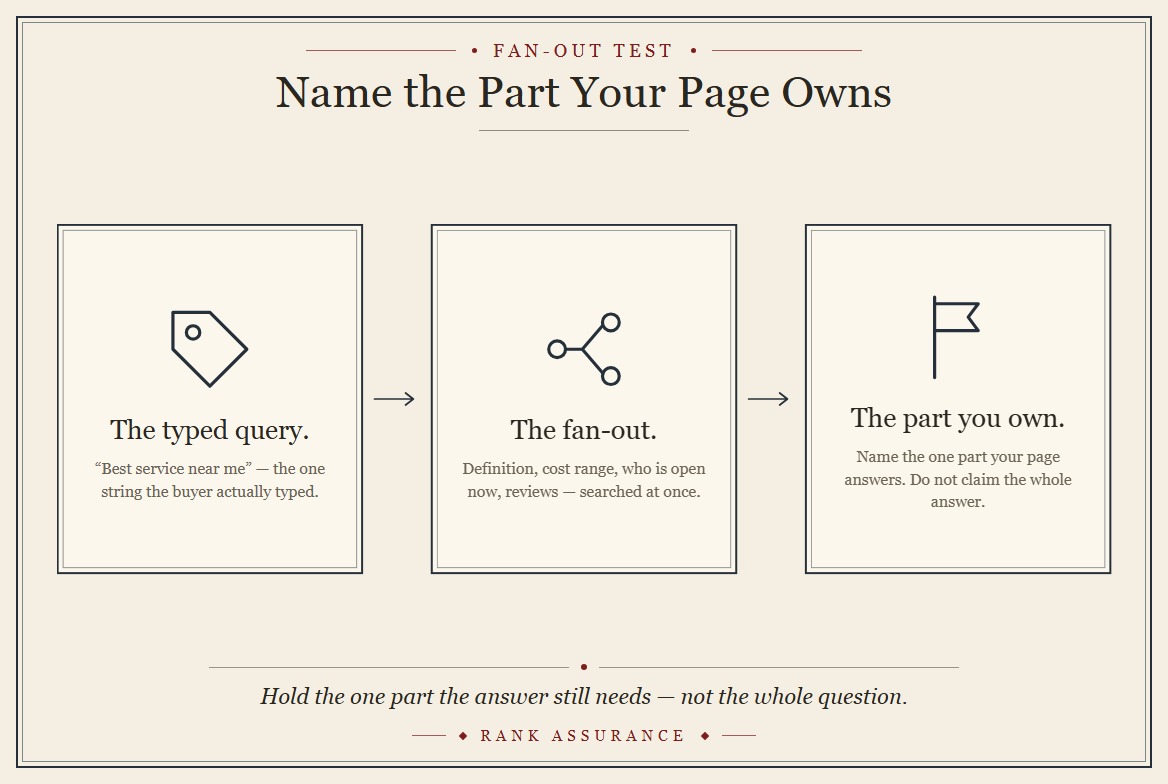
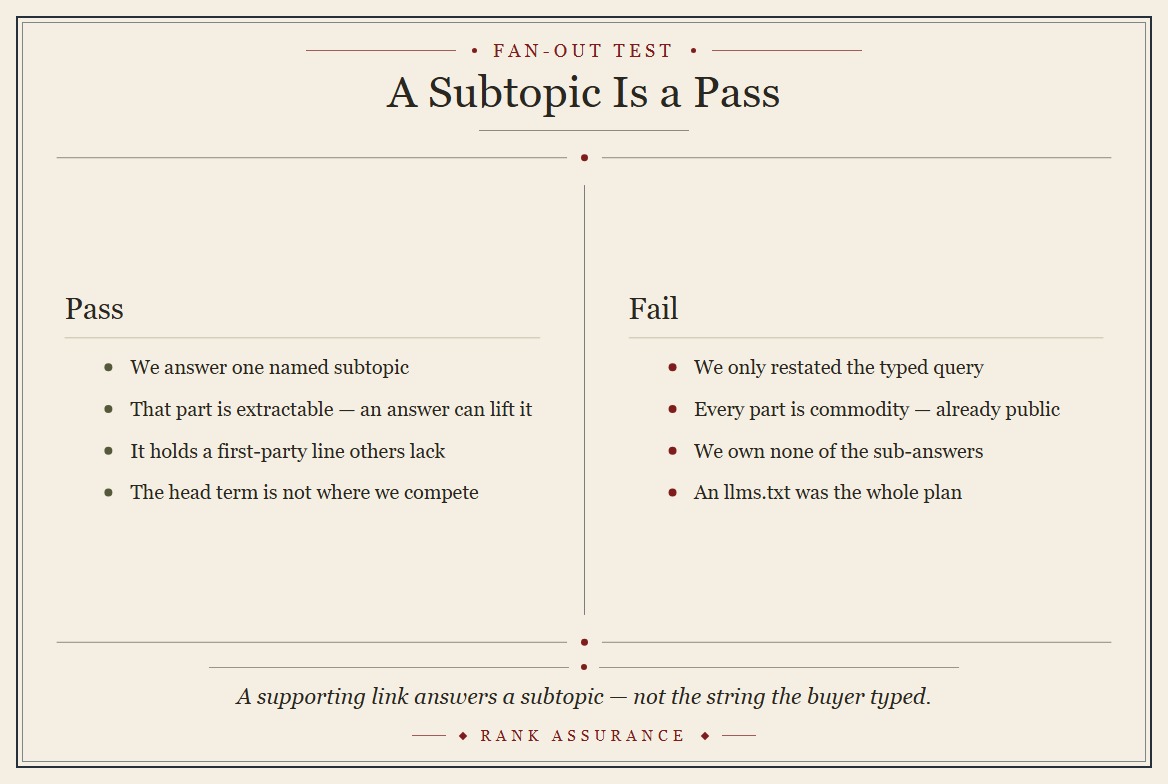
The Fan-Out Test asks which sub-question a generated answer actually used, and whether you hold a page that answers that part — not the head term the user typed.
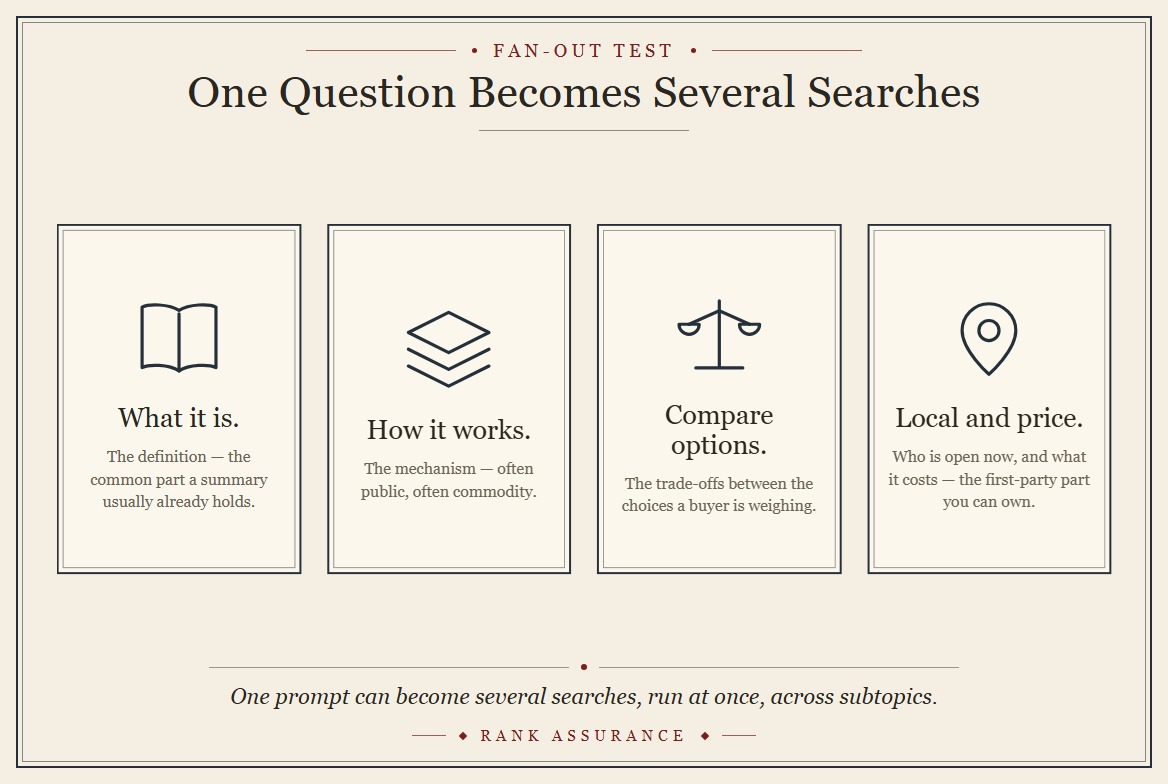
A person types one prompt. The system may search several related questions at once and write from those pages. Your URL can be used for a part of the job you never targeted as a keyword.
The question this article answers
Official AI Mode documentation describes dividing a question into subtopics and searching them together. That is retrieval, not a product you buy. The owner job is to hold a first-party page that answers a part the assembled answer still needs — a number, a method, a booking step — not to chase every implied keyword.
Fan-out is why a page that never ranks for the head term can still be used. It is also why a commodity “complete guide” can be skipped: the system already has the common parts — the Commodity-Page Test’s object exactly.
The boundary that keeps this from being “just long-tail keywords”: the unit is a fragment of one assembled answer, chosen by the system per answer — not a query a person typed or a page that ranks for one. This test sits under the Citation-Surface Test: eligibility and uniqueness first, then which part you hold.
What is official
Calculator
Fan-Out Calculator
The Part-Mapping Worksheet
- Open the live AI Mode or Overview answer and list the parts it actually contains — definition, cost range, availability, reviews, whatever it used. The answer’s own structure is the decomposition; nothing else shows it to you.
- Map each part to a URL you own, or to a gap.
- Cross out the commodity parts — the ones public documentation already answers. Those were never your job.
- Write only the first-party gap: the part where your page would hold the line the answer needed and no one else’s did.
The AI Answer report keeps the full text of each measured answer beside its sources, which makes the decomposition readable after the fact — which part drew on which page.
Official-path next step
- Run the worksheet above on one live answer that matters to you.
- If everything you could write is commodity, the Helpful-Content Test comes before any new page does.
- Read the Generative AI performance report for the pages that catch parts — the Generative-Impression Test is how to read it.
Questions
Is fan-out a ranking factor we can buy?
No. It is how the product retrieves. Unique pages still have to exist.
Does this replace keyword research?
It changes the unit. The unit is the part of the answer, not a stuffed head term.
Can I see the fan-out queries in Search Console?
No. The Generative AI report shows the URL and the feature it appeared in — not the sub-queries. The live answer’s own structure is the only visible decomposition.