
The Commodity-Page Test.
Common Knowledge Is Not a Reason for an Answer Engine to Name You
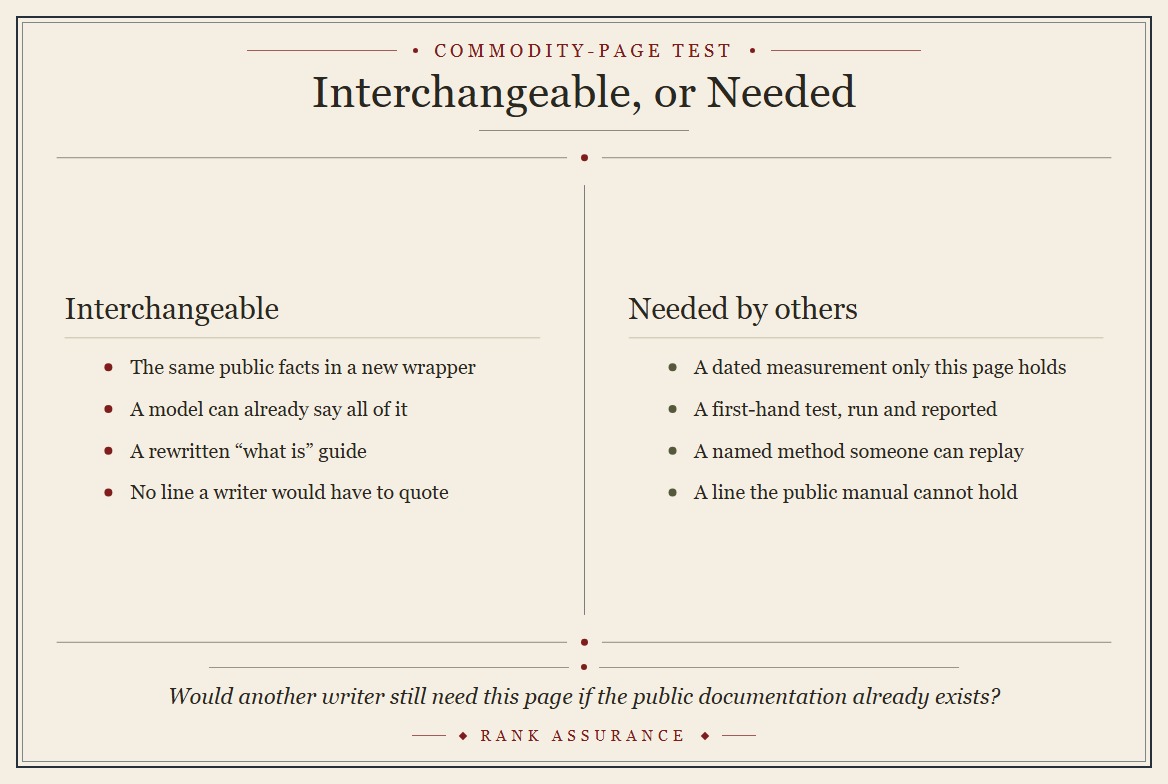
The Commodity-Page Test asks whether a page holds one line — a fact, measurement, or method — that public documentation does not: another writer's reason to cite it.
Reach and read are not the same as cite. A page that repeats the public manual is eligible to be skipped. The official AI-features guide says to create content that is not commodity knowledge. This test is that line, made checkable.
The question this article answers
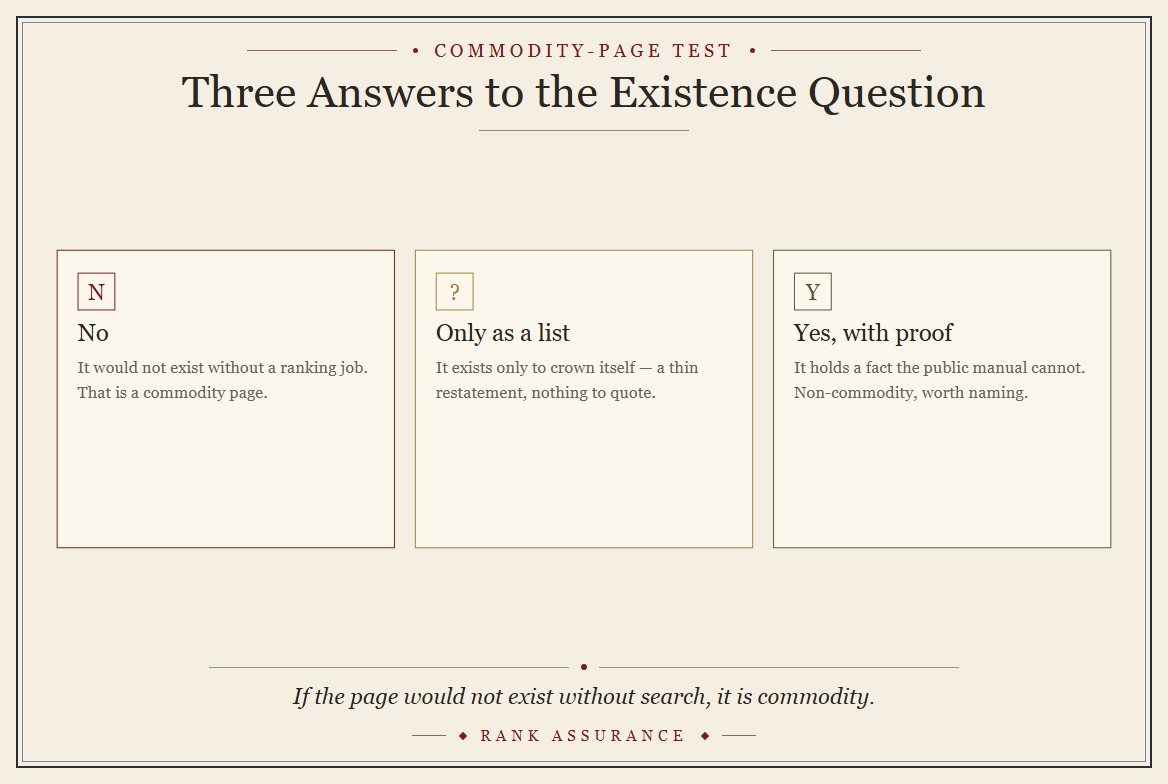
The Would-This-Exist Test asks whether the page would run without a ranking job. This test is narrower: does the page add a fact, method, measurement, or first-hand step that the public sources do not already hold. If it does not, an answer engine can describe the topic without naming you. That is not a penalty. It is a missing citation asset. It is also the “cite” leg of reach → read → cite — Is Your Website Visible to AI? frames that triad, and the Citation-Surface Test holds the cluster’s shared model.
Rank Assurance’s own research pages would fail this test if they only restated Search Central. A named test, a calculator, and a dated official table are the assets. A rewritten “what is SEO” is not.
What is official
Calculator
Commodity-Page Calculator
The One-Line Check
The test has a named procedure. Put the public official document next to your page and highlight the line that does not exist there. Filled in with this cluster’s own subject: the public manual says AI features require the page to be indexed and snippet-eligible. A commodity page repeats that sentence in new words — nothing to highlight. A citable page adds the line the manual cannot hold: what happened when a specific site tried it, on a date, with the before and after. The highlight is the citation asset; everything else on the page is packaging.
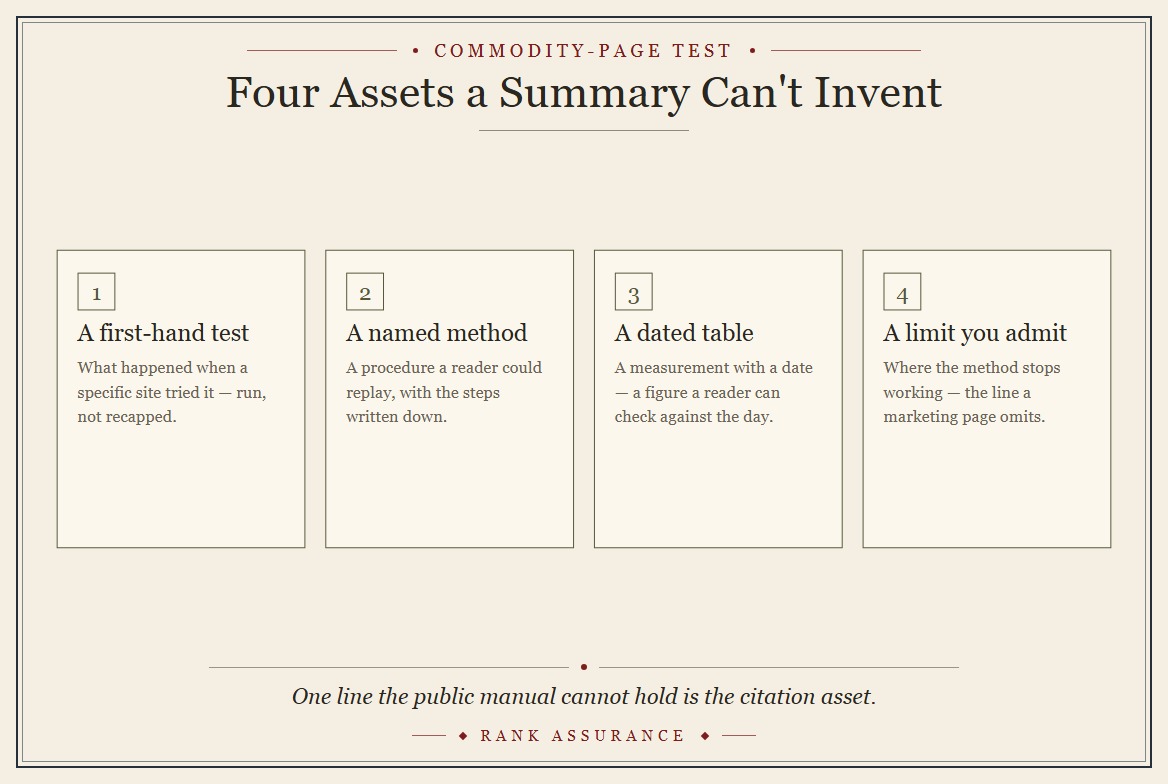
The four assets that survive the check, in Google’s own non-commodity terms: a dated measurement, a named method, a first-hand test, an admitted limit. One is enough — the unit is the highlightable line, not a word count. The AI Answer report records the number this test predicts: how often engines cite a URL when answering its category.
Official-path next step
- Run the One-Line Check: official document beside your page, highlighter in hand.
- If you cannot highlight one line, the page is commodity — rewrite it only if you own a fact to put in it.
- Contrast the URL against the pages the answer already names: what do they hold — a figure, a method, a dated table — that this page does not?
Questions
Can a commodity page still rank in classic Search?
Sometimes, for low-competition queries. That is not a reason an answer engine must name you. The quality systems’ concern is scale; the citation cost is separate and immediate — nothing to quote.
Is this the same as Helpful Content?
Related. Helpful Content is the quality system. This test is the citation reason.
Can pricing be the non-commodity line?
Yes. A page stating real local figures, dated, holds something no public manual does — information a reader can check. Publish field prices as facts with dates; they are the article’s information, not a lever.