
The Local-Citation Test.
A Map-Pack Rank Is Not an AI Overview Citation on the Same Query
The Local-Citation Test checks one local query on two surfaces: did the map pack show the business, and did the generated answer name it?
You can hold the map pack for “dentist near me” and still be missing from the overview that answers how long the visit takes. Same city. Same brand. Two objects.
The question this article answers
The Local Pack Test already covers the map unit. This page is only the split: pack visibility versus being named in a generated local or hybrid answer. A transactional query (“tacos nearby”) and an informational one (“how long does a dental exam take near me”) can resolve on different surfaces — which surface actually answered is an observation to make on the live result, not a rule to assume. Classify the query before you rewrite the GBP description.
Eligibility for AI features is still: indexed, snippet-capable, not spam. A current Business Profile helps the local entity. LocalBusiness schema is for rich-result eligibility. It is not an overview on-switch.
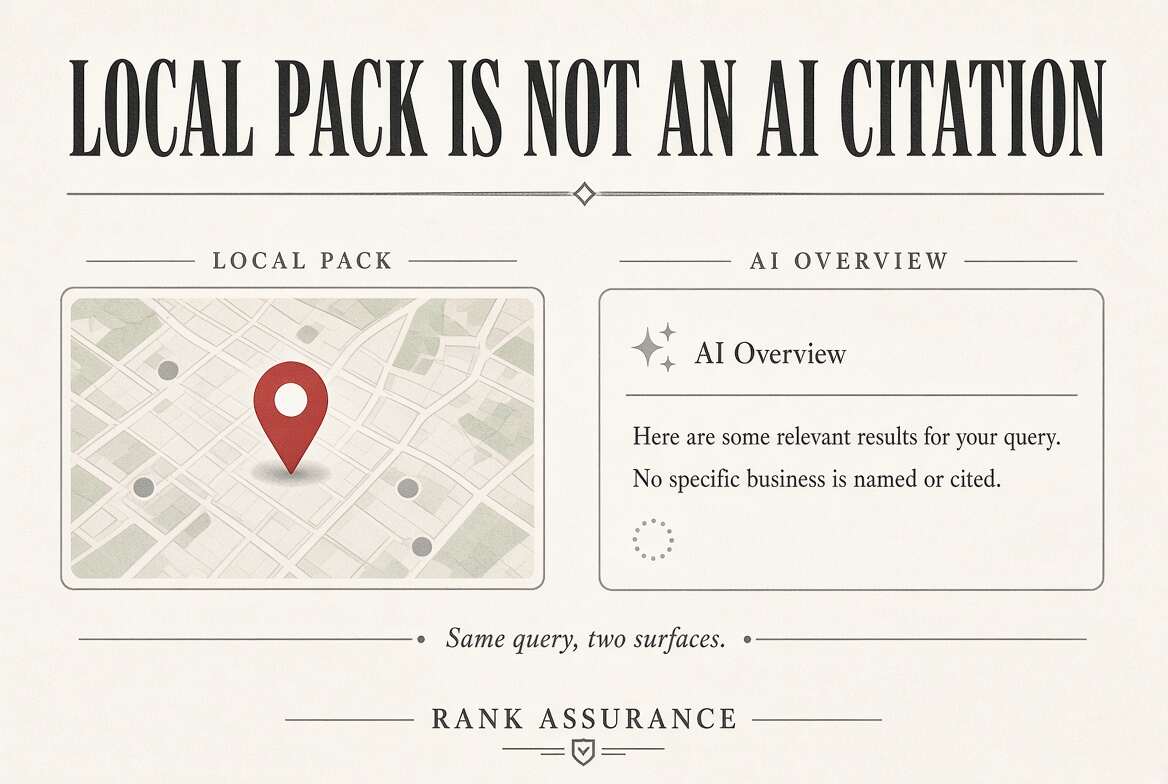
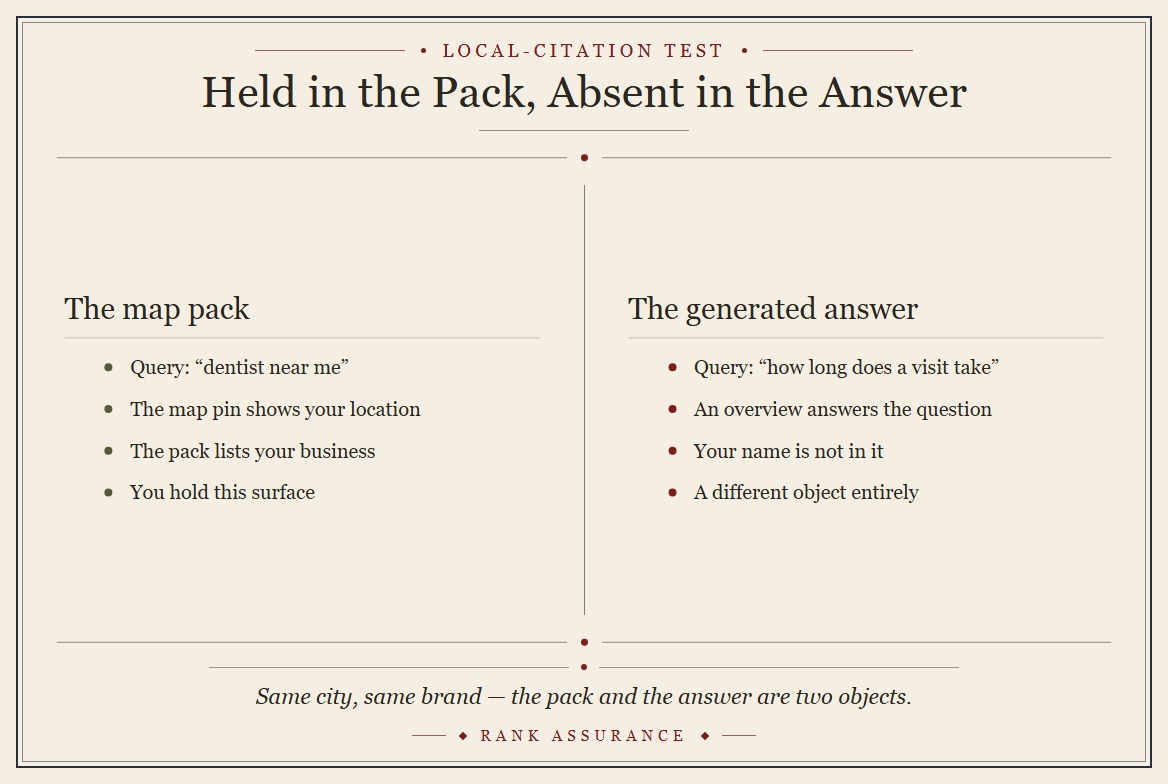
The Split-Screen: One Business, Two Reads
Put the same business through both reads on the same evening and the split becomes concrete. A dental practice holds the pack’s top three for “dentist near me” — category, reviews, and proximity did that, and no page needed to be quoted. The overview answering “how long does a checkup take near me,” on the same screen, cites a national explainer — because nothing on the practice’s site states its own visit length in an extractable sentence. Same city, same brand, two objects: a profile the pack could rank, and a page the answer had no reason to quote. Neither surface malfunctioned.
Measuring the Overlap
The overlap between the two surfaces is a measurement, not a rule — nothing Google has published says pack rank feeds the generated answer. The observation is cheap to run and worth writing down: for one local query, record two booleans — in the pack or not, named in the answer or not. Four cells. Repeat it across the queries that matter to you, dated, and you hold your market’s own overlap table instead of a guess. Measured market runs in the benchmark corpus record both observations side by side, and for local markets the AI Answer report records which businesses each live engine names for the category-and-city prompt.
What is official
The shared official model — same index, foundational SEO, the ignore-list for special AI files — is kept once, dated, at the Citation-Surface Test. The two facts this split rests on: AI-feature eligibility is a page property (indexed, snippet-capable, not spam), while pack presence is fed by the Business Profile — two objects with two feeds, which is why one can pass while the other fails.
Calculator
The Local-Citation Test Calculator
Official-path next step
- Run the same local query on both surfaces and record the four-cell result: in the pack or not, named in the answer or not.
- Pack miss: the Local Pack Test — profile, categories, consistency. That lane never runs through the landing page.
- Answer miss: First-Index and snippet eligibility on the landing URL first, then the Commodity-Page Test — does the page hold one local line worth quoting?
- Read the Generative AI performance report for the local landing pages next to calls and direction requests — two logs, two objects.
Questions
If we rank in Maps, will AI Overviews pick us?
Not automatically. Pack and overview are different surfaces reading different objects — record both before concluding anything.
Is LocalBusiness schema the AI switch?
No. It supports rich results. It does not turn on an overview citation.
Our profile is complete — why does the answer cite a directory instead of our site?
Because the directory’s page held an extractable sentence for the question and yours did not. A complete profile feeds the pack; the answer needed a quotable line on a crawlable URL. That is the Commodity-Page Test’s object, not a profile problem.
Should the location page or the service page be the citation target?
The page that actually holds the answer’s line — the visit length, the recovery time, the local specifics. Pick one URL per question and put the sentence there; a fact spread across two pages is on neither.