
The First-Index Test.
What a New Website Can Control Before It Has Any Authority
The First-Index Test asks whether a new site has cleared the four controls it owns — fetch, query match, uniqueness, and honest discovery — before buying authority.
How many pages does a new website need? There is no official number. A new site controls four things — fetch, query match, uniqueness, honest discovery — and the cold start needs no second domain and no budget. This is the sequence you can finish before anyone talks about page one.
The Question This Article Answers
How many pages does a new website need? There is no official number — no word-count, heading-count, or page-count target. A new site controls four things: fetch, query match, uniqueness, and honest discovery. The First-Index Test asks whether it has cleared those four before anyone spends a dollar on authority.
Industry “new site” recipes still sell a drip: publish a pile of URLs to beat a competitor’s site: count, wait a month, then add owned-network links on a schedule until page one appears in three to four months. None of that is in the Starter Guide. The guide’s first facts are simpler: Google finds pages by crawling what you publish and by following links from pages it already has. Changes can take hours to months. A money page — the page whose job is to win one query that brings customers — earns its place by answering that query, not by arriving with nineteen siblings.
The Four Controls a New Site Owns
These four are the new-site half of the library’s Four Gates: fetchable opens gate one (found); a real query plus a page unique enough to keep opens gate two (matched); honest discovery is how gate three (believed) starts without a scheme. Authority you do not have yet is the Authority Gap Test. Do not skip these four to go buy that gap.
Calculator
First-Index Calculator
One New Site, Walked Through the Controls
A fictional example makes the routing concrete. A residential electrician launches six URLs — home, about, contact, and three service pages — and walks the four controls with observable evidence for each.
The order of repairs is the calculator’s order: fetch first, then the query match, then uniqueness — and only then the work of being found by people.
Help Google Find the Site
The Starter Guide: you usually do not need a special submission ritual beyond publishing the site. Still do the parts you can check.
- Pick one host (
https://www.example.comor the bare domain) and redirect the rest. - Verify the property in Search Console. Submit a sitemap of the URLs you want indexed.
- Inspect the homepage and each money page. Request indexing when Inspection says Google does not have the current version.
- Confirm CSS and JavaScript are not blocked. The page Google sees has to be the page a person sees.
site:example.com is a rough check, not a complete inventory. Search Console is the inventory.
How long until something moves: the Starter Guide says hours to months, and to wait a few weeks before judging a change. That is not a first-page guarantee at day 90.
Pages That Match a Real Query
This is the relevancy gate — the Topic-Fit Test at launch scale. A new site with twenty URLs that do not answer a searchable job is twenty URLs Google has no reason to retrieve.
- Write the query the page is for at the top of the brief. If nobody searches it, it is not a money page.
- Look at who already ranks — including publishers, not only businesses that look like you.
- One job per URL. Internal links between related jobs. Descriptive titles. The Starter Guide still wants a clear
<title>and a snippet the page actually supports.
If the business is local, claim the Business Profile in the same week. The pack is a different surface — Local Pack Test.
There Is No Official Page-Count Target
Matching a competitor’s indexed-page count is not a ranking system. The Starter Guide says there is no magical content length. Thin templates published to inflate site: can become scaled content. Publish the pages that have a job. Add the next page when it has a job. Freshness is not “one post every five days because the calendar said so.” Freshness is a useful page that did not exist last month. A publishing calendar is a different object — the Content-Quota Test.
Promote the Site Without a Scheme
The Starter Guide’s promotion list is ordinary: tell people, use the channels your customers already use, do not over-promote in a way that looks like manipulation. That is the Earned-Mention Test on a site that does not have mentions yet.
A calendar of follow links from hosts you control is not promotion. It is the Sister-Site Test failing on week four.
site: count, schedule owned-network links every four days, or treat “page one in 90 days” as a plan.What the Starter Guide Says to Stop Obsessing Over
| Myth | Official Line (10 Dec 2025) |
|---|---|
| Meta keywords | Google Search does not use the keywords meta tag. |
| Keyword stuffing | Against the spam policies. |
| Keywords in the domain | Low impact. Choose the name for the business. |
| Magic word count | None. Write what the reader needs. |
| Subdomain vs folder | A business choice, not an SEO law. |
| Duplicate-content “penalty” | No manual action for hosting the same piece on two of your URLs. Copying other people to manipulate rank is a different problem. |
| Heading count or order | No official ideal. Semantic order helps people. |
| E-E-A-T as an installable factor | “Thinking E-E-A-T is a ranking factor — No, it’s not.” |
A New Site in AI Answers
The fetch control is also the reach control for the AI surface. The crawlers that read pages for answer engines — GPTBot, OAI-SearchBot, ClaudeBot, PerplexityBot — fetch over plain HTTPS the same way Googlebot does, and a page they can read is a page their engines can quote. A new site that never appears in AI answers usually has a first-index problem, not an authority problem: the page could not be fetched, or it answers no question anyone asks. Same controls, different prize — the Citation-Surface Test reads that surface in full.
The Cold Start: No Budget, No Second Domain
“I cannot afford a network” is the wrong sentence. The network is not the product. The cold-start question — what can a site with no budget and no extra domains legitimately do first? — has the same answer as the rest of this page, minus everything that requires operating a second host. A graph you operate is any set of hosts that exists because you point it at your money site — free blogs, satellite sites, mirror domains. The hosting bill does not change what it is.
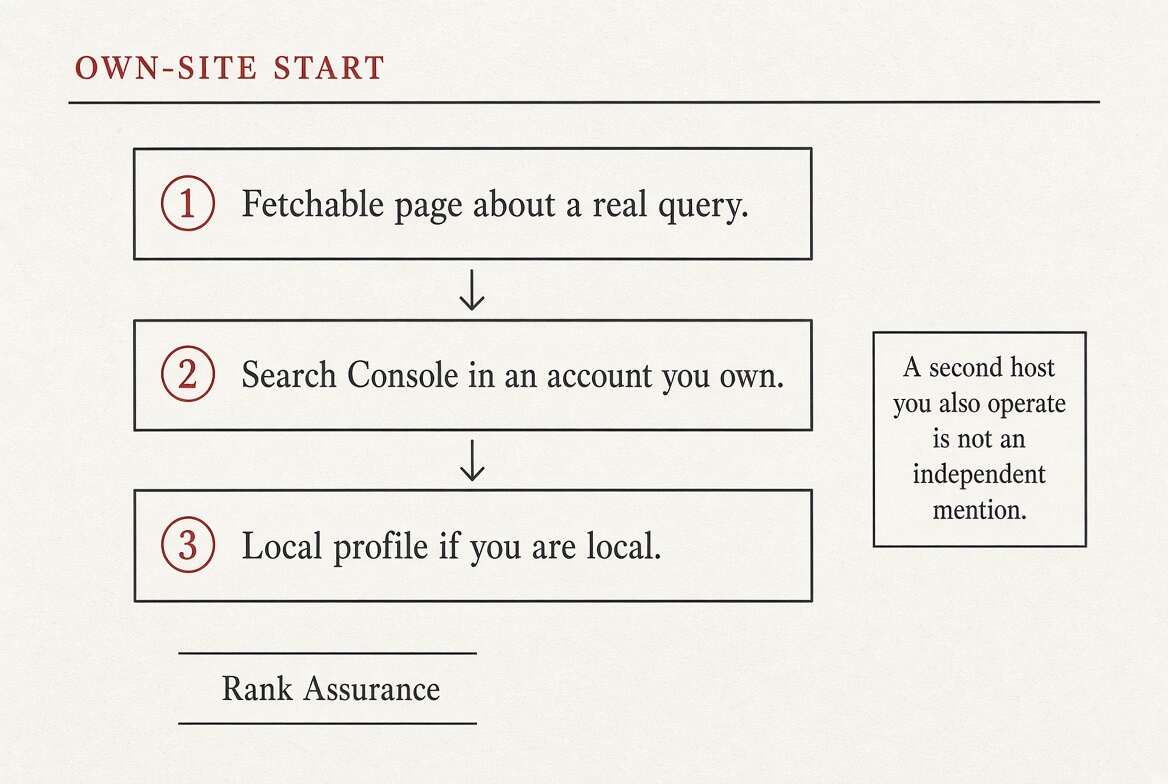
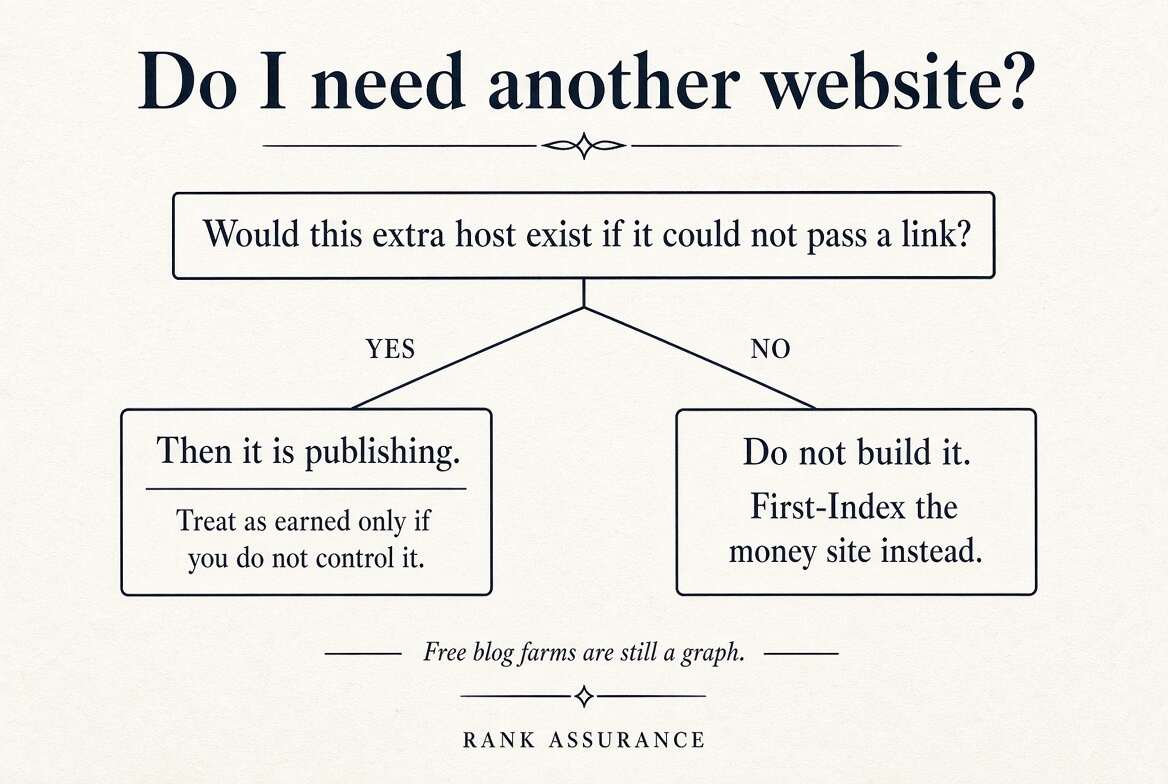
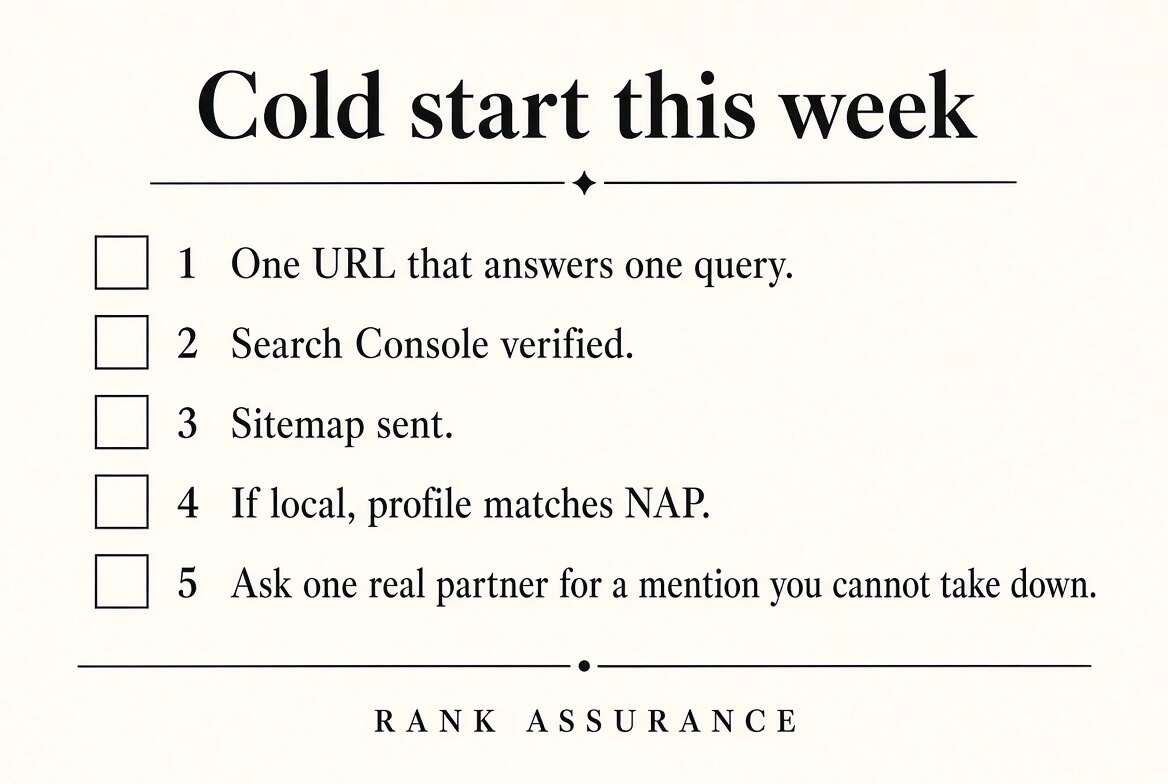
The whole cold start is five checks, none of which requires a second domain:
- One URL that answers one query.
- Search Console verified, in an account you own.
- Sitemap submitted.
- Local profile matching your name, address, and phone — if you are local.
- One real partner asked for a mention you cannot take down.
Creating links primarily to manipulate rank is link spam whether you paid for the host or not. Low-value pages created to place links are the same object. Site reputation abuse covers wrapping someone else’s host around your commercial page. When someone offers a “free backlink package,” run Would-This-Exist; if the ranking later depends on hosts you can take down, that was rent — the Sister-Site and Network-Footprint tests.
Official-Path Next Step
- Week 0: HTTPS, one host, Search Console, sitemap, Inspection on the money URLs.
- Week 0–2: homepage, about, contact, and the two or three service or product pages that match real queries. Claim the Business Profile if you are local.
- Week 2–8: add only pages that have a job. Fix whatever Inspection still rejects.
- Ongoing: earn mentions a stranger would publish. Watch classic Search results and the Generative AI report in Search Console. Run the Authority Gap Test when the page is relevant and still loses.
Questions
How Many Pages Does a New Site Need?
As many as have a job. There is no official target. Twenty thin URLs are worse than five that answer real queries.
Should I Wait 30 Days Before Asking Anyone to Mention Us?
No official wait. Request indexing when the page is ready. Mentions from sites you do not control can start whenever the story is real. Mentions from sites you control are a different test.
Is Duplicate Content a Penalty?
Hosting the same piece on two of your URLs is inefficient, not a manual action. Copying other sites to manipulate rankings is scraped-content spam.
Does Google Sandbox New Domains?
No sandbox appears in official documentation. The Starter Guide’s honest timeline — hours to months — explains most sandbox stories: discovery and evaluation take time, especially on a site with no independent mentions yet.
Should I Buy Backlinks in the First 90 Days?
No. Creating links primarily to manipulate rank is link spam on day one and on day nine hundred. The first-90-days work is this page: fetch, query match, uniqueness, honest discovery.
Do I Need a Blog at Launch?
You need the pages that have a job. A blog earns its place when a post answers a real question a customer asks — not as a freshness ritual. The volume trap is the Content-Quota Test.
How Long From Publish to First Impression?
The Starter Guide says hours to months, and to wait a few weeks before judging a change. There is no promised date, and no honest product can promise one.
Is a Cold Start Slower Than Buying Mentions?
Often. Time to impact is hours to months either way. Speed is not a reason to build a graph you also operate — the scheme risk survives long after the speed advantage fades.
Are Directories Useless?
One accurate listing where customers look is useful. A blast of fifty identical listings is noise. The local surface is the Local Pack Test.
Sources
- Google Search Central, SEO Starter Guide (updated 10 December 2025) — findability, useful content, promotion, myth table.
- Spam policies (updated 28 August 2026) — scaled content; link spam; scraped content; site reputation abuse.
- “Do you need an SEO?” — no first-place guarantee.
- Google Business Profile help — the local surface.
- Qualify outbound links — mark paid follows.
- “The Four Gates” — the library’s frame this page’s controls open.
- “The Authority Gap Test” — what to run once the page is relevant and still loses.
- “The Local Pack Test” — if the query is local.
- “The Citation-Surface Test” — if the result is an overview or an AI answer.