
The Network-Footprint Test.
How to Tell a Real Mention Cluster from a Manufactured Graph
The Network-Footprint Test is an outside-view check that tells independent publishers from one operator's manufactured link graph, using only what a buyer can see.
Sister-Site asks whether you should run extra domains. This page asks whether you already bought a package of them. A manufactured graph can be dressed to look independent. You do not need the operator’s hosting panel to see the pattern. You need the question the Earned-Mention Test already uses: would this page exist if it could not pass a link?
The Question This Article Answers
Industry “footprint” guides exist so a seller can keep a scheme standing. Shared addresses, sequential ranges, identical registration weeks, template farms, footer links on every URL — those are detection clues for a buyer, not a setup list. If a vendor’s pitch is that they know how to avoid footprints, they have already told you the product is a graph they intend to hide.
This page is the buyer’s side of the Sister-Site Test: you do not operate the hosts, you are being sold them. Everything below is visible from the outside — no hosting panel required.
Vendor Lines You Will Hear
“You need more sites.”
A count of hosts one operator controls is still one vote. Scale does not create independence; it usually creates sameness — shared templates, registration weeks, outbound maps, bylines. There is no published “safe portfolio size.” If the plan is “add more sites,” open Sister-Site, not a shopping list.
“We stay out of Search Console so it does not look owned.”
Concealment offered as a feature. The same family: posting on an irregular calendar so a host “looks real,” minimizing the shared outbound map so buyers cannot rhyme it, buying an indexing burst that appears and vanishes. None of it creates an independent publisher.
“These are Tier 2 and Tier 3 links.”
The same graph drawn as a pyramid: links created to prop other links. Official name: link spam. Natural mentions of a useful page are not purchased in layers. If the row is on a menu, it is the Paid-Placement Test; if the inventory is comments, profiles, and bursts, it is the Retired-Tactic Test.
“It is a portfolio, not a network — the sites do not even link to each other.”
Relabeling the set does not change the job of the hosts. Not interlinking is a concealment choice, not a business model; one owner is still one owner. And if the operator can hide the graph from you, they can also take the mentions down — read the contract with the Contract-Term Test before you pay for that switch.
“We mix strong and weak hosts so the graph looks natural.”
Mixing high, low, and brand-new vendor scores is still one operator. A vendor’s domain score is not Google — the Domain-Score Test is that argument in full — and a subdomain on a famous host is not that host’s vote. The test is purpose, not a score mix.
“We cannot show you examples — they would get copied.”
A set that cannot survive being seen is already a footprint. So is forced variation — different themes, excerpt against full post, staggered calendars — which is concealment wearing a design budget. Blocking ordinary crawlers so a vendor tool cannot see the host is the same tell.
Figure 1 — Real Mention vs Manufactured Host
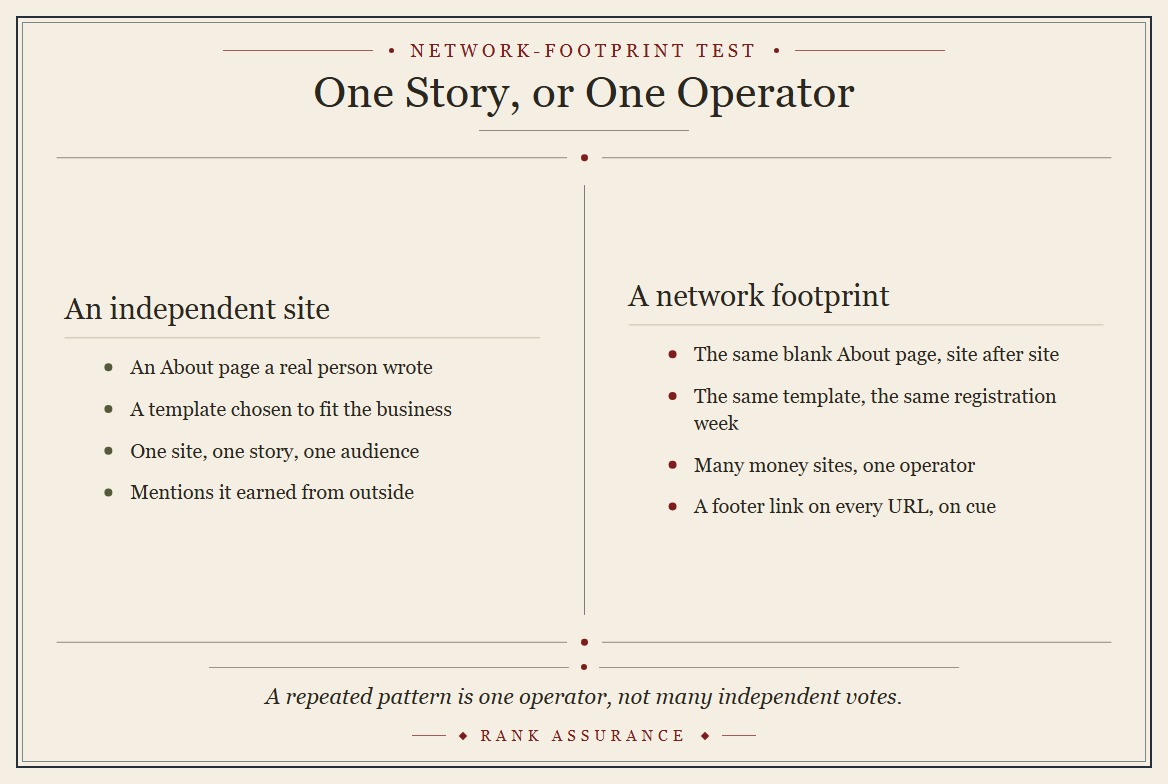
A real publisher survives the subtraction test: take away the link they gave you and the page still has a reason to exist, an audience, and an author. A manufactured host is the link plus filler.
Figure 2 — the Extra-Domain Question
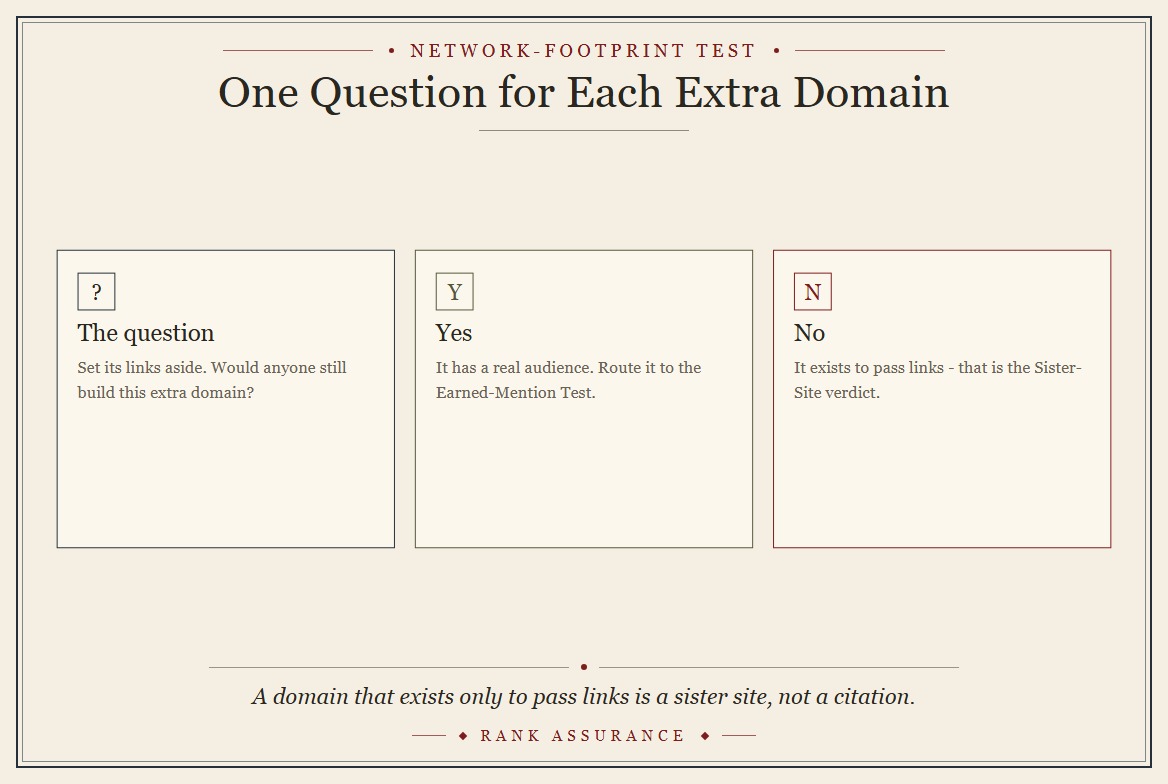
The question does not change because someone else operates the set. Would-This-Exist, asked of a host in the package, is the fastest single check a buyer has.
Figure 3 — What You Can See from the Outside
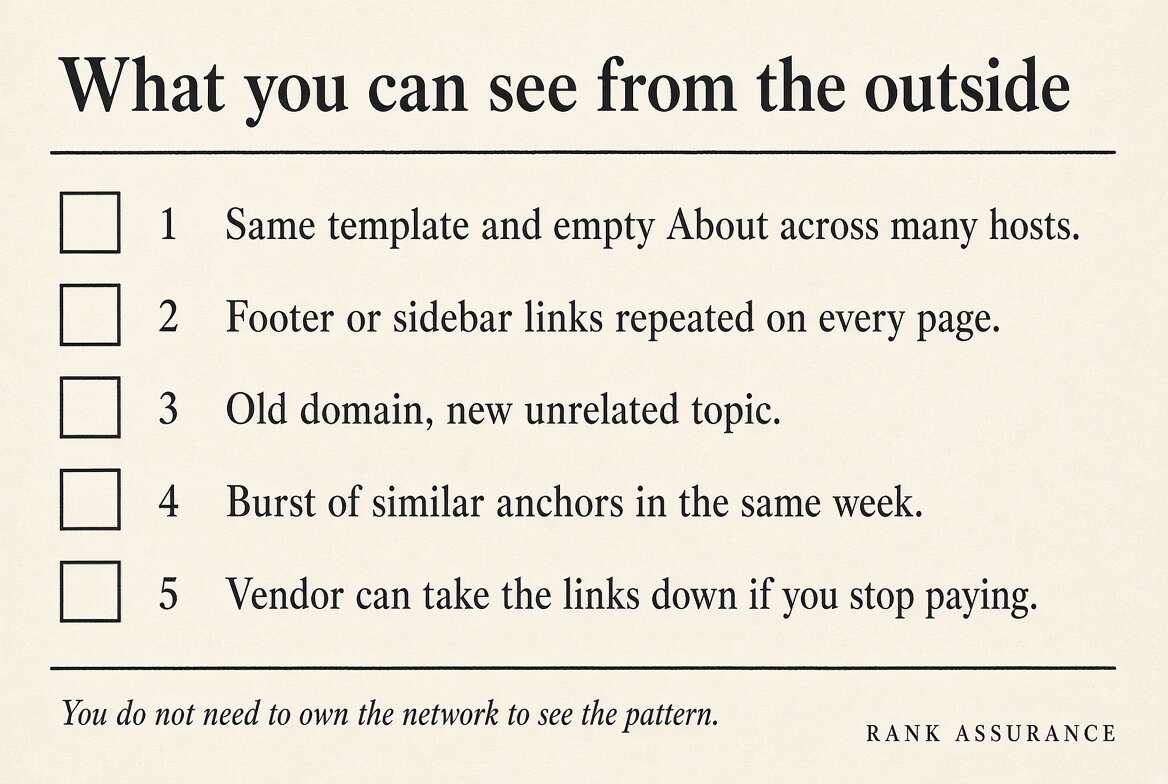
The checklist, in text. Open two or three of the hosts a vendor names and read down the left column. Two matches are enough to stop buying.
| What you can see | What it means |
|---|---|
| Empty, identical About pages | No publisher behind the host — one operator’s template. |
| Same theme, layout, and footer bones | One build, many names. |
| Money links in footers or sidebars | A named link-spam example, not an editorial mention. |
| The same outbound map on every host | The clients are the content. |
| No search presence for its own name | No audience. A publication nobody reads is inventory. |
| Bylines that repeat, or none at all | Nobody owns the words. |
| Launch dates in a tight window | A batch, not independent histories. |
| A take-down clause in the offer | Rented votes. Earned mentions have no off switch. |
Footer and template links distributed across many sites are already a named example in the spam policies. An expired domain given a new unrelated job is expired-domain abuse. A burst of similar keyword anchors in placed articles is the guest-post example on the same page.
A Worked Refusal
A composite case, for illustration. A vendor offers “placements on our private portfolio” and, under pressure, names three hosts. The first: an About page that says nothing a template did not ship with, and a sidebar of commercial links pointing at businesses in four unrelated industries. The second: a different color scheme on the same bones — same footer structure, same category list, same three-posts-a-month rhythm, one mid-article commercial anchor each. That is two hosts and two checklist rows — empty About, same outbound pattern — before the third tab loads. The buyer stops there, which is the point: the checklist is not a forensic audit, it is permission to stop early.
The Contract Tells
The paperwork confesses what the pitch conceals. Before paying, read for three clauses:
- The take-down clause — links are removed if you cancel. Rented votes, by the vendor’s own hand.
- Tier language — “Tier 2 / Tier 3 support links.” A pyramid of links propping links, named link spam.
- The no-show clause — placements cannot be listed, previewed, or named. A set that cannot be seen is a set that is hiding.
Any one of these belongs in the Contract-Term Test before a signature.
The AI-Answer Angle
Answer engines cite pages readers use — pages that can be retrieved, read, and attributed. A network no reader visits can never become a cited source, however its vendor scores are mixed. Money spent on a hidden graph is money spent on a surface AI answers cannot even see; what they can see is the public record around a name, which is the territory of the AI Answer explainer.
Calculator
Network-Footprint Calculator
Official Names
What This Page Will Not Teach
How to pick addresses. How to stagger registration. How to write filler so a host “looks real.” How to drip mentions so the calendar looks less planned. Those are construction steps. They do not make the graph independent.
Official-Path Next Step
- Open three of the hosts they named. If two fail the Figure 3 checklist, stop buying.
- If the ranking depends on links they can pull, that result is rent. Contract-Term Test.
- Keep only mentions that would exist for a person. Earned-Mention Test.
- If you already operate extra domains yourself, Sister-Site — do not add another.
- If links you already bought drew an unnatural-links action, the cleanup order — removal, documentation, disavow of leftovers, review — lives in the Suppression Type Test.
Questions
Is it different if the sites do not link to each other — a portfolio instead of a network?
The label does not matter. The job of the hosts does. If they exist to pass credit to you, that is the Sister-Site Test.
Footer links are easier to maintain. Are they just a quality issue?
Widely distributed footer and template links are a named spam example. They are not a maintenance preference.
What should I ask a link vendor before paying?
Three questions: name live placements I can open; show me the page that would keep existing if our link came out; and what happens to the links if I cancel. A vendor with real publishers answers all three without a pause. A vendor with a graph answers none of them.
Are niche edits and link insertions the same object?
Usually. A paid paragraph slotted into an existing page so it can carry a follow anchor is purchased ranking credit — the advertorial example with the publish date removed. The question is unchanged: would that page mention you if nobody paid?
I already bought network links — do I disavow?
Not as the first step. Stop the campaign, get what you control removed or marked, and only then handle leftovers — the full order, including when a disavow is actually official, is the Suppression Type Test cleanup.
Do AI engines count backlinks at all?
What answer engines demonstrably use is retrieval and attribution — pages they can read and cite, and the record around a name. A hidden vote graph offers neither a citable page nor a public record, so whatever link analysis feeds their retrieval, the network contributes nothing you can be named for.
Sources
- Spam policies (updated August 2026) — link spam; footer/template links; expired-domain abuse; low-value pages created to manipulate linking.
- Qualify outbound links — sponsored / nofollow for paid placements.
- Sister-Site Test · Earned-Mention Test · Would-This-Exist Test · Contract-Term Test.