
The Contract-Term Test.
When a Long SEO Agreement Protects the Work — and When It Only Protects the Invoice
The Contract-Term Test reads an SEO agreement for three things: visible work, a real exit, and who owns Search Console when you leave.
A twelve-month term is not automatically a scam. A twelve-month lock whose only product is first place is. This page is the buyer test for the paper: can you see the work, can you leave when it stops, and do you still own Search Console if you walk.
The Question This Article Answers
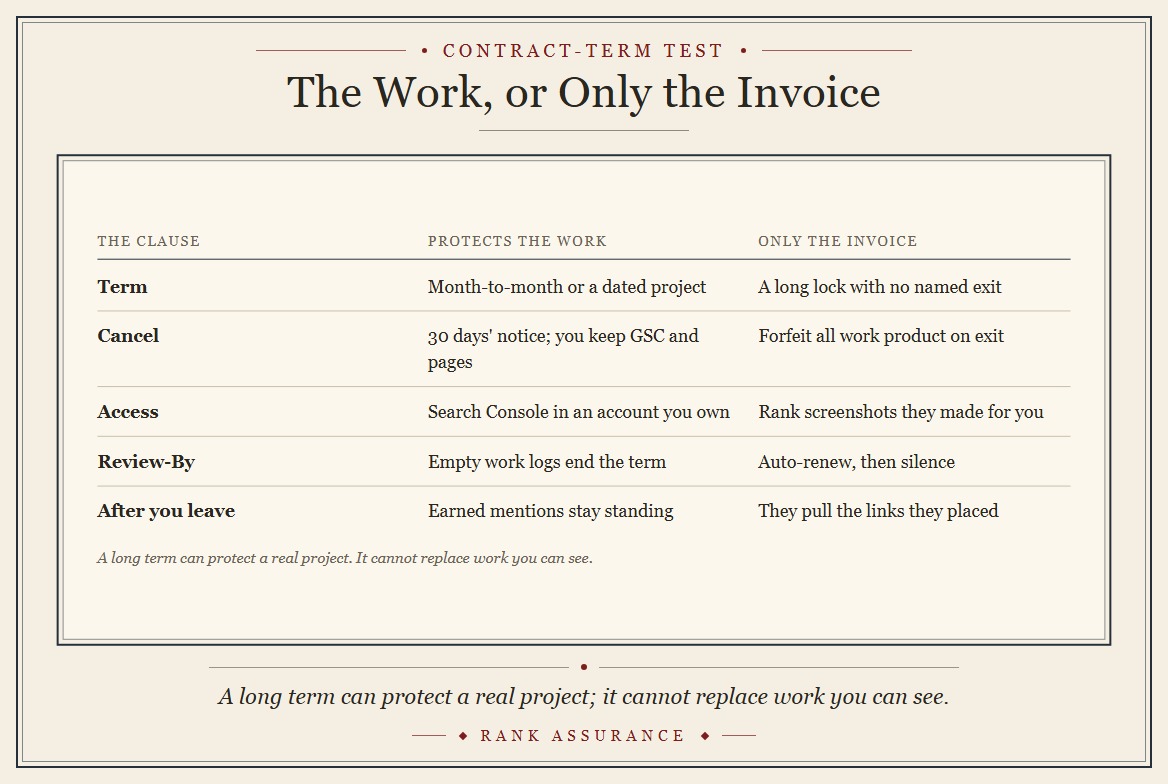
Industry talk treats every long contract as a trap and every cancel-anytime month as virtue. Neither is a ranking system. A migration, a rebuild, or a defined set of pages can have a start and an end. An open ranking subscription that you cannot exit is a lock on the card, not a plan for the site.
The Five Clauses
Contracts now bundle “AI visibility” deliverables. No sixth clause is needed — the same five apply — but clause 2 grows a line: data portability. The dated engine runs, the query lists, and the Search Console exports leave with you. AI evidence that lives only in the vendor’s dashboard is a rank screenshot with a newer font.
Calculator
Contract-Term Calculator
How Long Is Honest
The Starter Guide: a change can take hours to months. Wait weeks before judging it. That is not a twelve-month lock, and it is not a thirty-day first-place SLA.
- Index, title, and profile fixes can show in weeks. That is the First-Index Test.
- A competitive head term is not a thirty-day product. “Give it a year” is only fair if each quarter has a Work-Log.
- “If you are not #1 they are wasting your money” skips wrong query, wrong surface, and a page that is not fetched. Run the Ranking-Problem Test first.
| Work type | Honest term shape |
|---|---|
| Index, title, profile fixes | Weeks — a bounded project or one or two months, then done |
| Migration or rebuild | A dated project with an end and a deliverable you keep |
| Competitive head term | Quarters — each with a work log and a review date |
| Ongoing program | Month-to-month, or a year with a 30-day out and a Review-By clause |
No one can guarantee first place. A term that treats first place as the deliverable fails the Pitch Test and this one.
One Clause, Two Ways
The Red-Flag Version — a Composed Example
“Client commits to a twelve (12) month term, auto-renewing annually. Early termination forfeits all work product, and Provider may remove placements established during the engagement.”
The Honest Rewrite
“Twelve-month scope, cancellable with 30 days’ written notice. Client retains Search Console, all content produced, and all earned placements. At the 90-day review, an empty work log ends the term.”
Both are twelve months. The first sells retention; the second sells a project. “May remove placements established during the engagement” is the kill switch printed politely — clause 5 failing in advance, in writing.
What Happens If You Leave
You should keep the pages they wrote, the Search Console history, and any mention a real publication actually published. You should not keep a ranking that only existed because they pointed hosts they own at you. If leaving means the graph comes down, you were paying rent on authority — not buying work.
Logo walls and “we work with famous brands” are the Vendor Claim Test. Some clients allow a case study. Many do not. The test is a property you can inspect, not whether a logo exists. Reviews can be bought. We do not have a dataset that says half of them are fake, so that number stays off this page.
Official-Path Next Step
- Put GSC in an account you own before the first invoice.
- Write the cancel path and the Review-By date into the scope.
- Month one: Work-Log. Month three: Retainer Fit. If either fails, the term should let you leave.
Questions
Are 12-Month SEO Contracts Always a Scam?
No. A named-scope year with a 30-day out and a work log can be honest. An auto-renew lock with no GSC and a first-place promise is the problem.
They Said Real Clients Refuse to Be Listed. True?
Sometimes true. That is not a substitute for one property with dates that you can inspect.
Who Owns the Content They Wrote If We Split?
Whatever the paper says — so make it say you. Work-for-hire language putting pages, copy, and reports in your name on payment is standard. A vendor who keeps the copyright to your own service pages holds a quieter version of the link kill switch.
What Is a Reasonable Notice Period?
Thirty days is the working norm for a retainer — long enough for a handoff, short enough that the exit is real. Ninety days on a month-to-month program is retention wearing a professionalism costume.
Is Auto-Renewal Normal or a Trap?
Common, and fine only with a real notice window and a reminder obligation. Auto-renew plus a long term plus silence is how a one-year decision becomes a three-year one.
Sources
- “Do you need an SEO?” (updated 5 June 2026) — no #1 guarantee; secrecy about methods is a warning.
- SEO Starter Guide — hours to months; wait weeks before judging a change.
- Retainer Fit Test · Work-Log Test · Pricing-Model Test.