
The Pricing-Model Test.
How to Pay for SEO Without Buying a Ranking You Cannot Contract
The Pricing-Model Test asks one question of any SEO invoice — project, hourly, retainer, or performance: what work you can see does this payment attach to?
The invoice is not a ranking system. Project, hourly, monthly, and “pay when we hit #1” are just shapes. The only honest shape is one that attaches money to work you can see. Google does not sell first place. A contract that pretends it does fails this test before the first payment.
The Question This Article Answers
Pricing posts list hourly rates and retainer bands. Those are market commentary. They are not a Google product. The useful question is narrower: what is this payment attached to?
The Four Shapes
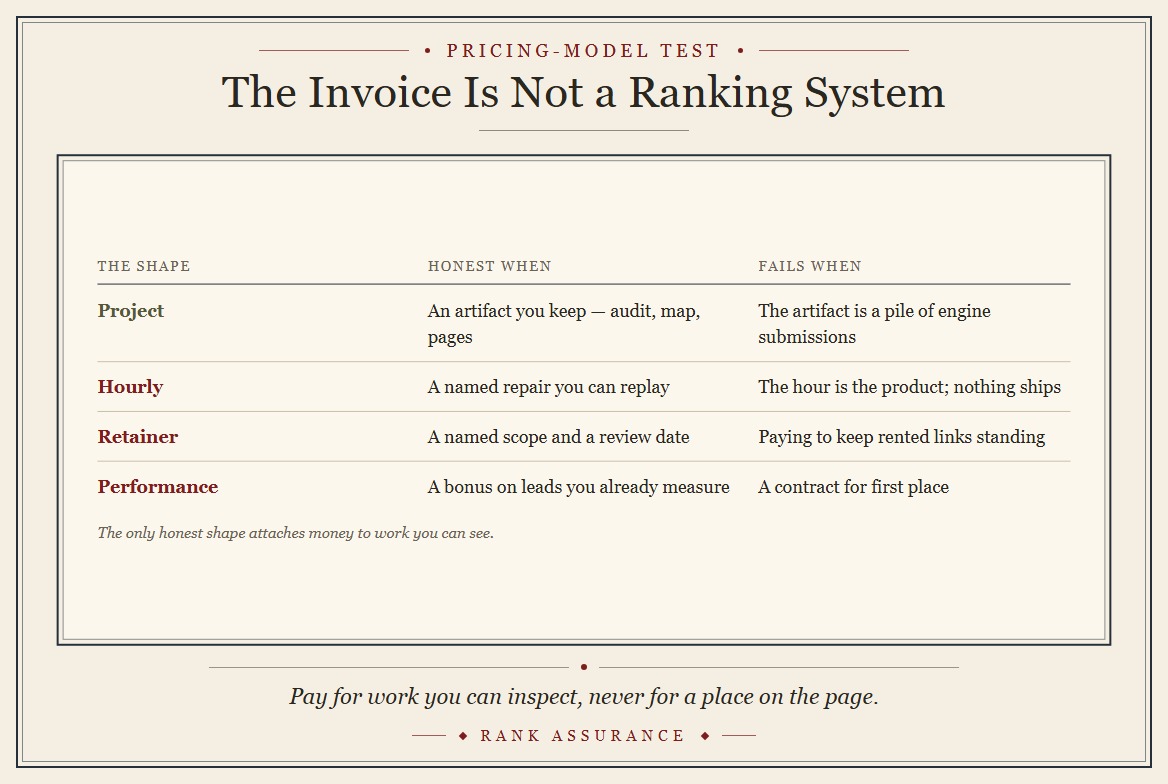
| Shape | Must be written down | Fails when |
|---|---|---|
| Project | The artifact, the URLs, the date it is yours | The artifact is “we submitted you to 500 engines” |
| Hourly | Which hour, which URL, which change | The hour is the product and nothing shipped |
| Retainer | This month’s work list + stop rule | You pay to “keep the links up” on hosts they control |
| Performance | A business metric you can audit | The metric is “#1 on Google” |
The 2026 labels do not add a fifth shape. An “AI-visibility subscription” or a “GEO retainer” is a retainer, and the same question applies: what named work does this month’s payment attach to, and where do you inspect it? “Pay when the AI recommends you” is the performance shape reborn, attached to a placement no engine sells — the AI twin of the pay-for-#1 clause. Dated engine runs you can re-execute are the only inspectable artifact that work can produce; the Generative-Impression Test covers what those runs mean.
The Blank, Filled In Once per Shape
Write one sentence before signing anything: this payment buys ____. Filled honestly, it reads like this:
- Project: this payment buys a technical audit as a document we keep, with the URL list and the date it becomes ours.
- Hourly: this payment buys eight named hours — the redirect-map repair on these URLs, replayable in the log.
- Retainer: this payment buys this month’s written work list — two pages, one earned-mention effort, the Search Console review at month end.
- Performance: this payment buys a base scope, plus a bonus on qualified leads counted in a system we own.
If the blank can only be filled with a position — “this payment buys page one,” “this payment buys being recommended by the AI” — the shape was never the problem. The deliverable was.
Calculator
Invoice Calculator
What Cannot Be on the Invoice
Updated 5 June 2026: no one can guarantee a #1 ranking. Advertising with Google does not buy organic placement. You should never have to link to the SEO.
Published market rates spread wide — and the spread is market commentary, not a quality score. A cheap invoice can still ship named work. An expensive invoice can still buy a scheme. That is why this page is not a rate card: the shape and the deliverable are checkable; “the right price” is not a fact any document can certify.
Links Are Not a SKU
“Lifetime links” and “monthly link maintenance” are both inventory talk. An earned mention is not a product you buy once or rent. A purchased follow that passes ranking credit is the spam-policy example unless it is marked sponsored. See the Earned-Mention Test, the Paid-Placement Test, and the Sister-Site Test — and the Link-Quality Test for what a mention is worth at all.
One-time is the right shape for diagnosis. Recurring is the right shape for work that still has a job next month. Neither shape makes a ranking a deliverable.
Official-Path Next Step
- Write one sentence: this payment buys _____.
- If the blank is a position, refuse. If it is work, put the work in the scope.
- Run the Pitch Test on the promise, the Work-Log Test on month one, and Retainer Fit on month three.
Questions
What Does SEO Cost for a Small Business?
Published rates spread from very small to very large, by market, scope, and model — and the spread is commentary, not a quality score. The safer question is the one this page runs: what does this particular payment attach to, and where do you inspect it?
Is Cheap SEO Ever Safe?
Sometimes. A small invoice that ships named work — a fixed title set, a repaired sitemap — is honest. A small invoice whose product is “submitted to 500 engines” or a silent link pack costs more than it charges.
Should Setup Fees Be Separate from the Retainer?
Separation is fine and often honest — diagnosis is a project, the program is a retainer. The test does not change: each fee attaches to named work, and the setup deliverable is a file you keep.
Is Hourly Always a Scam?
No. Hourly consulting with a log is honest. Hourly “SEO” with no URL list is how time hides the absence of work.
Is a Revenue-Share Honest?
It can be a business deal if you can audit the revenue. It is not a ranking product. Do not let it replace a work list.
Sources
- “Do you need an SEO?” (updated 5 June 2026) — no #1 guarantee; ads do not buy organic.
- Spam policies — buying ranking-credit links.
- Starter Guide — hours to months before you judge a change.
- Retainer Fit Test · Work-Log Test · Contract-Term Test.