
The Retainer Fit Test.
When a Monthly SEO Invoice Is Working — and When It Isn’t
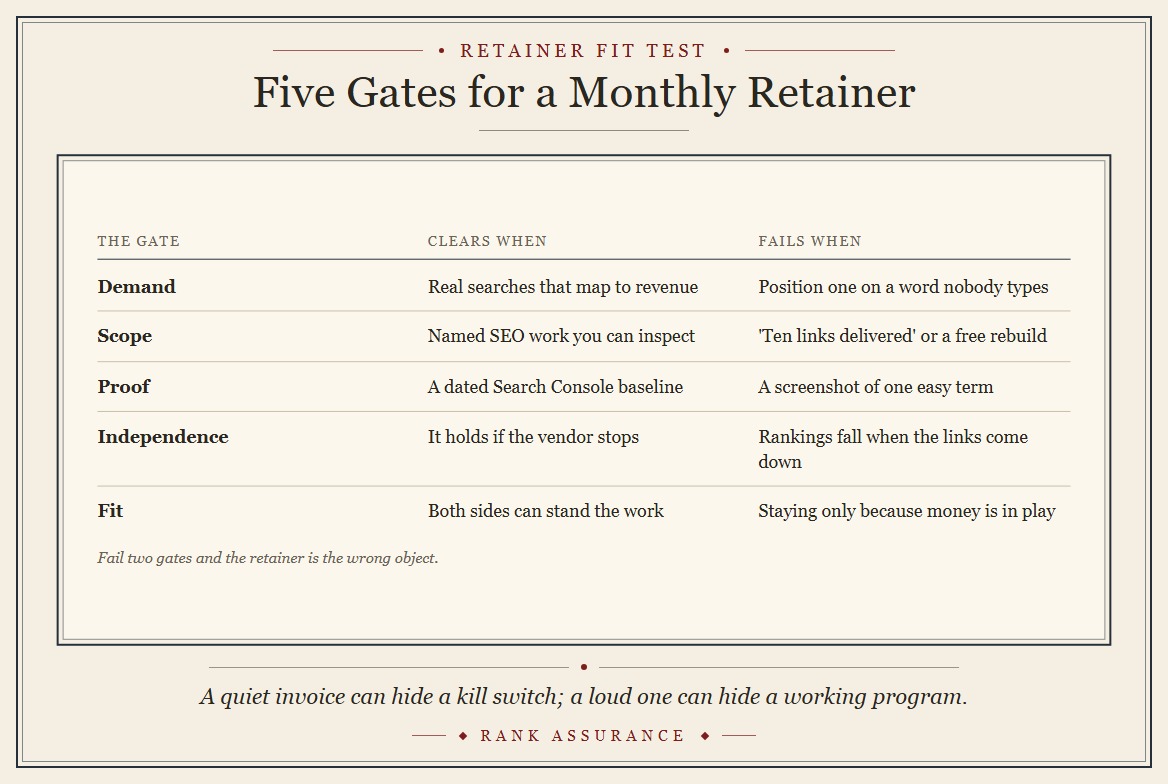
The Retainer Fit Test runs five gates — demand, scope, proof, independence, fit — over a monthly SEO engagement, from both sides of the invoice.
A quiet invoice is not proof the work is working. A loud invoice is not proof it isn’t. This article gives both sides of an SEO engagement five gates they can run against Search Console and a written scope — before anyone promises page one, buys a link package, or fires the other person in anger.
The Question This Article Answers
Someone is paying every month. Someone else is sending a report. One side thinks the relationship is perfect because nobody calls. The other side thinks it is failing because not every keyword is sitting at position one. Both can be wrong at the same time.
Google’s own hiring page is blunt: a useful SEO can save time and improve visibility, and a bad one can damage the site and the reputation. Guarantees of first place are a reason to walk away. Read-only Search Console is how an audit starts. Those are not agency folklore. They are the official path this test follows.
The Five Gates
Fail two or more gates and the retainer is the wrong object, even if someone is “at the top” of a word nobody types.
Calculator
Retainer Fit Calculator
Demand: Ranking a Word Nobody Searches
What it is. A kickoff that skips search volume and business value, then celebrates position one on a phrase the market does not type — or on a phrase so competitive that a two-month retainer was never going to close the authority gap. The measured sample reports show the pattern often enough to treat it as a default suspicion: winning positions parked on queries with no one behind them.
Industry talk treats “they picked the wrong keywords” as a client flaw. Sometimes the buyer did pick a vanity term. Sometimes the vendor let them, because an easy win photographs well. Either way the gate failed before any link was built.
How it hurts. Gate 2 looks green while revenue does not move. The buyer thinks SEO does not work. The vendor thinks the buyer is ungrateful. Both are arguing about the wrong query.
Official-path fix. Write the query list into the scope: demand, current position, competitor URLs, and the conversion the query is supposed to produce. Revisit the list when the business changes. Do not treat “all keywords at the top immediately” as a deliverable. Google’s hiring page tells you to walk away from a first-place guarantee.
What not to do. Do not use a no-competition phrase as proof the method will scale to the head term. That is competition math, not a case study.
Scope: SEO, a Rebuild, or a Link Package
Three different jobs get sold as “SEO.” Only one belongs on this invoice without a separate contract.
The “cable company” relationship — pay, never speak, stay at the top — is often advertised as the ideal. For the buyer it is a warning. If you cannot name what changed on your site this month, you cannot tell a program from a scheme. Google’s hiring questions include: how will we communicate, and will you share every change and the reason for it?
Proof: One Easy Term Is Not a Program
A useful report is boring. Queries, dates, Search Console clicks and impressions, the pages that moved, the work that was shipped. A useful kickoff is the same data, taken before anyone touches the site.
The pitch-deck success story — “page five to the top, traffic times ten, two months,” told about someone else’s site — is a story, not a planning default. It survives every retelling because nobody can open it. Competitive queries have an authority gap. Core updates re-rank quality. Manual actions exist. None of that fits in a guaranteed calendar.
Official-path fix. Grant read access to Search Console for the audit. Do not grant write access until you have hired. An audit should estimate improvement and effort. If the estimate is “first place,” find someone else. That sentence is Google’s.
Independence: What Happens If the Vendor Stops
Ask this out loud: if we stop paying, what happens to the rankings in 30 days?
If the honest answer is “they fall because we will take the links down,” you are not buying SEO. You are renting a graph the vendor owns. That is the hostage model. It also sits inside Google’s link-spam policy: buying or selling links for ranking purposes. The cleanup, if you already have those links, is in the Sister-Site Test and the Suppression Type Test — not a slower drip and not a threat.
Earned editorial mentions, partners, and citations you do not control behave differently. They can still fade. They do not have a kill switch on someone else’s invoice.
Run the same question on the retainer’s newest bundle: “AI presence.” If the evidence for it lives in a dashboard the vendor controls — a prompt panel only they can run, a score only they can see — it has the same kill switch as a rented link graph: cancel, and the “presence” is unverifiable the next morning. Demand dated engine runs you can re-execute yourself — the engine, the question, the date, the answer text. Independence is the gate, whatever the surface.
Fit: Money Does Not Cancel a Bad Contract
A large monthly number does not entitle the buyer to work that was never scoped. It also does not oblige the vendor to keep a relationship that is all grievance and no review. Both sides get to end a bad fit. The professional version is a 30-day notice against the written scope, a handoff of Search Console and the query list, and no ranking-hostage clause.
Relying on one oversized account is an operations risk for the vendor. For the buyer it is a different risk: the program dies when that shop has a bad quarter. Diversify the work, not just the invoice.
What Google Tells You to Ask Before You Hire
“Do you need an SEO?” is the primary document. The questions that still matter in 2026:
- Examples of previous work, and whether they follow Search Essentials.
- What results they expect, on what timeline, and how they will measure them.
- How you will communicate, and whether every change on the site is explained.
- Whether they are interested in the business — what is unique, who the customer is, how search is supposed to help.
- References you can actually call.
- An audit on read-only Search Console, with no first-place guarantee.
A vendor who will not sit through those questions is not a “best client” problem. They failed the interview.
The 90-Day Review, Written Out
This article prescribes the review three times. This is the agenda — four items, one hour, both sides in the room:
The Agenda
1. Queries against the baseline: open Search Console, contracted list, kickoff range beside the last 90 days.
2. Work log against the scope: every month has a dated list, or it does not.
3. The independence question, asked out loud: what happens in 30 days if we stop?
4. Fit, both directions: can each side stand the next quarter — and if not, what does the handoff look like?
Keep the answers with the contract. The next review starts by reading the last one.
Official-Path Next Step
- Write or reopen the scope. Name the queries, the work, the access, and the 90-day review.
- Put Search Console in the middle. Baseline first.
- Kill ranking-credit packages. Keep paid mentions only if they are qualified.
- Run the Authority Gap Test on the money URLs. If the gap is large, more articles and more rented links are usually the wrong next project.
- If the relationship fails fit and cannot be rewritten, end it. Hand off the property. Do not hold the graph hostage.
Questions
They Got Us to Number One on One Phrase in Two Months. Is the Retainer Working?
Only if that phrase has demand, maps to revenue, and was not the easy leftover in the set. Check the rest of the contracted queries in Search Console.
What Results Should I Expect After Six Months?
There is no universal number, and anyone who quotes one is selling. Progress is a function of the authority gap on your queries: index and match fixes can show in weeks, competitive head terms move in quarters. What you can expect at any size of gap is a work log and a baseline comparison that both open.
They Want Write Access to Search Console Before We Have Signed. Normal?
Google’s hiring page says read access for the audit. Write access comes after you hire.
Should I Pause SEO in the Slow Season?
Pausing spend is a business call; just price the restart honestly. Earned work — pages, mentions, fixes — keeps standing while you pause. A program that threatens to collapse the month you pause was failing the independence gate all along.
How Do I Switch Agencies Without Losing Rankings?
Keep what was always yours: Search Console, the query list, the pages, the earned mentions. Take the handoff in writing. The only rankings you can lose in a switch are the rented ones — and if the old vendor threatens exactly that, read the next answer.
They Say the Rankings Will Drop If We Stop Paying. True?
That is a hostage graph. Treat it as a Sister-Site / link-spam problem, not as proof the work was valuable.
Is It Reasonable to Fire a Vendor Who Is “Getting Results” If the Relationship Is Miserable?
Yes, if the scope cannot be rewritten. It is also reasonable for a vendor to decline extra unscoped work even when the invoice is large. Fit is a gate, not a mood.
Sources
- Google Search Central, “Do you need an SEO? Tips for hiring an SEO” (updated June 2026) — interview questions, references, read-only audit access, walk away from first-place guarantees.
- Google Search Central, “Google Search Essentials” — the document a vendor should say they follow.
- Google Search Central, “Spam policies for Google web search” (updated 27 August 2026) — buying or selling links for ranking purposes.
- “The Authority Gap Test” — why an easy term is not proof the head term will move.
- “The Sister-Site Test” — extra domains that exist to pass ranking credit.
- “The Suppression Type Test” — manual action vs classifier vs core update vs not a penalty.