
The Work-Log Test.
How to Tell Whether an SEO Vendor Did the Work
The Work-Log Test asks whether a month of SEO produced a dated, inspectable list — pages, tickets, earned mentions — visible in Search Console, not a vendor chart.
A ranking that wobbles one position is not a deliverable. A slide that says “page five to page one” is not a case study. A badge that says “Google Certified SEO” is not a credential Google issues. This article is the mid-engagement test: can you point to work that happened, on queries that matter, in Search Console — or is the invoice buying a story about the weather?
The Question This Article Answers
Industry lists of “SEO scams” mix three different failures: a pitch you should not have signed (already covered), a contract that no longer fits (already covered), and a month where nothing inspectable happened. This page is only the third.
Google’s hiring page already said the hard parts: no one can guarantee first place, be careful of secrecy and cold email, start with read-only Search Console. The Work-Log Test is what you run on the report that arrives after that.
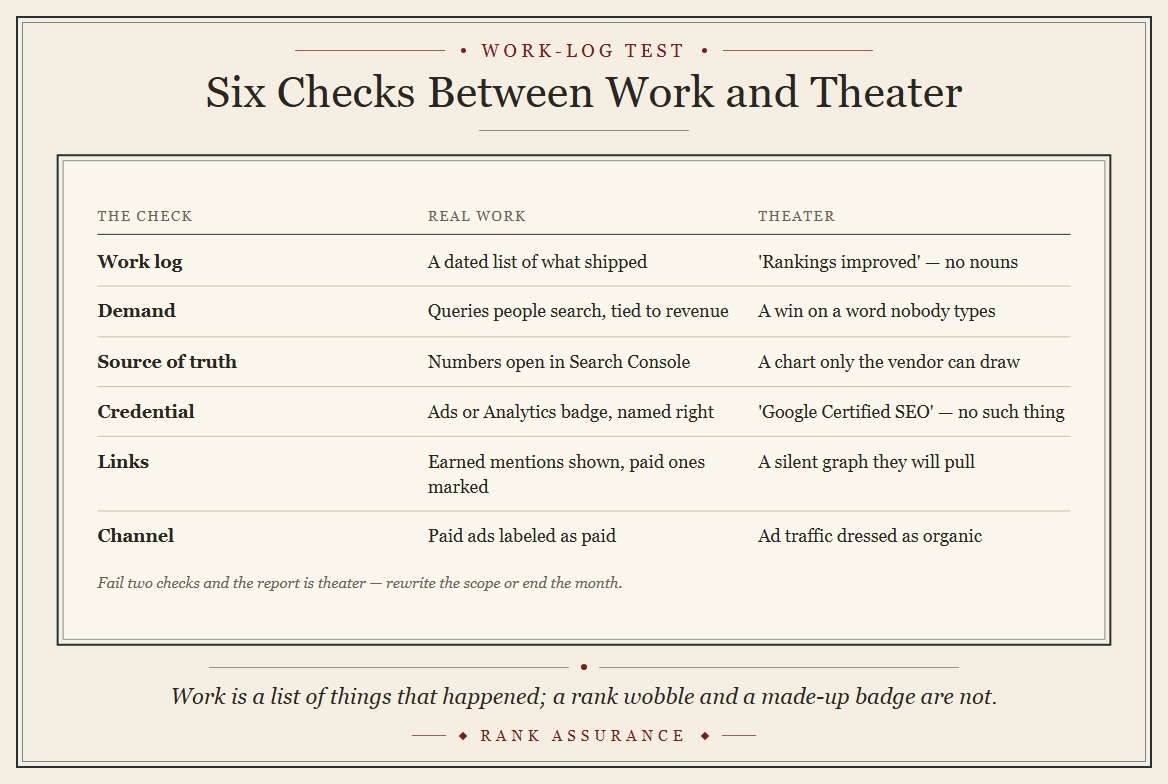
The Six Checks
Fail two or more and the report is theater. Rewrite the scope or end the month.
Calculator
Work-Log Calculator
Claiming Credit for Drift
Positions move when nobody touches the site. New URLs get crawled. Competitors publish. Core updates reshuffle. A report that says “we moved you from 26 to 25” without a work log is weather commentary.
The official-path fix is boring: every month, a list of URLs changed, technical tickets closed, mentions earned, and the Search Console slice for the contracted queries. If that list is empty, you paid for drift.
Do not use “not #1 in three to six months” as automatic proof of fraud. Time-to-rank follows the authority gap. Fire them for no work log, not for a competitive query that is still climbing.
The Month Log, Written Out
The difference between a report and theater fits in five lines. This is the honest version — copy the shape into the scope:
An Honest Month, Five Lines
1. Shipped: /service/water-heaters rewritten; /locations/mesa published.
2. Technical: redirect chain on the old blog closed (ticket #214).
3. Earned: one mention — the county trade association’s member page, URL attached.
4. Measured: Search Console, contracted queries — clicks and impressions, this month beside last.
5. Next: the two pages and one outreach effort queued for next month.
Beside it, the report it replaces: “Rankings continue to improve. Visibility is trending up. We remain committed to your growth.” Three sentences, zero nouns you can open. The five-line log is auditable by anyone in ten minutes; the adjectives version cannot be audited at all — and that is its job.
Guarantees on Words Nobody Searches
Google’s hiring page: no one can guarantee a #1 ranking. The quieter version of the same scam is a guarantee on a phrase with no demand. The screenshot looks like a win. The business does not move.
Write the query list into the scope before the first invoice. Demand, current position, competitor URL, conversion. Revisit it. That is the same demand gate as the Retainer Fit Test, applied to the report rather than the relationship.
Case Studies That Cannot Be Opened
A chart the vendor drew is a claim. A permissioned URL, dates, queries, and a Search Console export you can reproduce is a case study. The Vendor Claim Test already said a logo is not proof. This page says the same thing about last quarter’s slide.
Independent “third-party verification” is nice and rare. Shared Search Console is the standard you can actually require.
“AI Mentions Improved” in the Monthly Report
Reports now carry an AI line: “AI visibility up,” an “AI mention score” chart. Run check 3 on it unchanged. A chart with no reproducible run behind it is the vendor-chart-only fail in new clothes — there is no console you can open to confirm it, so the evidence standard has to be stated in the scope: engine, question, date, answer text, re-runnable by you. A vendor doing real work on this surface produces dated runs happily. A vendor selling a score cannot. The Generative-Impression Test covers what these counts mean; the Citation-Surface Test covers what being named requires.
“Google Certified SEO”
There is no official Google SEO certification and no Google SEO partner badge. John Mueller’s public line in 2022 still holds: Google does not stamp agencies as approved SEO specialists. People put weird things on web pages.
Real certificates exist for Ads, Analytics, and other products — real skills, different surfaces, not a license to rank pages. The full badge taxonomy, including the new “AI SEO certified” pile, is the Credential Test. For this check, one search settles it: a vendor who conflates an Ads badge with “Google certified us for SEO” has already failed.
Links They Will Not Name
Two false sentences travel together. “Links do not matter.” “Links are 98% of SEO.” Neither is in Google’s documentation. Links from independent relevant sites are a ranking signal. Buying ranking credit is link spam. A vendor who says links are worthless while selling a silent package, or who says links are everything while skipping relevancy and penalties, is selling a fraction as a religion.
Ask to see the mentions. If the honest answer is a graph they will take down when you leave, that is the hostage model in the Sister-Site and Retainer Fit tests — not “honest link building.”
Ads Sold as Organic
Google’s hiring page is explicit: advertising with Google has no effect on organic presence. Google does not accept money to rank a page in organic results. A proposal that treats Meta ads, Search ads, or “Google ads help your SEO” as the organic program is a channel mix-up, not a ranking strategy.
Local citations and directory listings can support a map pack. They are not a substitute for pages that answer the query. Monthly blogs that never touch money URLs are a content calendar, not automatically a scam — and not automatically a program.
Official-Path Next Step
- Ask for this month’s work log before the next invoice.
- Open Search Console on the contracted queries. Compare.
- If the credential was “Google Certified SEO,” correct the record or leave.
- If the links are a kill-switch graph, stop adding them. Run the Sister-Site Test.
- If the work log is real and the relationship still fits, keep going. Review at 90 days with the Retainer Fit Test.
Questions
What Should a Monthly SEO Report Include?
Five things: the dated work list, the contracted-query slice from Search Console, mentions earned with URLs, tickets closed, and what is queued next. Anything else is garnish. Adjectives are not a section.
They Have a Google Ads Certificate. Is That Fake?
No. That certificate exists. It is not an SEO certification. Do not let the badge stand in for a work log.
Rankings Went Up and They Cannot Say What They Changed. Now What?
Treat the lift as unexplained until the log appears. Do not pay extra for weather.
The Report Celebrates an “Authority Score” Improvement. Is That Work?
No. A vendor score is an estimate, not a deliverable, and moving it is not in any engine’s documentation. Ask which query moved and which work moved it — the Domain-Score Test.
How Many Hours Should a Retainer Produce?
Hours are an input; the log is the output. A month with forty billed hours and no nameable artifact is still an empty month. Buy the list of things that happened, not the time sheet.
They Say Ethical SEO Means They Never Build Links. True?
Earned mentions are allowed. Buying ranking credit is not. “We never touch links” plus no other inspectable work is an empty month.
Sources
- Google Search Central, “Do you need an SEO?” (updated June 2026) — no #1 guarantee, no special relationship, ads do not buy organic rank, unsolicited email, read-only audit access.
- Search Engine Roundtable, 25 February 2022 — Mueller: Google does not recognize or stamp SEO agencies.
- Google Search Central, spam policies (updated 27 August 2026) — buying or selling links for ranking purposes.
- Blinkjar Media, “SEO Scams Explained,” 31 January 2026 — first-page guarantees, ads sold as SEO, listings-only retainers (agency explainer, not a Google document).
- “The Vendor Claim Test” — before you sign.
- “The Retainer Fit Test” — whether the engagement still fits.