
The Credential Test.
A Certificate Proves You Finished a Course — Not That You Can Move a Query
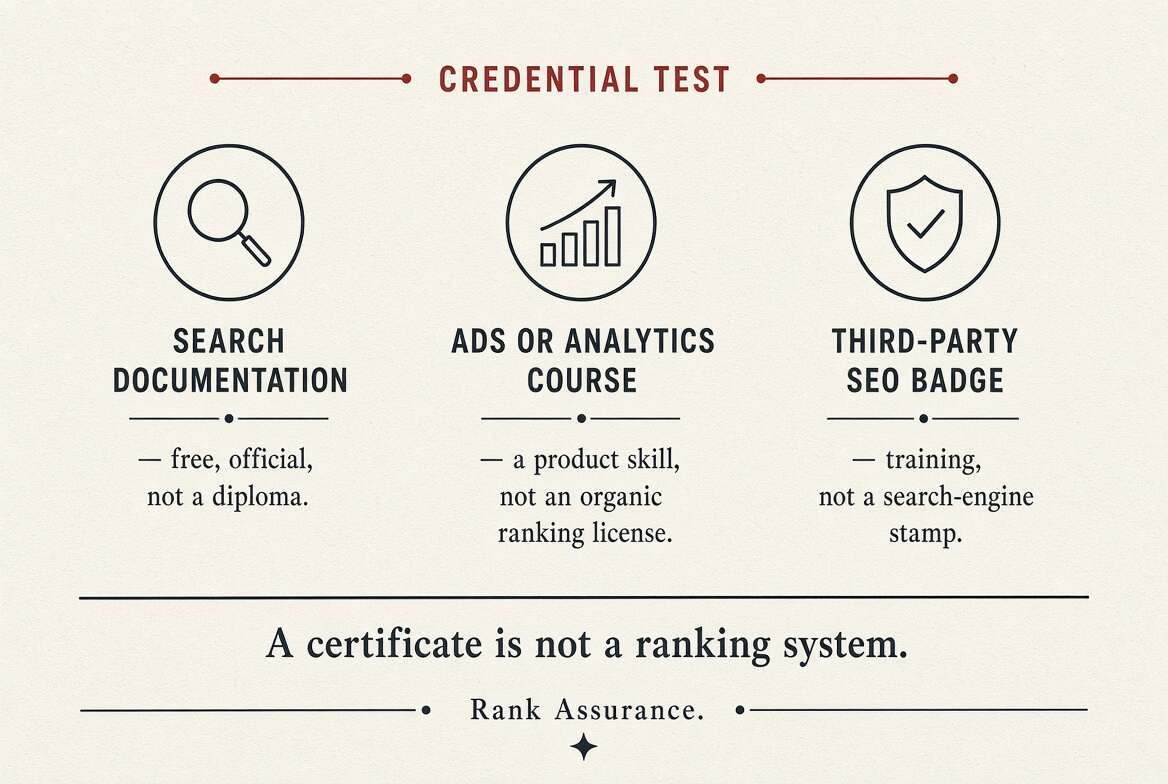
The Credential Test separates what a badge certifies — a product exam, a school's test, free documentation — from the license no search engine sells.
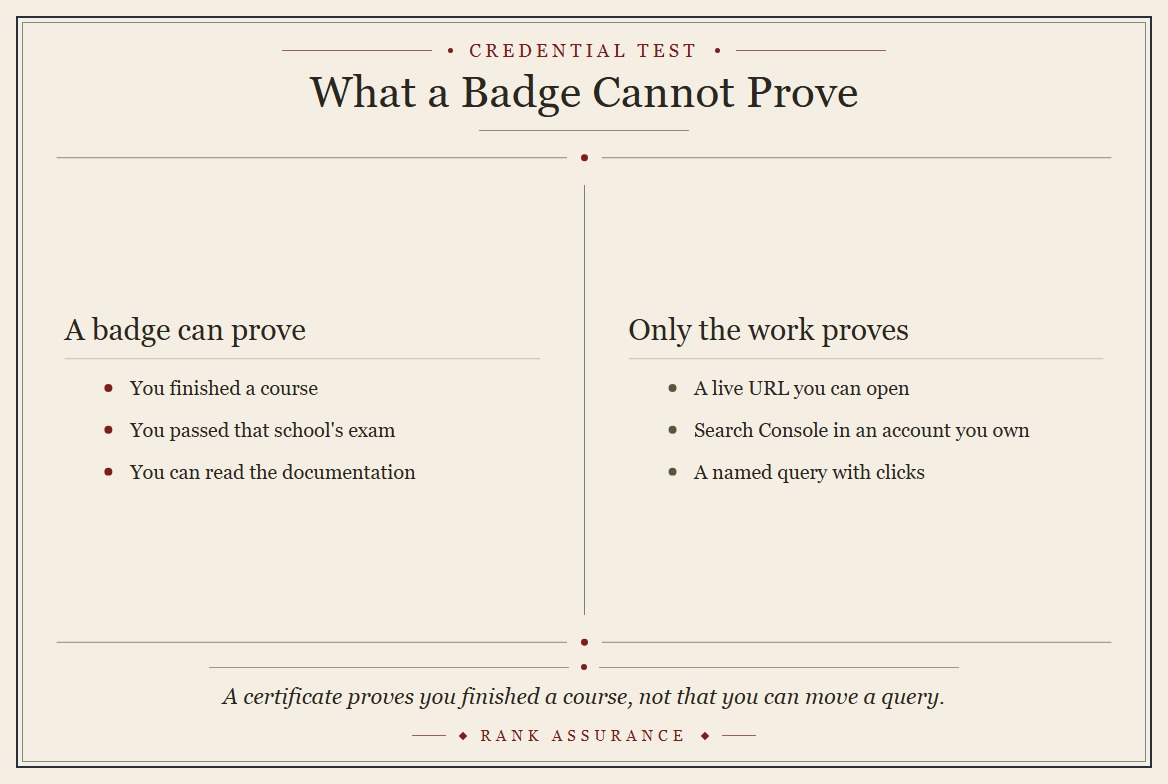
Search does not sell an organic-ranking license. A product course certifies Ads or Analytics. A third-party badge certifies that school’s test. Official Search guidance is free documentation — not a diploma. Proof is still a live URL, Search Console in an account you own, and a named query with clicks.
The Question This Article Answers
Is there an official Google SEO certification? No. Search does not sell an organic-ranking license, and no badge changes what you should believe about the work. Certificates are not a ranking system. They do not appear in the ranking-systems guide. They do not replace Search Console.
The Five Objects
| Object | What it is | What it is not |
|---|---|---|
| Search documentation and events | Free official guidance. Starter Guide, Search Essentials, Search Central Live | A diploma you hang to rank |
| Product certification | A passing score on Ads, Analytics, or another product exam | An organic-ranking license |
| Third-party SEO badge | That school’s test. Can teach HTML and Search Console | A search-engine stamp on the vendor |
| “AI SEO” / “GEO” certificate | That school’s test again, with a newer label | An endorsement from any AI engine |
| Work on a URL you can open | The only ranking-shaped proof | Replaced by a PDF |
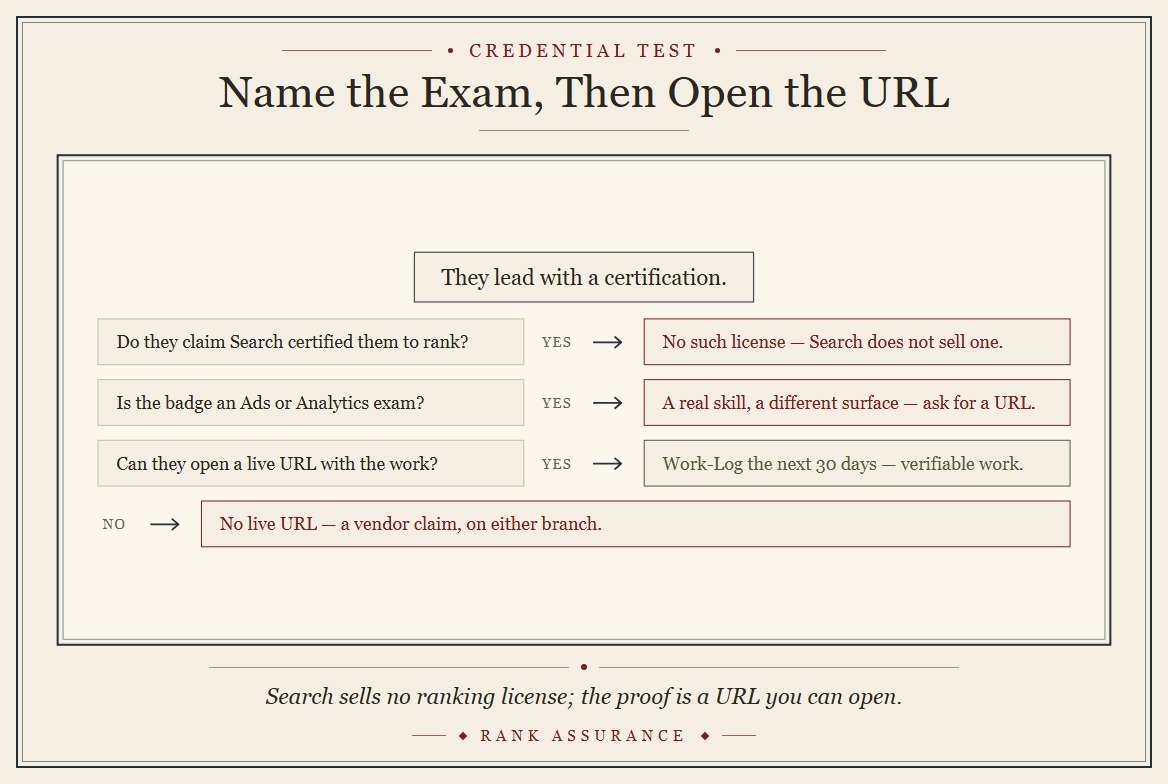
If a homepage says “Google Certified SEO,” ask which exam. If the answer is a paid-ads product, they certified advertising — a different surface from organic ranking. If they cannot name the exam, Fake-Client. If they can show a URL and clicks in an account you own, Work-Log the next 30 days. The badge is optional color.
Training is not automatically a scam. The fail is treating the badge as Google’s endorsement of the agency, or as a ranking lever. Ranking systems do not list certificates. The same fail has a cousin: a vendor score worn as a credential — “we raised the score, we know what we are doing.” A score is a vendor’s estimate, not a license, and it is the Domain-Score Test.
The AI Badge Pile
The badge economy is re-forming around AI: “AI SEO certified,” “GEO certified,” “ChatGPT optimization partner.” Run the same test. No engine issues an organic-visibility credential — not Google, and none of the AI-engine companies, not OpenAI, not Anthropic, not Perplexity. A certificate with an AI word in it is still that school’s test. It can teach real material. It is not an endorsement, and it is not a lever inside anyone’s answers.
The tell is identical to the classic one: a vendor who leads with the badge instead of a URL. Ask what a dated engine run of a buyer question shows for a past client. A badge cannot answer that. The Citation-Surface Test is what would.
The One-Search Verification, Walked Once
Badge to Issuer in Under a Minute
The homepage says “Google Certified SEO Experts.” You ask: which exam? The answer comes back “Google Ads Search Certification.” One search on that exam name shows the issuer — Google’s product-training academy — and the subject: paid search campaigns. Verdict in one move: a real certificate, a real skill, a different surface. It says nothing about organic ranking, and it was worn as if it did.
Every badge resolves the same way: name the exam, find the issuer, read what the exam actually covers. If any of those three steps fails, the badge was decoration.
Calculator
Credential Calculator
Official-Path Next Step
- Ask which exam. Write the product name down.
- If it is Ads or Analytics, that skill can still be useful on that surface. It does not move organic position by itself.
- Ask for one live URL they shipped and one query. Open it. Vendor Claim / Fake-Client if they cannot.
- Grant read-only Search Console after a signed scope. Work-Log 30 days.
Questions
Is There an Official Google SEO Certification?
Not for organic Search ranking. Search publishes free documentation. Product academies certify Ads, Analytics, and related tools.
Is There an OpenAI or ChatGPT Certification for Visibility?
No. No AI engine issues a visibility credential. “ChatGPT optimization partner” is a vendor’s own label, not an engine’s.
Is a “Google Partner” Badge an SEO Endorsement?
No — it is the most-conflated badge on the pile. The Partner program is about managing Google Ads. It is real, and it is about advertising, not organic ranking.
Do University Digital-Marketing Certificates Count?
As education, yes — that school’s test, sometimes rigorous. As a ranking license, no. The hiring decision still runs on URLs, dates, and a work log.
Are Paid SEO Courses Scams?
Not automatically. Some teach crawlability and Search Console. The badge is not the work, and it is not Google’s endorsement of the vendor.
Sources
- SEO Starter Guide — official documentation, not a diploma.
- Do you need an SEO?
- A guide to Google Search ranking systems — certificates are not listed as a system.
- Skillshop — product training for Ads, Analytics, and related tools.