
The Fake-Client Test.
When a Case Study, Logo Wall, or “Prospect” Is a Prop
The Fake-Client Test checks both directions of a prop: whether a vendor's claimed client is real, and whether a 'buyer' is a researcher harvesting strategy.
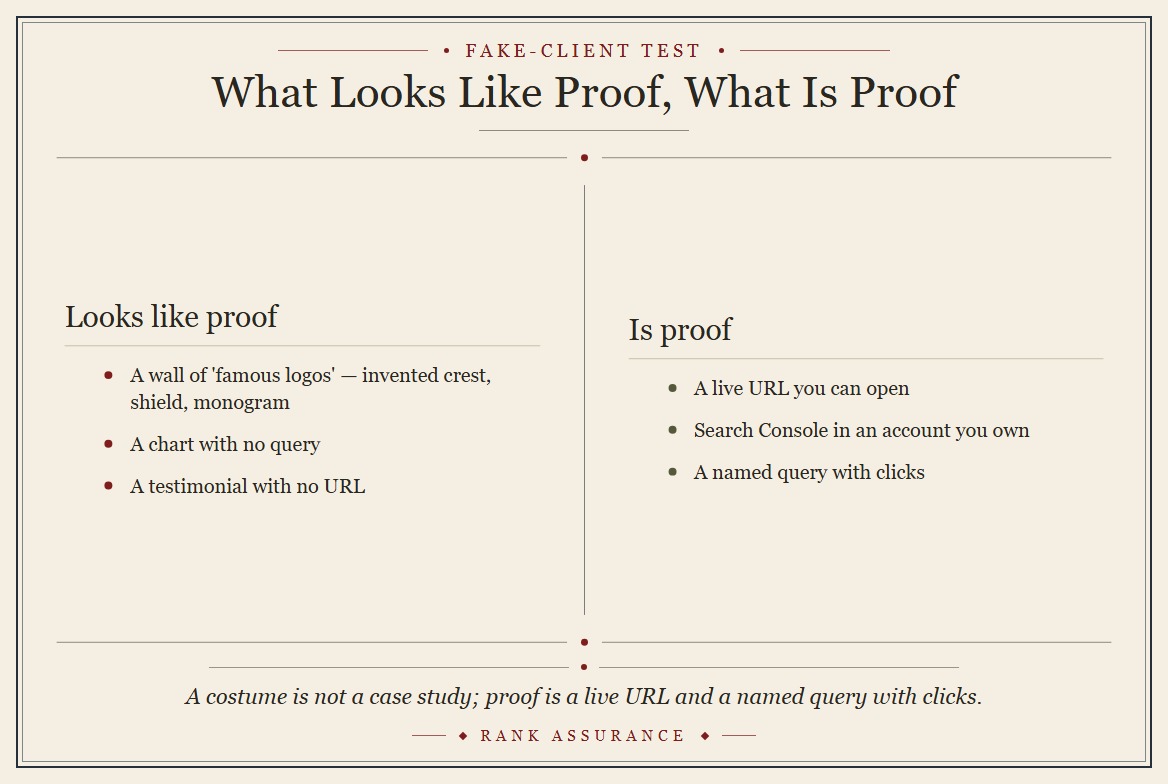
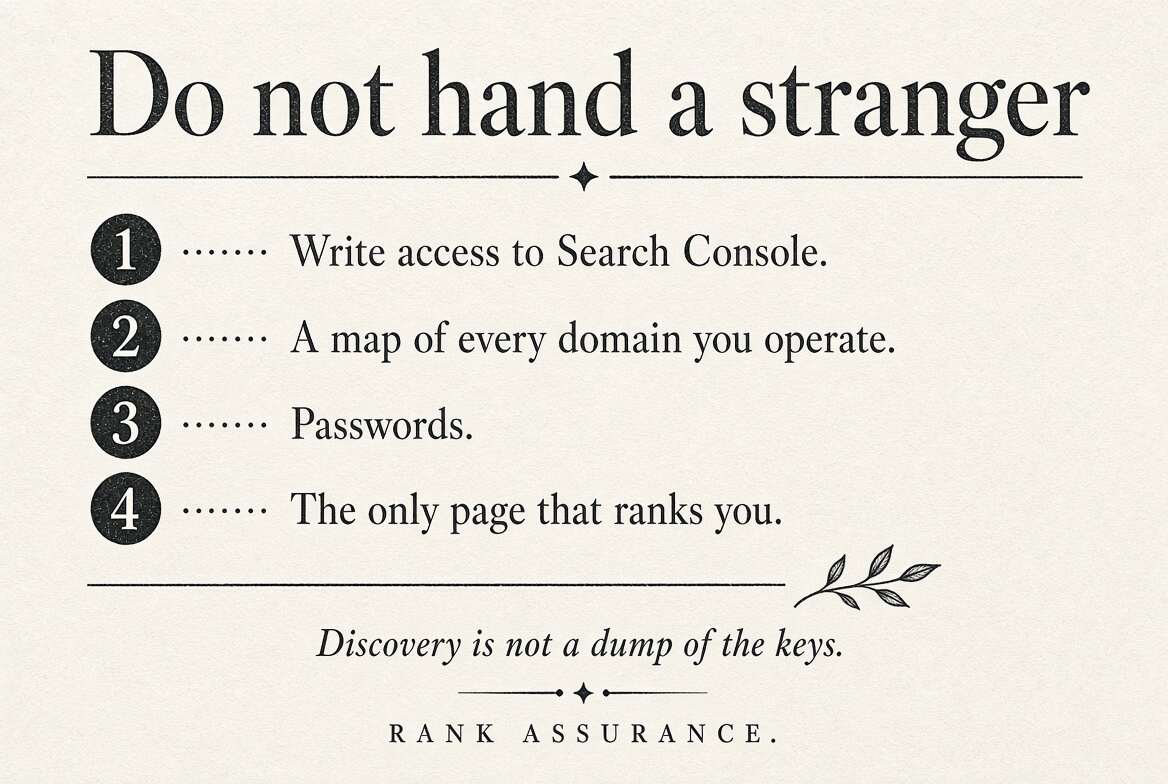
Owners get lied to two ways. A vendor invents a client they never had. A stranger invents a business to harvest a process. Proof is a live URL, Search Console in an account you own, and a named query with clicks. Discovery is not a dump of the keys.
The Question This Article Answers
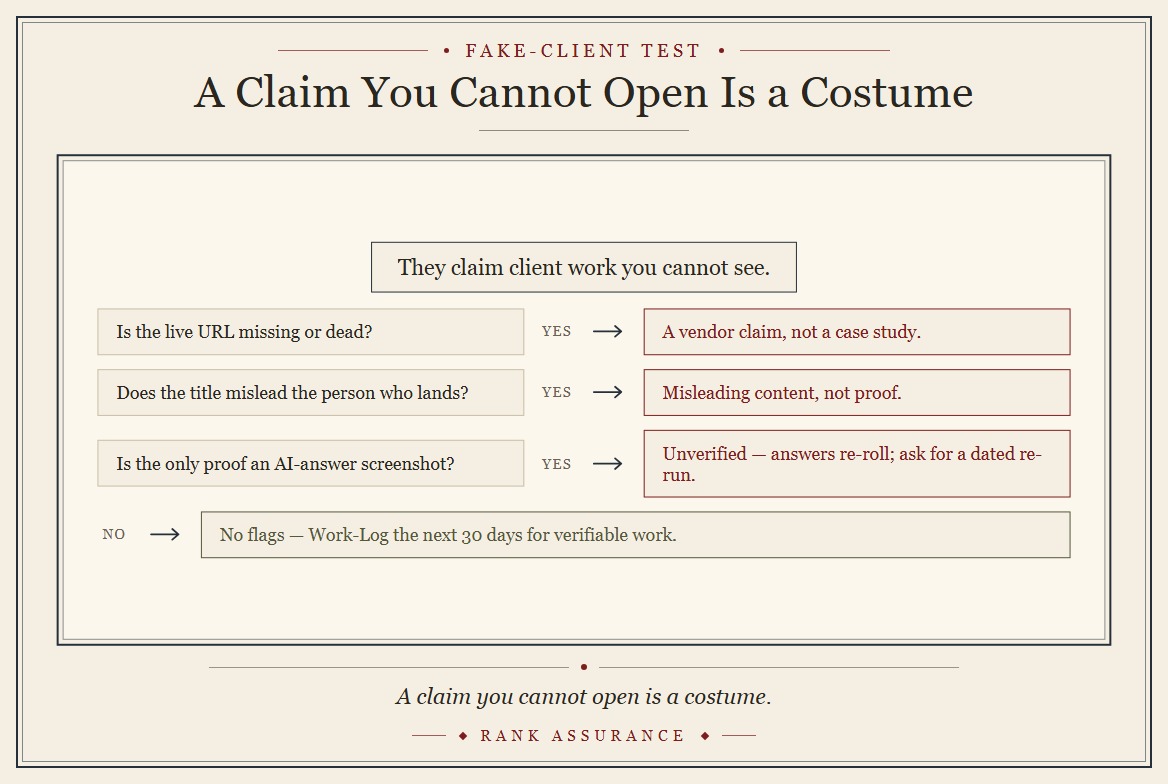
Is this lead a buyer, a competitor collecting a free strategy, or a case study that will not survive a search? One aside before the plot: people also say “fake client” about a bait title — a page that promises a topic it does not cover. That is a quality problem, the Topic-Fit Test, not an impostor problem, and it is not this page’s subject.
The Five Objects
The AI screenshot deserves its own sentence because it is the easiest prop ever made. An answer-engine capture is trivial to fabricate and — because answers re-roll — impossible to verify as an image. The only check is a dated re-run of the same question on the same engine, by you. A vendor whose “proof” is a screenshot they will not let you reproduce has shown you a costume.
The junk-inbound row is a different threat class compressed into one line: nobody is posing as anyone, someone is pointing garbage at you after a public win or an angry exit. Do not buy a rescue package that night. Open Search Console, read what actually changed, and start at the Negative-SEO Test — most junk graphs are simply ignored.
This page does not teach anyone how to pose as a buyer, how to map another firm’s hosts, or how to attack those hosts. If extra domains you operate are the thing someone wants a map of, that graph was already the Sister-Site Test.
One Discovery Call, Dissected
Buyer Tells vs Researcher Tells — a Composed Example
A real buyer asks: “Can you get my emergency plumber page ranking in Mesa?” — the query, the city, the page. “Who is above us right now?” — they have looked. “What would the first month cost?” — they are pricing a job.
A researcher asks: “Which sites link to your clients?” — the map. “Walk me through your full process first” — the recipe. “What tools and vendors do you use?” — the supply chain. No query, no city, no page of their own.
The pattern is the plot of this whole page: a real buyer names their own property; a researcher asks about yours. One further check costs a minute — search the inquirer’s business name. A real buyer’s business exists in the results: a map listing, a site, reviews. That is the Name-SERP Test run in reverse, and a “company” with no name surface anywhere is a costume until proven otherwise.
Calculator
Fake-Client Calculator
Official-Path Next Step
- Ask for one live URL they shipped and one query it ranks for. Open it.
- If they cannot produce it, Vendor Claim. Stop.
- If they can, grant read-only Search Console on one property after a signed scope. Work-Log the next 30 days.
- Keep write access and extra-host lists off the table until you have a contract you can cancel. Contract-Term.
Questions
Is Free Discovery Always a Trap?
No. A short call that names the query is normal. A demand for the full linking map before a contract is not.
Someone Listed a Search Engine as a Client. Real?
Treat it as unverified until there is a URL and a person who will take a call. The Vendor Claim Test owns this one — “we do SEO for Google” is usually a category error.
They Want Analytics Access to “Prepare the Proposal.” Normal?
No. A proposal needs the query, the market, and public results pages. Read-only Search Console comes after a scope is signed — and write access later still.
How Much Strategy Is Safe to Share on a Discovery Call?
The diagnosis shape, not the map. Name the kind of gap and the kind of work. Keep the query lists, the referring hosts, and the process documents for the signed scope.
Can a Testimonial Video Be Verified?
Partly. A person praising a vendor is a reference you have not called yet. Verification is still a live URL, a query, and dates — the Live-URL Test.
Sources
- Do you need an SEO? — read access first; no guaranteed #1.
- Spam policies — misleading content, keyword stuffing, link spam.
- Vendor Claim Test · Work-Log Test · Negative-SEO Test · Name-SERP Test.