
The Negative-SEO Test.
When Incoming Links Are Noise, When They Are a Manual Action, and When a Mention Simply Went Away
The Negative-SEO Test sorts a junk-link scare into owner states - a named Search Console problem, ignorable noise, or a lost mention you never owned - before any disavow.
Ugly inbound links exist. Most of them are ignored. A ranking drop is more often the wrong query, a page that stopped being useful, or a mention you never owned coming down. Open Search Console before you buy a rescue. This page does not teach an attack.
The Question This Article Answers
People sell fear: a competitor blasted you, or paid a publisher to drop your best link. Both things can happen. Neither is the first diagnosis. Official guidance on disavow is blunt: most sites will not need the tool, because systems already assess which links to trust.
Open Search Console before you buy a rescue. Every state below starts there, and most of them end there too.
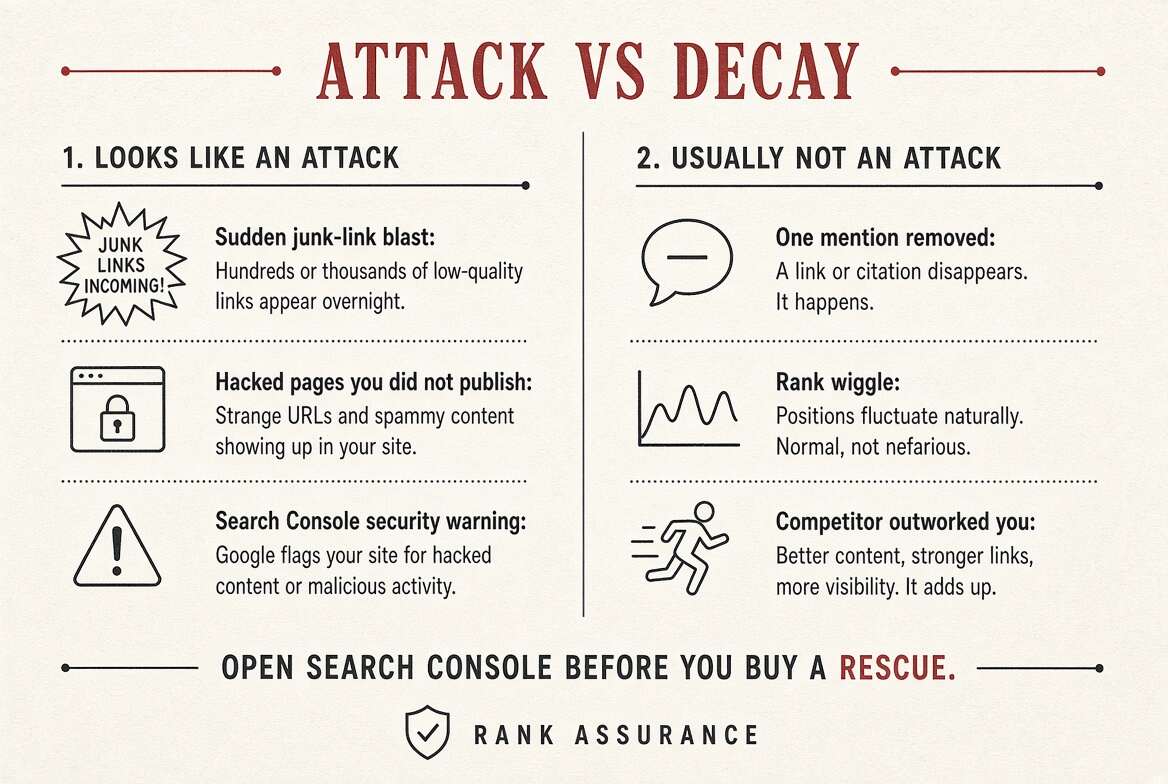
The Negative-SEO Test
Four checks, in order, on the property that scared you. Fifteen minutes, no vendor report required.
- The notice. Search Console → Security & Manual Actions. A named unnatural-links action or a security issue is real work with an official path. “No issues detected” means everything after this step is watching, not cleaning.
- The links export. Links → Top linking sites → Export. Compare against last quarter’s export if you keep one. You are looking for a delta: thousands of new hosts in a short window, all outside your industry, aimed at your money pages. A slow trickle of scrapers and junk directories is the ordinary background every site accumulates.
- The mention audit. If what actually changed is that a real page which mentioned you came down, that is not an attack — you never owned that URL. A mention a vendor could remove was rented, not earned.
- The rank and query check. Performance report: did positions on money queries actually collapse in the same window, or did a vendor’s dashboard just repaint? A link spike with unmoved rankings is Google’s systems doing what they document: ignoring junk.
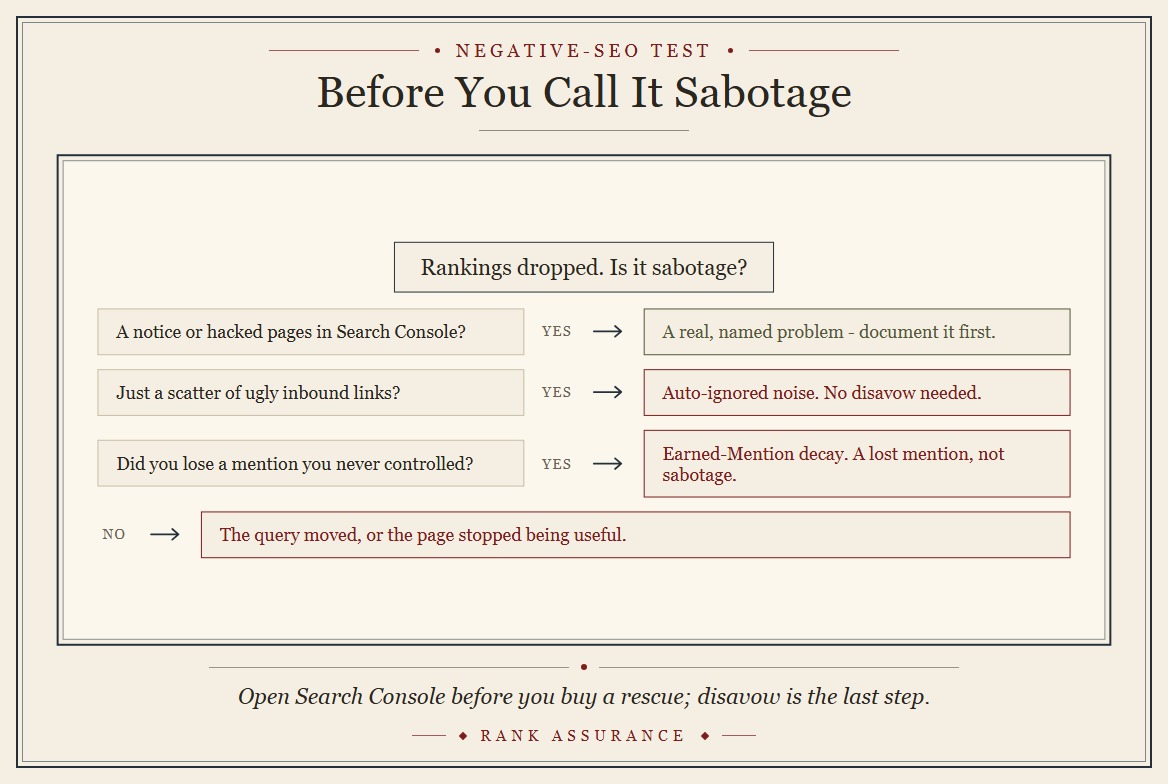
Attack or Ordinary Junk: The Evidence
Every site collects ugly inbound links. An attack is a pattern, and the pattern is visible in the export without any toxicity score.
| Signal | Ordinary junk | Looks like an attack |
|---|---|---|
| Arrival speed | A trickle across months | Thousands of new hosts inside days or weeks |
| Host topics | Scrapers, stat pages, junk directories that link to everyone | Casino, pharma, adult — off-topic categories aimed at one brand |
| Anchors | Your name, your URL, fragments | Commercial exact-match phrases you never bought |
| Target pages | Spread across the site | Concentrated on the money URLs |
| Search Console | Nothing named | Sometimes an “unnatural links” action naming the pattern |
| Rankings | Unmoved | Collapsed in the same window |
Even the right-hand column is not automatically a filing. It is the case where watching turns into the disavow decision below — and only after the removal attempt that official guidance puts first.
The Five Owner States
| State | What you do | Open |
|---|---|---|
| Manual action or security issueshown in Search Console | Fix what Google named. Then reconsideration if they ask. | Suppression Type |
| Sudden junk inbound, no manual action | Watch. Most of it is ignored. Do not buy a monthly protection package first. | This page |
| A real page that mentioned you came down | You never owned that URL. If a vendor can pull it, you rented it. | Earned-Mention · Network-Footprint · Contract-Term |
| Nothing inbound changed | Wrong query, wrong surface, or the page stopped being useful. | Ranking-Problem · Topic-Fit |
| You built or bought the graph yourself | Not an attack. Clean it up as links you created — removal, marking, then leftovers. | Suppression Type · Sister-Site |
Hacked pages you did not publish are a security problem, not a link-building problem. Clean the site. Fake reviews and profile vandalism belong on the local surface — Local Pack / Business Profile support — not a disavow file.
If your visibility depended on one follow link that someone could pay to remove, that mention was inventory. Diversify into pages that exist for readers.
Calculator
Negative-SEO Calculator
The Disavow Decision, in Text
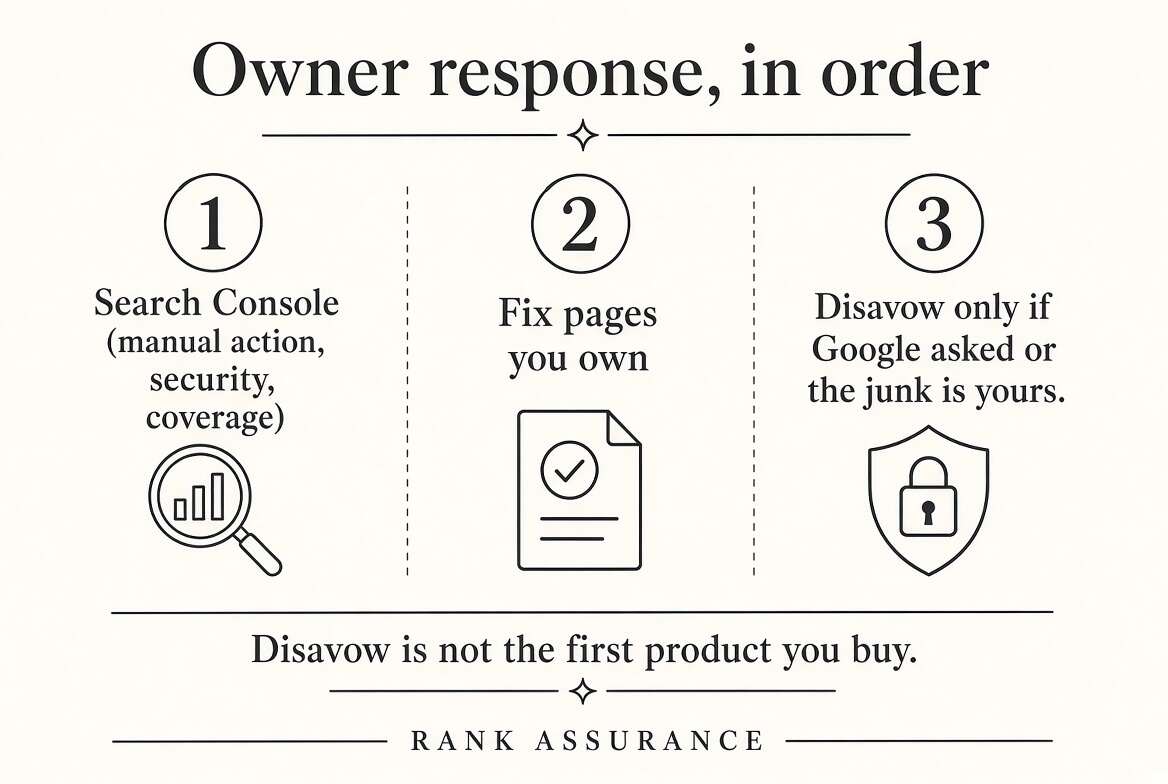
The decision is a short flow, and it runs on the two facts you already collected — the notice and the ranking move:
- A manual action names unnatural links: attempt removal where a human can be reached, document the attempts, disavow the domains you cannot reach, then Request Review. This is the one case where disavow is squarely official.
- No manual action and rankings did not move: do nothing to the link graph. The junk is being ignored, which is the documented default.
- No manual action, but a real collapse in the same window as a huge off-topic spike: a narrow disavow of the attack domains is the advanced leftover step — after the watching, not instead of it, and never as a monthly ritual against your real press and customers.
The full differential — was the collapse an update, a technical exclusion, or the links at all — is the Suppression Type Test; this page is only the inbound branch of it.
The AI-Answer Version of the Fear
The 2026 pitch has a second act: “a competitor is poisoning what the AI engines say about you.” The honest state of that fear — scraped copies of your pages, fake reviews, vandalized profiles feeding a model’s picture of the brand — is that it is largely unmeasured, and no engine publishes a filing path for it. What you can actually do is the same discipline as this page: check what is being said about the brand by name (the Name-SERP Test), keep the profiles and review surfaces you control clean at the source, and read how answer engines choose what to say on the AI Answer explainer. Panic products exist for this surface too; the evidence standard does not change.
Official-Path Next Step
- Search Console: Manual actions. Security issues. Coverage.
- Fix pages you own. Remove injected spam. Restore hacked templates.
- If a publisher dropped a mention, treat it as Earned-Mention — you cannot file a penalty against their editorial choice.
- Disavow only after removal attempts, and usually only with a link-related manual action or a set you created and cannot get down. Official: most sites will not need the tool.
Questions
Should I disavow every month as protection?
No. That is a product, not official guidance. Most sites will not need the tool.
What if a vendor says a competitor paid to have our link removed?
Possible as a business act. You still do not own their page. If your ranking depended on one URL they could pull, that was rent.
How do I tell an attack from the spam links every site gets?
Speed, aim, and consequence. Ordinary junk trickles in, links to everyone, and moves nothing. An attack pattern arrives in a burst, targets your money pages with commercial anchors you never bought, and — in the rare case that matters — coincides with a named notice or a real collapse.
Can a competitor poison what ChatGPT says about my business?
The mechanisms people fear — scraped copies, fake reviews, planted pages — exist, but their effect on answers is largely unmeasured and there is no filing path. Keep the surfaces you control clean, watch your name queries, and treat anyone selling “AI reputation defense” with the same evidence standard as a disavow package.
Should I file a spam report with Google about an attack?
You can — Google accepts spam reports — but they feed system improvements, not your case file. A spam report is not a support ticket and does not trigger a review of your site. The work that changes your state is still the notice, the removal attempt, and, in the narrow case, the disavow.
Sources
- Disavow links — most sites will not need this tool; use after you cannot get harmful links removed, especially with a manual action.
- Manual actions.
- Spam policies — link spam.
- Suppression Type Test · Earned-Mention Test.