
The Retired-Tactic Test.
If It Only Worked When Scaled, It Is Now a Policy Object
The Retired-Tactic Test maps old SEO moves to their official 2026 spam-policy names: if a tactic only worked at scale, it is now a named policy object.
Most “you cannot do that anymore” lists are nostalgia. The useful version is a policy map. Keyword stuffing, hidden text, comment and forum blasts, and purchased exact-match anchors are named spam types in 2026. Exact-match domains are a weak signal, not a banned TLD and not a strategy. There is no official five-percent anchor cap.
The Question This Article Answers
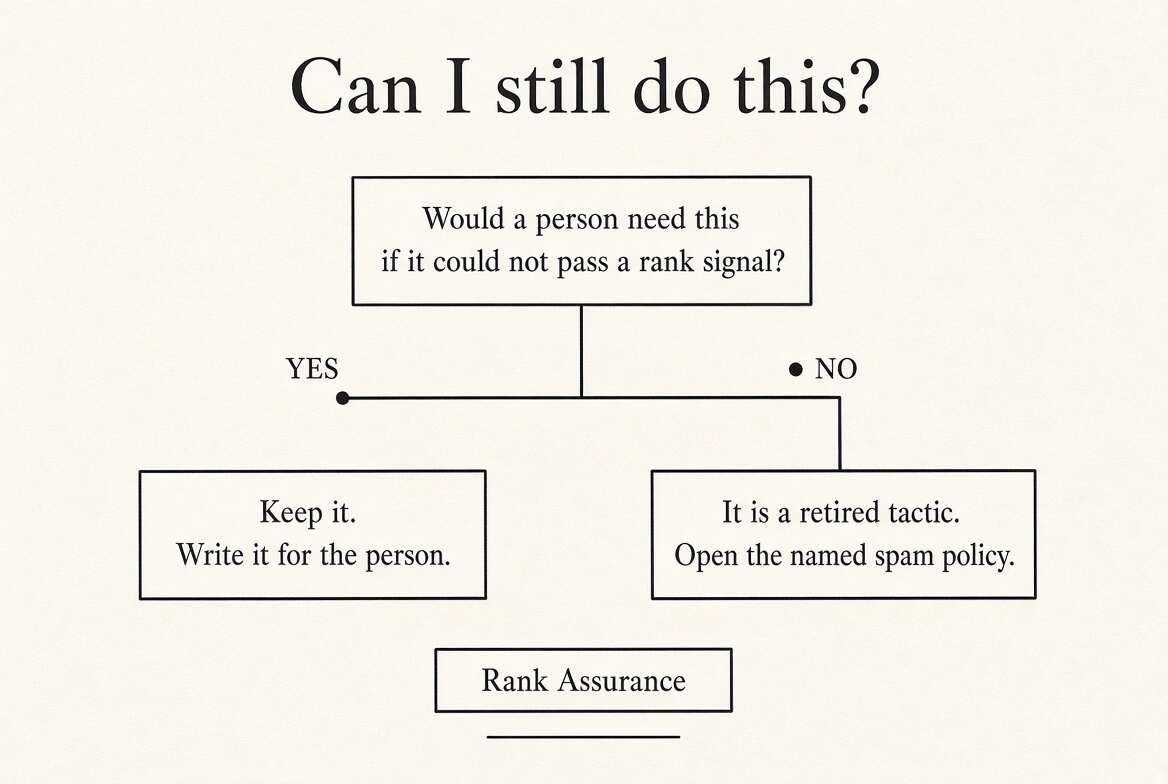
Spammers did not “ruin SEO.” They scaled a trick until the documents named it. The owner question is not “what still flies under the radar.” It is the same filter as Would-This-Exist: would a person need this if it could not pass a rank signal?
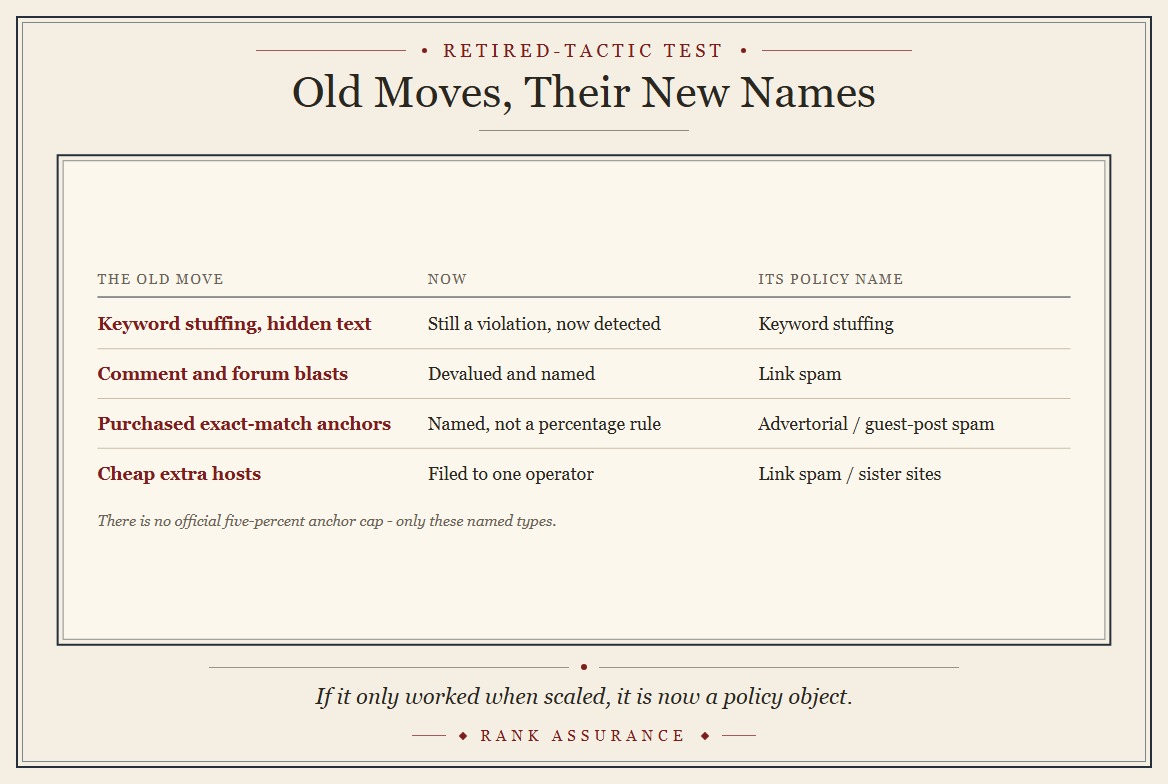
Every retirement in the map below is the same mechanism run to completion: a tactic worked, so it was scaled; the scale left a footprint; the footprint got an official name. The map gives the verdicts; the museum labels give each tactic its two-sentence obituary.
The Map
| Old move | Official 2026 name | Named | Open |
|---|---|---|---|
| Repeat or hide the phraseuntil the page is unreadable | Keyword stuffing / hidden text | Long-standing | First-Index · Would-This-Exist |
| Automated commentsblog comments and forum signatures | Named link-spam examples | Long-standing | Earned-Mention · Network-Footprint |
| Purchased articleswhose job is an exact-match follow | Advertorials / guest posts with optimized anchors that pass credit | Long-standing | Anchor-Text · Earned-Mention |
| A stack of extra hosts you also operate | Link spam — creating links primarily to manipulate rank | Long-standing | Sister-Site · Cold-Start |
| Thousands of near-identical pages | Scaled content abuse | March 2024 | Citation-Surface · Topic-Fit |
| Buying a lapsed namefor its leftover links | Expired-domain abuse | March 2024 | Sister-Site |
| Mass-producing pages with AI | Scaled content abuse — however the pages are produced | March 2024 | Content-Quota · Would-This-Exist |
| Stuffing pages for answer engines | Keyword stuffing, re-run on a new surface | Same policy | Citation-Surface |
| A domain that is the query | Exact-match domain system — damping, not a bonus | Not a spam policy | Name-SERP · Topic-Fit |
| A cheap TLDused as a reason the site cannot rank | Not a published TLD ban | Never named | This page |
No exact-match anchor cap is in the documents — not five percent, not ten, not any number. Official link guidance is: write labels a person can use, and mark paid follows. Diversifying a purchased graph so it “looks natural” is evasion, not a retirement plan.
.info and other inexpensive endings are not an official penalty class. Cheap hosts were used for spam because they were cheap. The object is the spam, not the registry.
The Museum Labels
Keyword stuffing and hidden text. The oldest trick in the collection: repeat the money phrase until the page ranks, or hide it in white-on-white text so only the crawler reads it. It worked when matching was mostly literal. It has been named spam in Google’s documentation for as long as the spam rules have existed, and the modern spam policies still carry it with examples.
Comment and forum blasts. Automated signatures and comment links worked because early link analysis counted votes without asking who cast them. The spam policies now list forum comments and signatures with optimized links as a link-spam example by name. Reviving the tactic with better software revives the policy object, not the effect.
Purchased exact-match articles. Advertorials and guest posts carrying keyword-rich follow anchors worked while paid credit was hard to spot at scale. The campaigns left the most legible footprint in the museum — the same anchor, everywhere — and the policies name optimized-anchor guest posts and advertorials that pass credit as link spam. The mix question lives in the Anchor-Text Test.
Operated host stacks. A stack of extra domains voting for the money site worked while ownership was expensive to cluster. It is link spam — links created primarily to manipulate rank — and the full lifecycle is the Sister-Site Test.
Scaled near-identical pages. City-spinner and template pages worked because coverage looked like relevance. In March 2024 the pattern got its own name — scaled content abuse — and core updates had already been fading it before the name landed.
Expired-domain harvesting. Buying a lapsed school or newsroom name for its leftover links worked while history and purpose were not compared. March 2024 named it expired-domain abuse, with the explicit note that it “isn’t something people accidentally do.”
Mass AI page production. The 2026 re-run of the scaled-pages tactic with cheaper production. The policy was written for it in advance: scaled content abuse applies however the pages are produced — the method is not the object, the scale-without-value is.
Answer-engine stuffing. Writing pages “for the AI” by repeating the phrases a bot might echo is keyword stuffing re-run on a new surface. Engines that summarize pages still need a page a person could use; the Citation-Surface Test reads that surface directly.
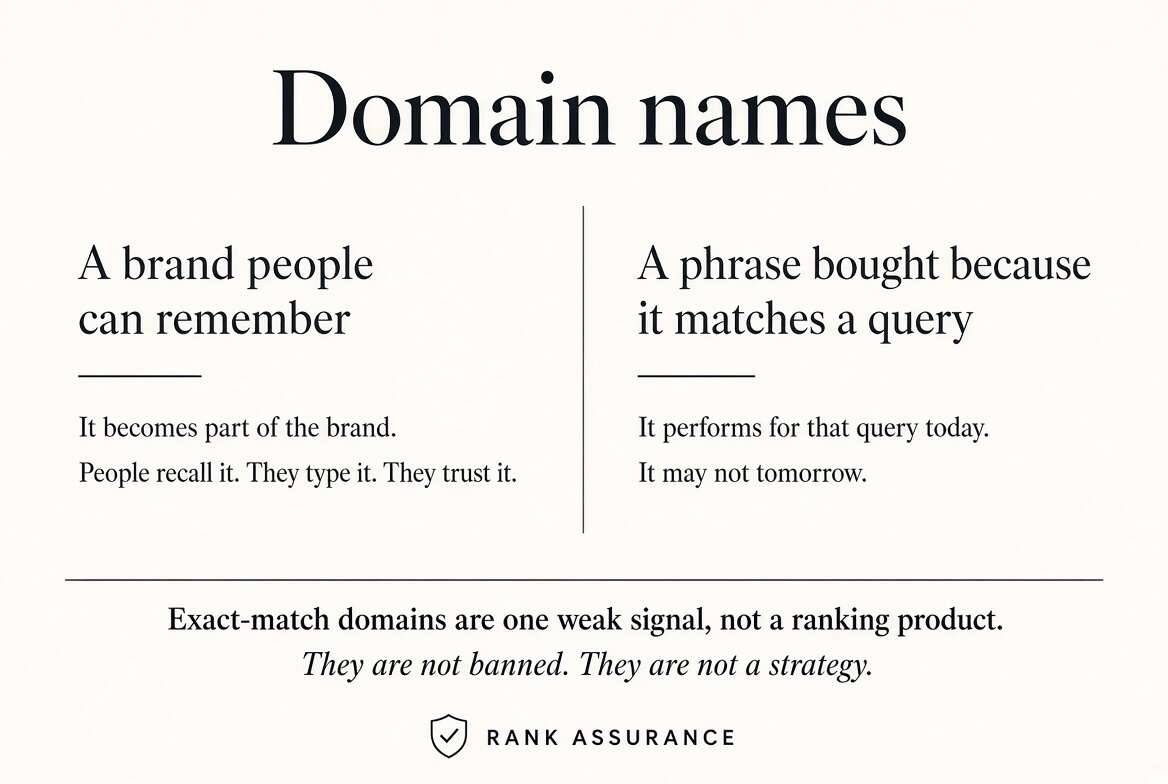
Exact-match domains. Never a spam policy — a damping story. Buying the query as a domain worked long enough that Google documented an exact-match domain system whose job is to keep a matching name from earning credit the page did not. The name still has to sit on a page that answers the query.
Calculator
Retired-Tactic Calculator
Official-Path Next Step
- Name the tactic in one sentence, then ask the Would-This-Exist question of it (Figure 2).
- If it matches a spam-policy row, stop. Do not modernize the footprint.
- If it is a domain name, pick a brand people can type. Cover the query on the page. Topic-Fit.
- If you need mentions, Earned-Mention — pages that would exist without the follow.
One mechanism runs through every label above: scale, then footprint, then policy name. A tactic that only works when nobody can see the pattern is a tactic whose end is already scheduled.
Questions
Are exact-match domains banned?
No. Google documents an exact-match domain system whose job is damping — making sure a matching name does not earn credit the page did not. A name is not a strategy, and it does not replace a page that answers the query.
Is there an official exact-match anchor percentage?
No cap at any number is published. Optimized anchors in paid guest posts are the named spam example; the mix question is the Anchor-Text Test.
Is AI-generated content against Google’s policies?
Not as a category. The policy object is scaled content abuse — many pages, little value — and it applies however the pages are produced. One useful page written with help is not the pattern; a thousand interchangeable ones are.
Do directory submissions still do anything?
Low-value directories and bookmark sites built for links are inside the link-spam examples. A directory a customer actually uses — a trade body, a local chamber — is a real citation, and that distinction is the whole test.
Are press-release links a link scheme now?
Distributing releases with optimized exact-match anchors sits in the same family as advertorials that pass credit: mark the links or drop the anchors. A release that earns real coverage is fine — the coverage is the mention, not the wire copy.
Sources
- Spam policies (updated August 2026) — keyword stuffing, hidden text, link spam, scaled content, guest-post optimized anchors, forum signatures.
- Google Search Central Blog, March 2024 core update and new spam policies (5 March 2024) — scaled content abuse, expired-domain abuse, site reputation abuse named.
- Ranking systems guide (updated 10 December 2025) — the exact-match domain system ensures matching names do not receive outsized credit.
- SEO link best practices — descriptive labels; no official percentage cap.
- Creating helpful, reliable, people-first content.