
The Content-Quota Test.
A Publishing Calendar Is Not a Ranking System
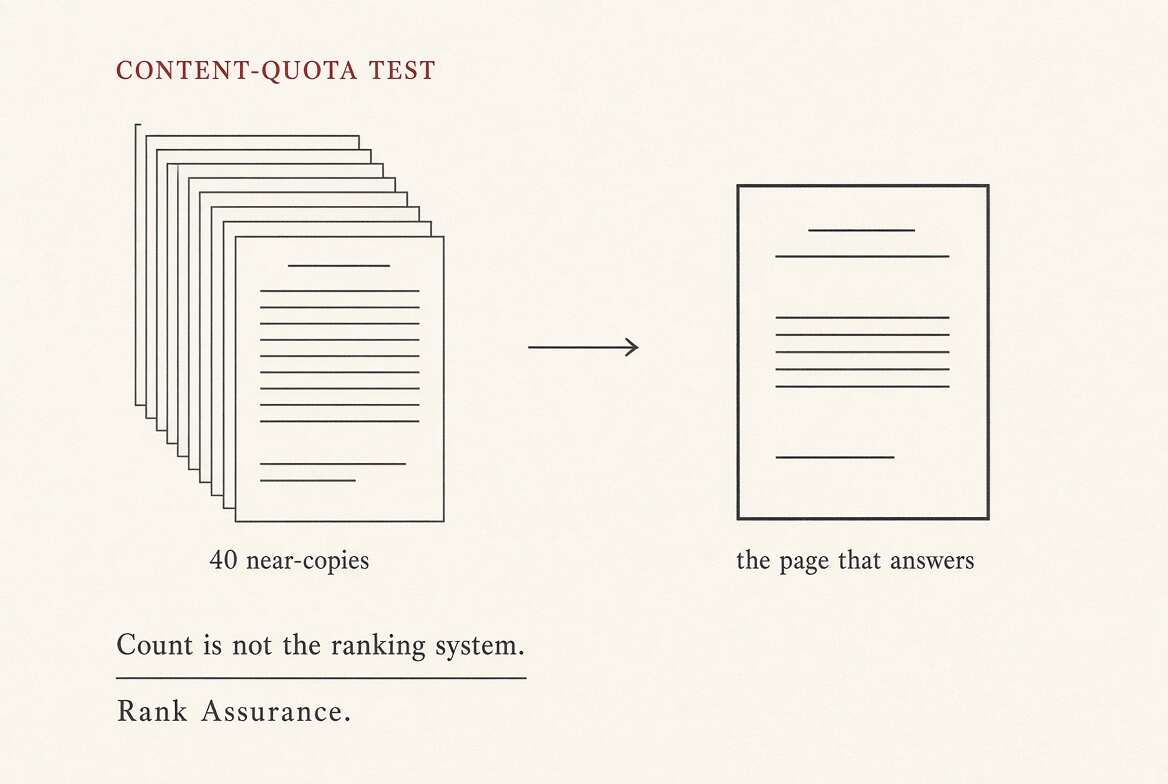
The Content-Quota Test asks whether a publishing plan answers real queries or just fills a calendar — a quota of near-copies is scaled content, not a ranking plan.
A useful page is required. Forty near-copies are not a ranking plan. Search publishes people-first guidance and names scaled generic volume as spam. Mentions from pages that would exist without the follow still matter. Count is not the ranking system. Clicks and booked work are.
The Question This Article Answers
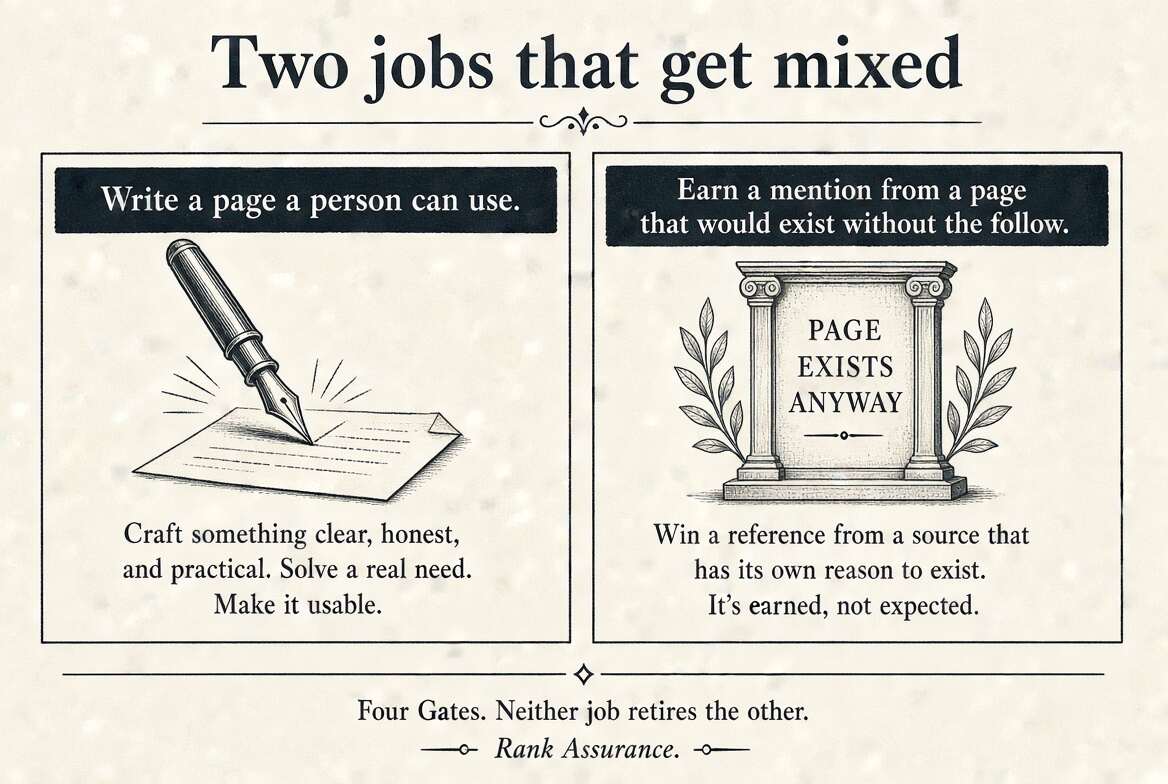
Will writing more posts rank this site? Count is not the ranking system. A calendar is a production schedule. Ranking is the Four Gates, in order — found, matched, believed, clean: a crawlable URL that answers the query, independent mentions that believe it, and no suppression object on the record. “Content does not rank” is too strong. “Content is the whole plan” is also too strong. The Content-Quota Test asks whether a publishing plan answers real queries or just fills a calendar.
Four Outcomes
Large properties appear faster on new URLs because they already cleared fetch, match, and graph — not because “content does not matter.” That head start is the Page-and-Graph Test. A brand-new phrase with no results can surface a first useful page. That is First-Index, not proof that a quota replaces mentions.
Search systems try to reward pages written for people. They also try to reduce pages written mainly to rank. Both of those sentences are official. Neither sentence says “links are 99 percent.”
One Query, Two Paths
A Search Console query sits just off page one — impressions rising, one URL close. Two plans exist.
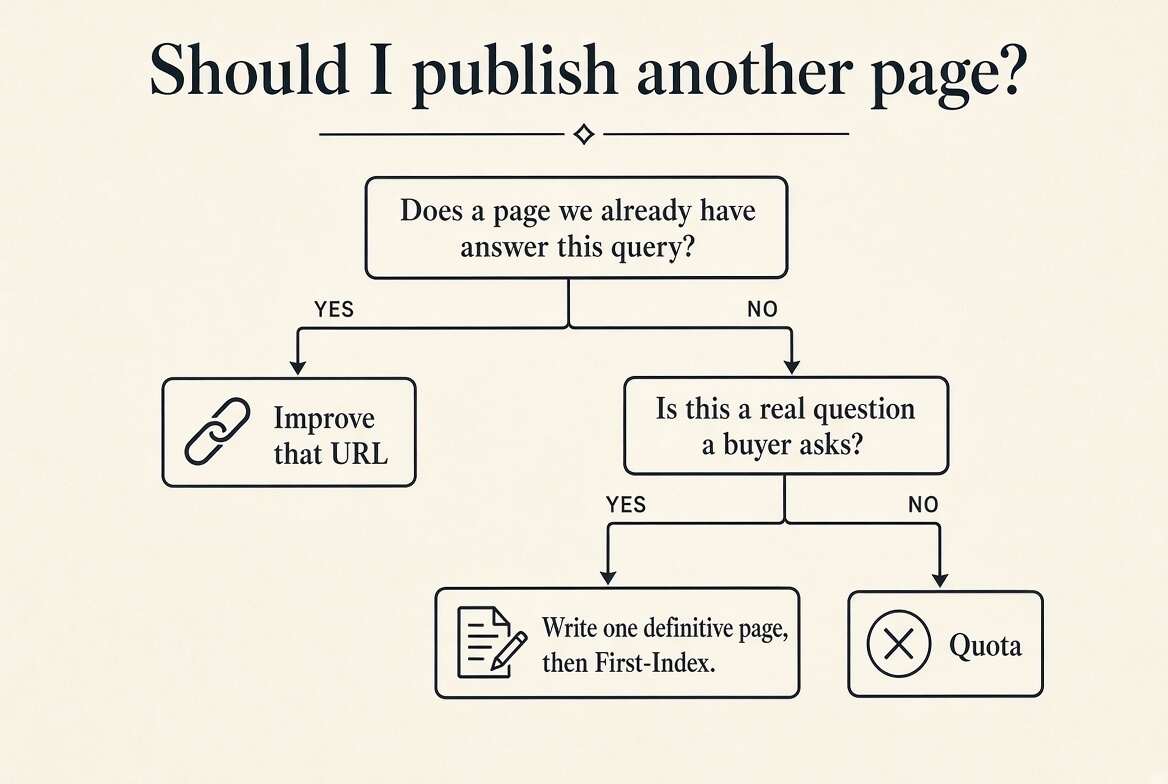
Path A — update the URL. Add the section readers came for, answer the follow-up questions the query implies, fix the title so the snippet matches, request recrawl. One page gets more useful; its history and its impressions stay attached to it.
Path B — mint eight variants. Eight new near-copies of the same answer now compete with the close URL and with each other. None becomes the page a person would bookmark, and the set reads as exactly what the spam policy names: many pages produced mainly to manipulate rankings.
Path A is the official path. The just-off-page-one read is a working heuristic of this library, not a published Google threshold — the point is the direction: a URL that already earns impressions is evidence the update job beats the new-URL job.
The Quota on the AI Surface
Answer engines make the quota case harsher. They deduplicate near-copies and quote one page. A stack of forty variants has no better chance of being the cited answer than one of them — usually worse, because none is definitive. The one-definitive-page rule is answer-engine-native: the page a person would bookmark is also the page an engine can quote. The Citation-Surface Test reads that surface.
Calculator
Content-Quota Calculator
Official-Path Next Step
- Open Search Console. Find queries where a URL already appears.
- If that URL is thin, update it. If it is close, make it the definitive answer. Topic-Fit · E-E-A-T for the quality of the one page.
- If no URL matches a real buyer question, write one page, then First-Index. Do not write eight variants.
- If the page is useful and still invisible, Authority Gap — not another calendar.
Questions
Does Content Rank a Site by Itself?
No. A matching crawlable page is required. Independent mentions and a clean record still matter. Four Gates.
Can Search Tell Good Content From Filler?
Systems exist to reward people-first pages and to reduce scaled generic volume. “Search cannot tell” is not the official line.
How Many Posts per Month Is Safe?
Wrong question — a count is neither safe nor unsafe. A page that answers a real query is safe at any pace; forty near-copies are the named risk at any pace. There is no official posts-per-month number, and this page will not invent one.
Should I Delete or Merge Old Posts?
Merge near-copies into the one page a person would bookmark, and redirect the merged URLs to it. Delete only what no reader needs and nothing links to. Improving beats removing when the page has any real job left.
Does Refreshing Dates Help?
Changing a date without changing the work changes nothing a system rewards. Freshness that counts is a useful page — or a real update to one — that did not exist last month. First-Index’s page-count section says the same thing about launch volume.
Is AI-Written Volume Treated Differently?
Origin is not the test. Scaled unhelpful volume fails whether a person or a tool typed it — the Helpful-Content Test covers the system that reads it.
Sources
- Creating helpful, reliable, people-first content.
- Spam policies (updated 28 August 2026) — scaled content abuse.
- SEO Starter Guide (updated 10 December 2025) — no magic content length; useful pages.
- A guide to Google Search ranking systems (updated 10 December 2025).