
The E-E-A-T Test.
There Is No Score — Trust Is Still How Quality Gets Described
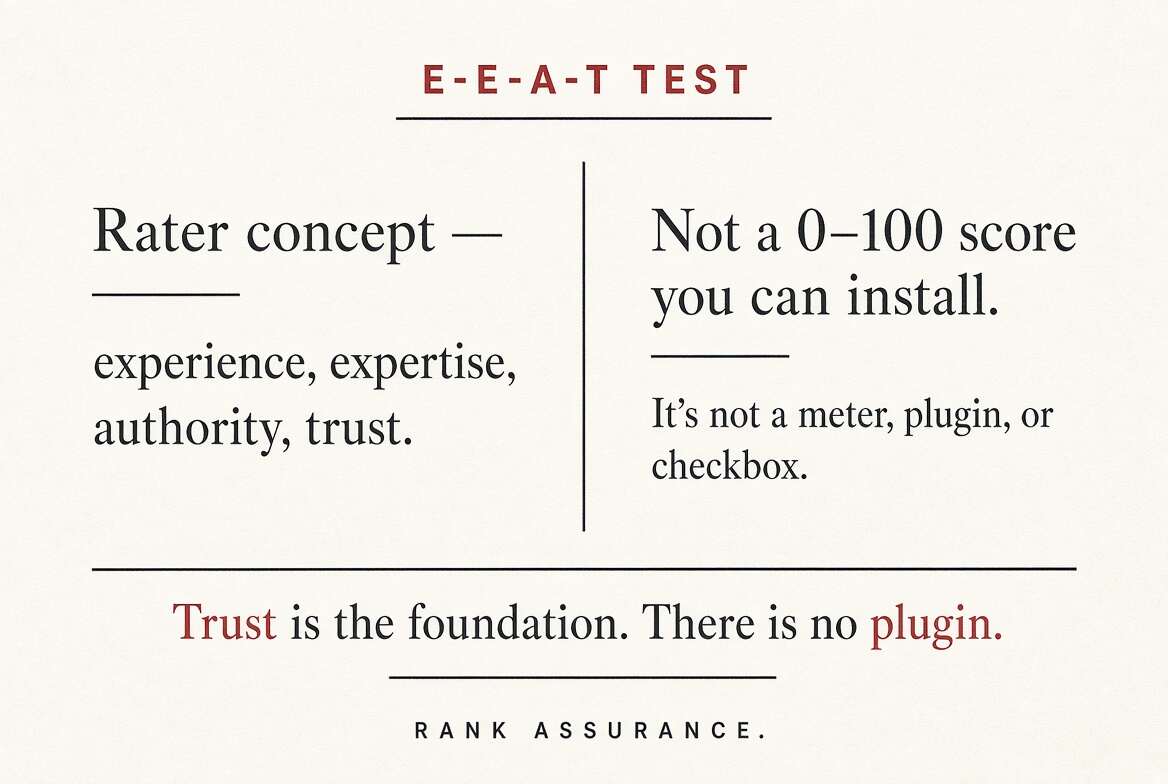
The E-E-A-T Test asks whether a stranger can tell who did the work and verify the claims — there is no score, and trust is judged hardest.
Official line: E-E-A-T itself is not a specific ranking factor. Systems still use a mix of signals that identify experience, expertise, authoritativeness, and — most of all — trust. There is no meter. A vendor who sells “we will raise your E-E-A-T” is selling a number that does not exist. Showing first-hand work on the page is people-first work. Four Gates still apply.
The Question This Article Answers
Not a score you can buy. Not a concept you can ignore. Search Quality Raters use E-E-A-T to judge whether systems are serving people; rankings are not those rater scores injected into a page. Systems still look for pages that demonstrate the four letters — especially trust. The E-E-A-T Test asks whether a stranger can tell who did the work and verify the claims.
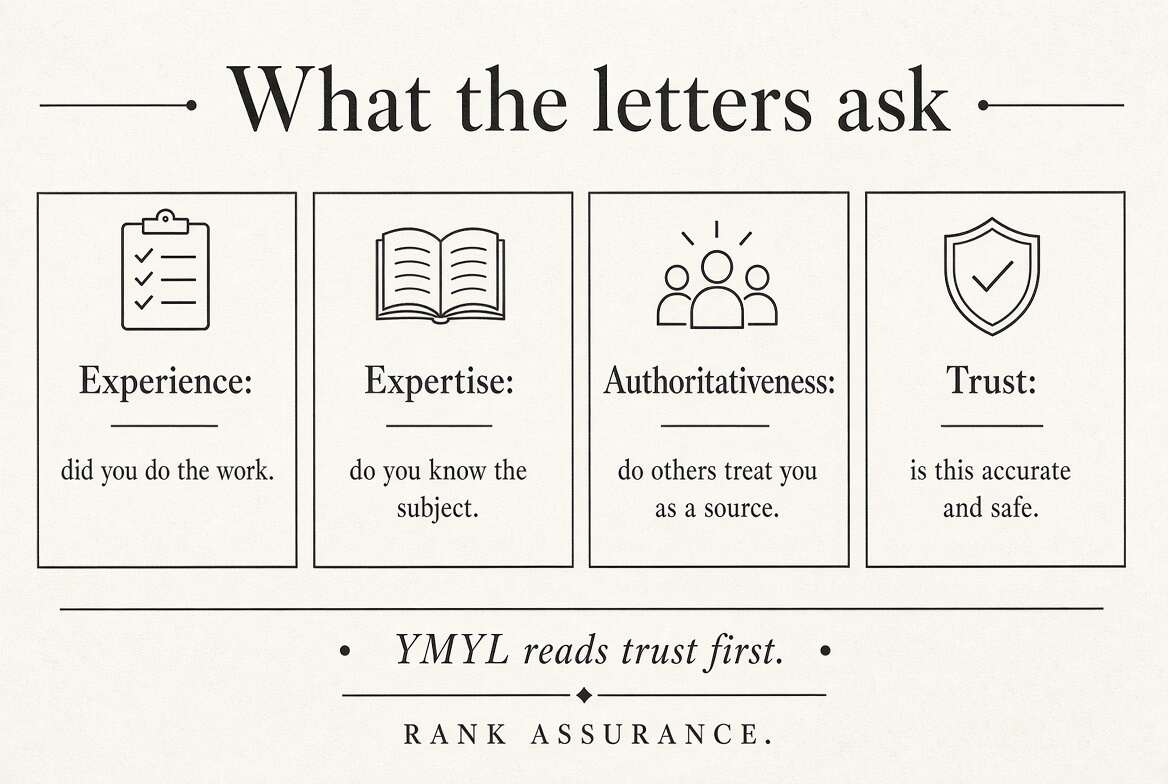
The Four Letters, in Plain Terms
Four Objects
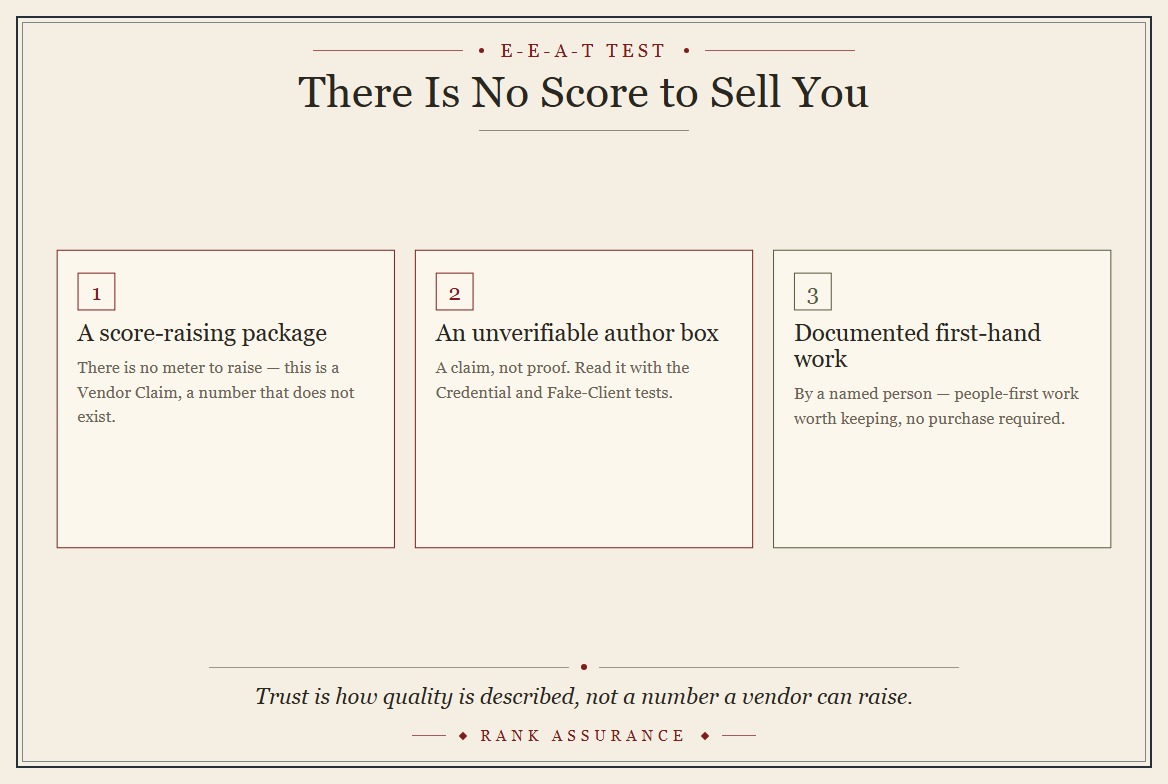
| Object | What It Is | What to Do |
|---|---|---|
| Rater concept | Four questions used to describe quality | Read the people-first page. Trust first |
| Invented score | A vendor meter, badge, or “E-E-A-T algorithm” | Vendor Claim. There is no API |
| Fake author kit | A name, stock photo, and invented degree | Credential + Fake-Client. Trust fails |
| First-hand page | Who did the work, what they saw, what a stranger can check | People-first. Then Four Gates |
Authoritativeness here is not a vendor domain-count. It is whether other people treat you as a source — Earned-Mention. Experience is whether the page shows the work, not whether a footer lists letters.
Improving a thin page that already has impressions is still an update job (Content-Quota). “Quality never matters, only links” is Two-Site folklore. Do not reprint it as a law.
One YMYL Page, Walked Past the Letters
A procedure page at a surgical practice, checked the way a stranger would check it:
- Experience. The page describes the procedure as performed at this practice — recovery timelines they observed, not paraphrased from elsewhere. Pass.
- Expertise. Clinical claims carry sources; the one statistic on the page links to the study it came from. Pass.
- Authoritativeness. A hospital affiliation page and a professional directory both list the surgeon — records the practice does not control. Pass.
- Trust. The surgeon is named, the license number is checkable at the state board, the practice address and phone are real and answered. Pass.
The failing version of the same page is one change: no identifiable practitioner. A hidden surgeon on a procedure page fails the test — no bio widget repairs it, because the missing thing is a checkable person, not a paragraph.
What a Measured Sample Shows
Our measured local-service sample points the same direction, as observation rather than doctrine: the on-page signals that separate top-ranked pages from bottom-ranked ones are trust-and-completeness hygiene — a findable privacy policy, a real contact surface, the boring proof a careful visitor looks for — while HTTPS and a mobile viewport are near-universal table stakes that separate nothing. Correlation, not causation; the direction is the point. The sample, the method, and the current numbers live at the benchmarks page and in the measured study.
The Letters on the AI Surface
An unidentifiable author now fails two audiences at once. Raters read the page the way the walkthrough above does, and answer engines lean on the same public record — a named person, checkable claims, mentions on pages you do not control — when they decide whom to name and cite. That is observation, not a published scoring rule. Entity clarity is double-duty work: the same fix serves the rater and the engine. The Name-SERP Test covers the entity’s own results page; the AI Answer explainer covers how the answer surface is measured.
Calculator
E-E-A-T Calculator
Official-Path Next Step
- Open the URL. Can a stranger tell who did the work?
- Are the claims first-hand or sourced? Would you trust this page with money or health?
- If a vendor invoiced “E-E-A-T optimization,” ask which fact on the page changed. Work-Log.
- If the page is honest and still invisible, Authority Gap — not another badge.
Questions
Is E-E-A-T a Ranking Factor?
Not as a specific factor or a page score. Official docs say systems use a mix of factors that identify content with those qualities. Trust is the most important of the four.
Should I Ignore It?
No. Ignore the meter. Do not ignore accuracy, who wrote the page, or first-hand experience — especially on YMYL topics.
Do Author Bios Improve Rankings?
A bio is not a lever by itself. The working part is verifiability — a named, checkable person beats a decorated box with a stock photo. Add the bio because a stranger can confirm it, not because a checklist said “add bio.”
Do Credentials Need Schema Markup?
Markup helps machines read what is already true on the page. It cannot create a practitioner, a license, or a record. Do the checkable part first; mark it up second.
Is E-E-A-T Only for YMYL Pages?
The concept applies everywhere; the weighting does not. Official language gives trust extra weight on health, money, and safety pages. A hobby blog is read with the same questions and a lighter hand.
How Do AI Engines Judge Trust?
No engine publishes a trust score. The observable pattern is that answer engines favor identifiable sources with independent records — the same public evidence the letters describe. The $0 version of that work is real: showing the work costs nothing, which is the cold-start point of the First-Index Test.
Sources
- Creating helpful, reliable, people-first content — E-E-A-T is not a specific ranking factor; trust is most important; YMYL extra weight.
- A guide to Google Search ranking systems (updated 10 December 2025).
- Benchmarks · What separates page-one local-service sites — the measured sample behind the observation above.
- Credential Test · Content-Quota Test · Two-Site Test.