
The Ranking-Problem Test.
Which Failure You Have Before You Touch the Site
The Ranking-Problem Test is an ordered triage naming the failed gate — fetch, query match, surface, suppression, or independent support — before anyone changes the site.
“Not on page one” is a symptom. It is not a diagnosis. This page is the order of operations for the rest of the library. Run the checks in this sequence. Do not buy a mention package for a URL that is noindexed, and do not rewrite the homepage for a local-pack query.
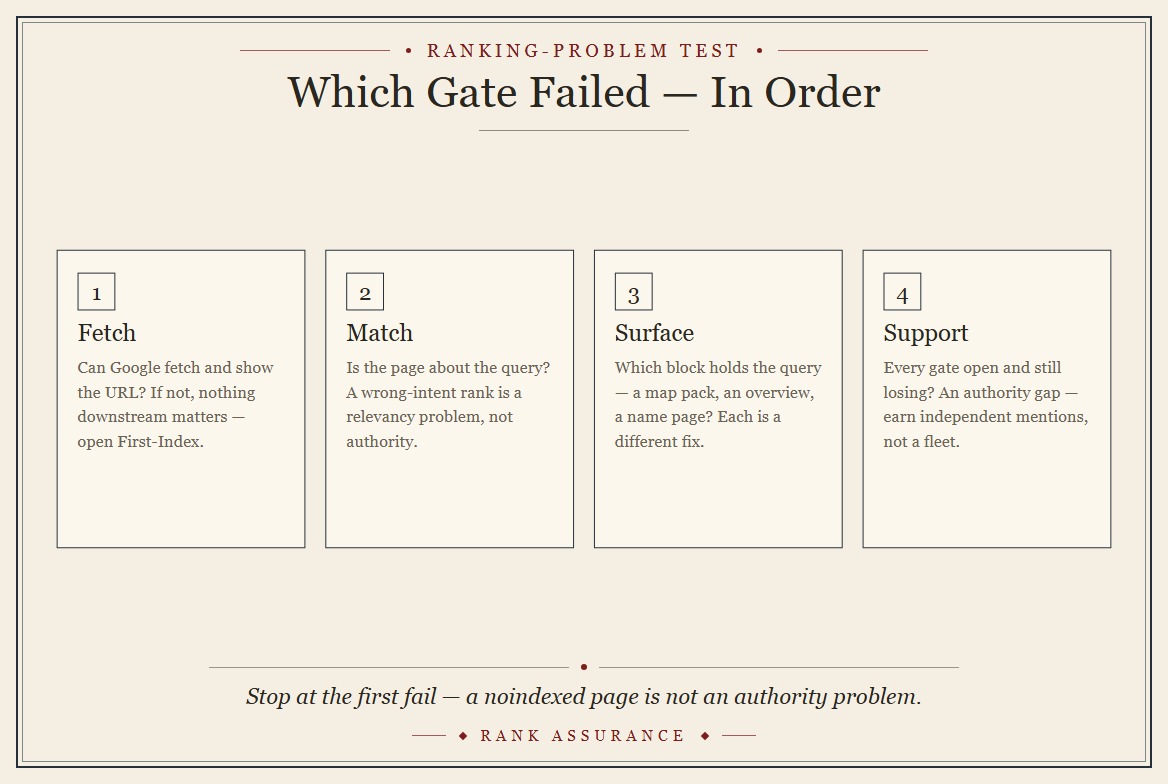
The Question This Article Answers
Industry talk still collapses every disappointment into one sentence: you are not #1, therefore you need more authority, therefore you need a graph of sites you control. That sequence skips fetch, query match, surface, and suppression. Google’s own starter material starts earlier: can Search find the page, is the page useful and about what people ask, and is anything blocking it.
The Order
| # | Ask this | If it fails, open |
|---|---|---|
| 1 | Can Google fetch and show this URL? | First-Index Test |
| 2 | Is the page about the query you are measuring? | A wrong-intent ranking is the query gate — the First-Index Test’s second check. Ranking for the wrong intent is a real problem. |
| 3 | Which surface is the result using? | Local Pack · Name-SERP · Citation-Surface |
| 4 | An AI answer took the query — impressions moved, clicks did not, or an assistant names competitors | the Citation-Surface Test |
| 5 | Is there a manual action or a named spam pattern? | Suppression Type Test |
| 6 | Are extra domains doing the ranking work? | Sister-Site Test |
| 7 | Does a stronger relevant host outrank a better-written page? | Authority Gap Test |
| 8 | Are mentions earned, sponsored, or a scheme? | Earned-Mention Test |
| 9 | Is a vendor involved? | Vendor Claim · Work-Log · Retainer Fit |
| 10 | Do people arrive and not buy? | Conversion. Separate job. Still measure it. It is not a ranking system. |
Stop at the first fail. A noindex tag does not become an authority problem because someone skipped step 1.
Calculator
Ranking-Problem Calculator
What This Is Not
- It is not “the only SEO problem is not being #1.” Wrong query, wrong surface, and an overview taking the click are search problems too.
- It is not “content has nothing to do with rank.” Relevancy and helpful content are published systems. A popular encyclopedia ranking is not proof that bad pages win.
- It is not a 99 / 0.8 / 0.2 split. Those numbers are not a dataset.
- It is not a reason to stand up a portfolio of domains. That is the Sister-Site Test failing.
Official-Path Next Step
- Open Search Console. Inspect the URL you care about.
- Run the calculator. Open only the matching test.
- Fix that gate. Then re-measure.
- If every gate passes and you still lose, you have an authority gap — independent mentions, not a fleet you own.
Questions
Why Not Start with Backlinks?
Because an unindexed page cannot use them, a local-pack query may not need them first, and a manual action will ignore them. Cheap checks first.
We Rank and Nobody Buys. Is That SEO?
It can be the wrong query (relevancy) or a conversion problem. Separate the two. Do not pretend revenue is irrelevant to the business.
Sources
- Google Search Central — SEO Starter Guide (updated 10 December 2025).
- Google Search Central — Search Essentials.
- Google Search Central — Ranking systems guide — many systems, not one lever.
- Google Search Central — Spam policies (updated 28 August 2026).
- The owner tests linked in the order table.