
The Live-URL Test.
Show the Query, the Page, and the Competition
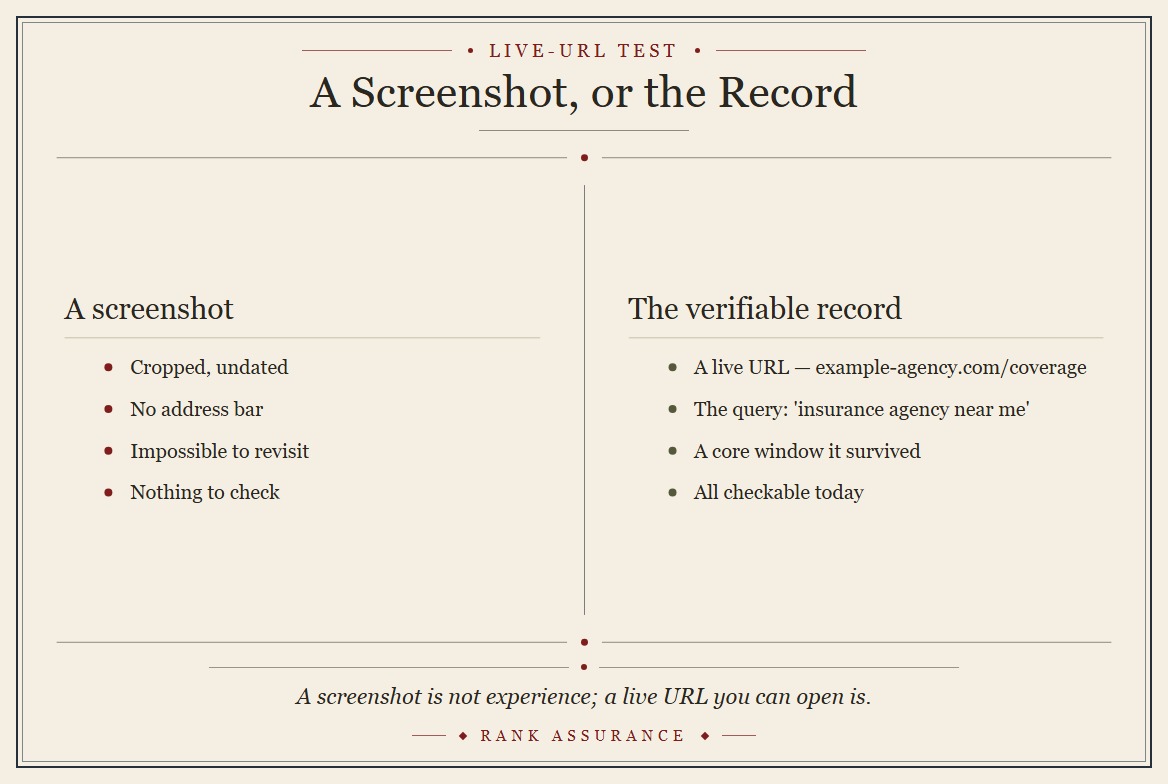
The Live-URL Test demands four inspectables from any ranking claim: the query, the live URL, the competing pages, and a date range spanning a core update.
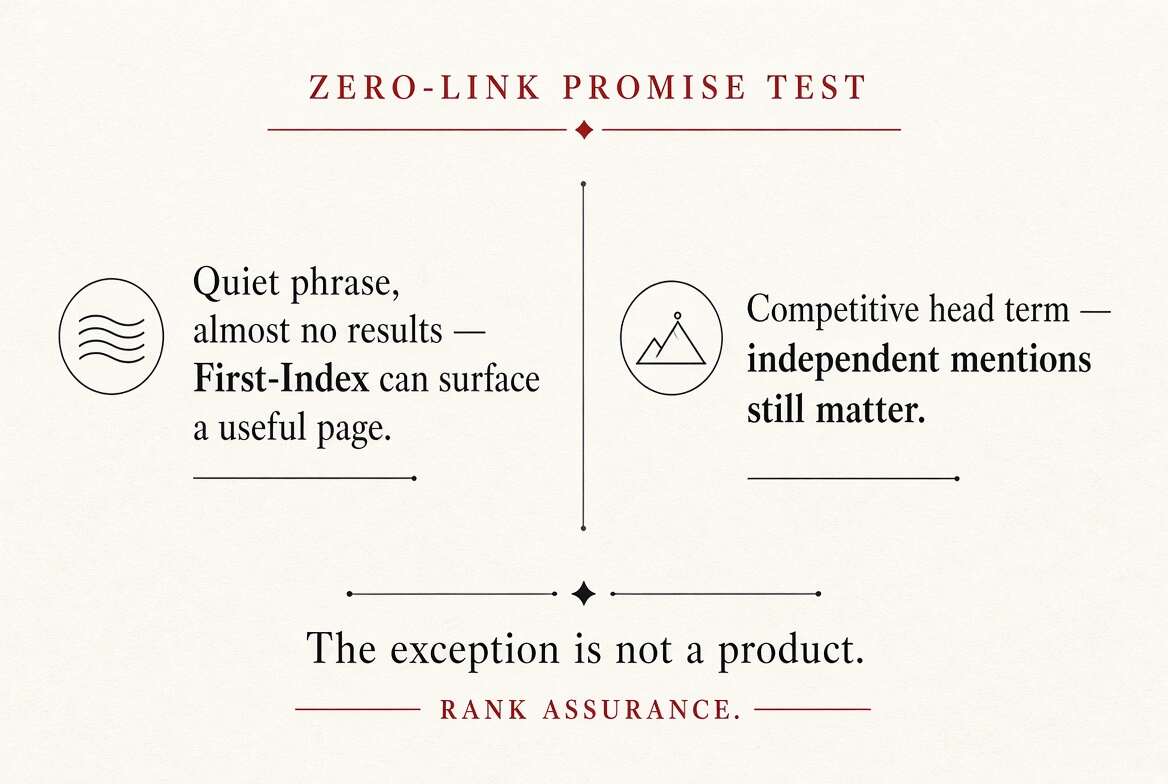
A quiet phrase with almost no results can surface a useful first page. That is First-Index, not a method you can sell for a contested head term. Anyone who ranked a competitive query with “content only” can name the live URL, the query, who else sits there, and whether it survived a core window. A blurred screenshot is not experience. Nobody can guarantee position one.
The Question This Article Answers
Someone says they write pages that rank without independent mentions — or that they “do SEO” because the industry has no license. What can you inspect? This page does not reprint Content-King, First-Index, or Fake-Client. It is the proof those pages ask for.
The Four Objects
| Object | What it is | Working test |
|---|---|---|
| Quiet first-index phrase | Almost no competing results. A useful first page can surface | First-Index |
| Contested query | Other real pages already sit there | Four Gates · Authority Gap |
| Blurred case study | A chart with the domain hidden | Fake-Client |
| No URL at all | A slogan, a guarantee, or a writing calendar | Pitch · Credential · Content-King |
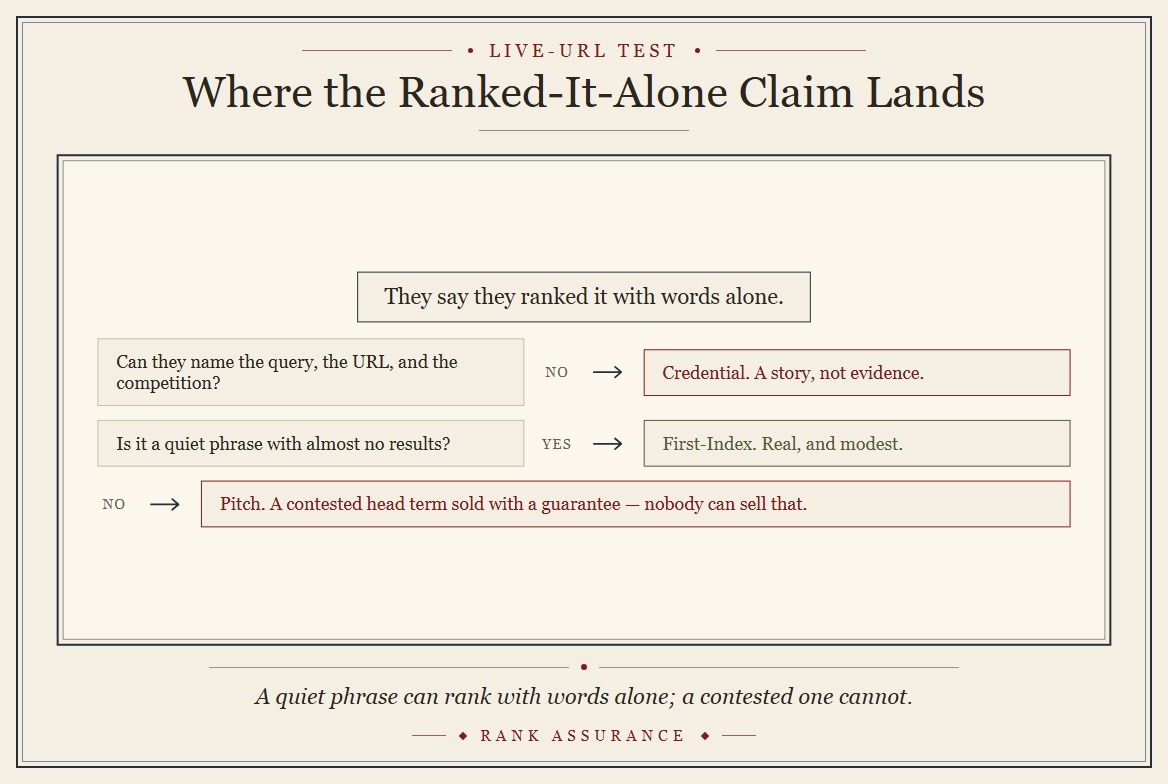
Official starter-guide language is short: no one can guarantee rankings. A writing retainer can still be honest work when the missing gate is match. It is Pitch when the promise is a contested #1 with words alone.
On a contested query, run the verification yourself. Open the SERP and look at who actually sits there — publishers, incumbents, the pages with years of citations. Then ask for the date range. If the property is yours, the range is checkable in your own Search Console; if it is theirs, ask for the export. A claim that cannot survive that ten-minute walk was never a case study.
This industry has no license. That is not permission to skip proof. The Work-Log Test is how you tell a practitioner from a slogan next month.
“It ranks with no backlinks” is the same demand. Name the live URL and the query. If the phrase is quiet, that is First-Index — the exception, not a method. If it is contested and they still cannot show the page, Content-King does not become a product. And a sold pyramid of links pointing at links is not the missing proof — buying the graph is its own failure, the Network-Footprint Test.
The AI Version of the Same Claim
“We got a client cited by ChatGPT” is this claim on the new surface, and the demand does not change: name the engine, the question, the date, and the answer text. One thing does change — AI answers re-roll. The same question asked twice can name different businesses, so a screenshot of one answer is even weaker evidence than a SERP screenshot. The only durable form is a dated run you can re-execute yourself. What being named actually requires is the Citation-Surface Test; what the counts mean is the Generative-Impression Test.
The Proof Request, Assembled
The article’s demand as one copyable message — send it unchanged:
Four Lines to Send
1. The query, exactly as typed.
2. The live URL that ranks for it.
3. Who else sits on that results page today.
4. A date range that spans a core update — and the Search Console export for it.
An honest practitioner answers in one email. A seller answers with a deck.
Calculator
Live-URL Calculator
Official-Path Next Step
- Ask for the query and the live URL. If they cannot name both, Pitch + Credential.
- Open the SERP. Is the phrase quiet or contested? First-Index vs Authority Gap.
- Ask whether the URL still sits there after a core window. A spike that vanished is not a method.
- Work-Log the next 30 days on your named URL. Do not buy a slogan.
Questions
Can Anything Rank Without Independent Mentions?
Yes — a new or almost-empty phrase can surface a useful first page. First-Index. That exception is not a product for “best credit card.”
Does a Writing Retainer Always Mean a Scam?
No. If the closed gate is match, writing is the work. If the promise is a contested #1 with no mentions and no URL they can show, that is Pitch.
They Showed a Client Video Testimonial Instead of a URL. Is That Enough?
No. A testimonial is a person praising the vendor; the test is a page you can open. Take the video as a reference call you have not made yet — then still ask for the four lines.
The Client Is Under NDA. What Is the Minimum Proof?
A reference call plus a dated Search Console export with the domain redacted but the queries and the range intact. If neither exists, the claim stays a claim.
How Do I Check a Claim Survived a Core Update?
Ask for the date range first, then compare it against Google’s published update timeline. A range that ends the week an update began is the tell. A range that spans one is the proof. Rank-Drop explains what updates do and do not mean.
Sources
- SEO Starter Guide — no guaranteed rankings.
- Creating helpful, reliable, people-first content.
- Spam policies — scaled content abuse.
- First-Index Test · SEO Pitch Test · Fake-Client Test · Credential Test.