
The Content-King Test.
A Slogan Is Not a Ranking System — and It Is Often a Sales Line
The Content-King Test asks what a 'content is king' claim is selling: a reader-true principle, a ranking law it is not, or a production retainer.
The phrase is true for readers: a useful page can hold someone and can be cited. It is false as a ranking law. A publishing quota, a course formula, or a production retainer does not name the missing gate. Ask which URL, which query, and which invoice the slogan is covering.
The Question This Article Answers
The Content-King Test asks what a “content is king” claim is selling: a reader-true principle, a ranking law it is not, or a production retainer. When someone says the phrase, this page names which of its five uses just walked into the room. It does not reprint Content-Quota, Two-Site, or E-E-A-T. Those already exist.
This page and the Popular-Advice Test divide one job. That page is the general filter — it files any viral tip into four buckets. This page takes the single most-sold phrase in the industry and dissects it use by use: the sales-costume bucket, at full length, on its favorite costume. Where the slogan came from and why the losing page is often the clearer one is the Authority Gap Test.
The Five Uses of the Slogan
| Use | What it means | Open |
|---|---|---|
| Reader-true | A useful page can hold a person and can be cited | Helpful-Content · Earned-Mention |
| Ranking-false | The phrase as a law that replaces mentions or fetch | Authority Gap · Two-Site |
| Sales costume | Therefore buy the quota, the course, or the tool | Content-Quota · Pitch |
| Unverifiable proof | Logo wall used to bless the slogan | Fake-Client |
| AI-era volume | “Publish more so the AIs learn you” — volume sold as AI visibility | Citation-Surface · Generative-Impression |
Reader-true. The honest use, and the oldest. A page that actually answers the question can hold a person, earn a mention, and be quoted by an answer engine. The shape to picture is the service page a buyer actually reads to the end. This use is required. It has never been sufficient on a contested query, and the person saying it this way usually is not selling anything.
Ranking-false. The phrase promoted from principle to law: publish well and the rest follows — no fetch problem matters, no mention gap matters. The shape to picture is “we don’t need links, the content will rank itself,” said about a head term where every page-one result carries years of independent citations. The Authority Gap Test is the measurement this use is skipping.
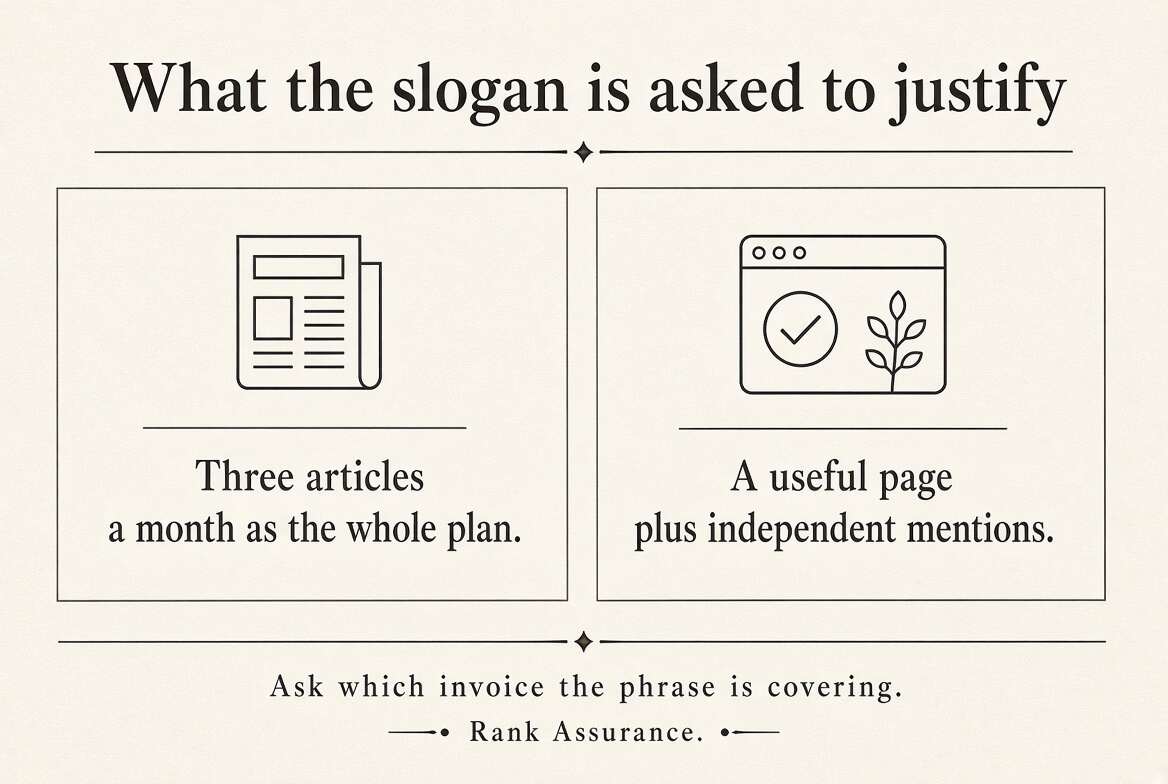
Sales costume. The law converted to an invoice: therefore buy the monthly quota, the course, the writing tool. The shape to picture is a “three articles a month” retainer where nobody can name which query any article targets. The slogan is doing the selling; the calendar is doing the billing. That is Content-Quota wearing a crown.
Unverifiable proof. The costume with a deck: a logo wall or a blurred chart blessing the slogan. Recognition is not performance, and a famous mark is not a case study — that is the Fake-Client Test, and the proof to demand is the Live-URL Test.
AI-era volume. The 2026 mutation: “publish more so the AI engines learn you.” Volume sold as AI visibility. Answer engines cite pages they can fetch, match, and trust — the same gates, new surface. An unnamed pile of posts is not a citation program, and “the AIs will learn you” without a named buyer question and a dated engine run is this decade’s version of the law that was never true. The Citation-Surface Test names what being quoted actually requires.
The exceptions are real and bounded. A quiet phrase with almost no results can surface a first useful page, and a property already trusted on a topic can publish faster — that is the First-Index Test. Those exceptions do not make a calendar the whole plan.
A Worked Example, Composed
Two Pages, One Query
A composed example, labeled as such. Page A is a 3,000-word guide on a contested query: accurate, well-structured, written by the person who does the work. Its domain is two years old and almost nothing independent mentions it. It sits on page four. Page B is thinner and plainer, on a domain that publications have cited for a decade. It holds position three.
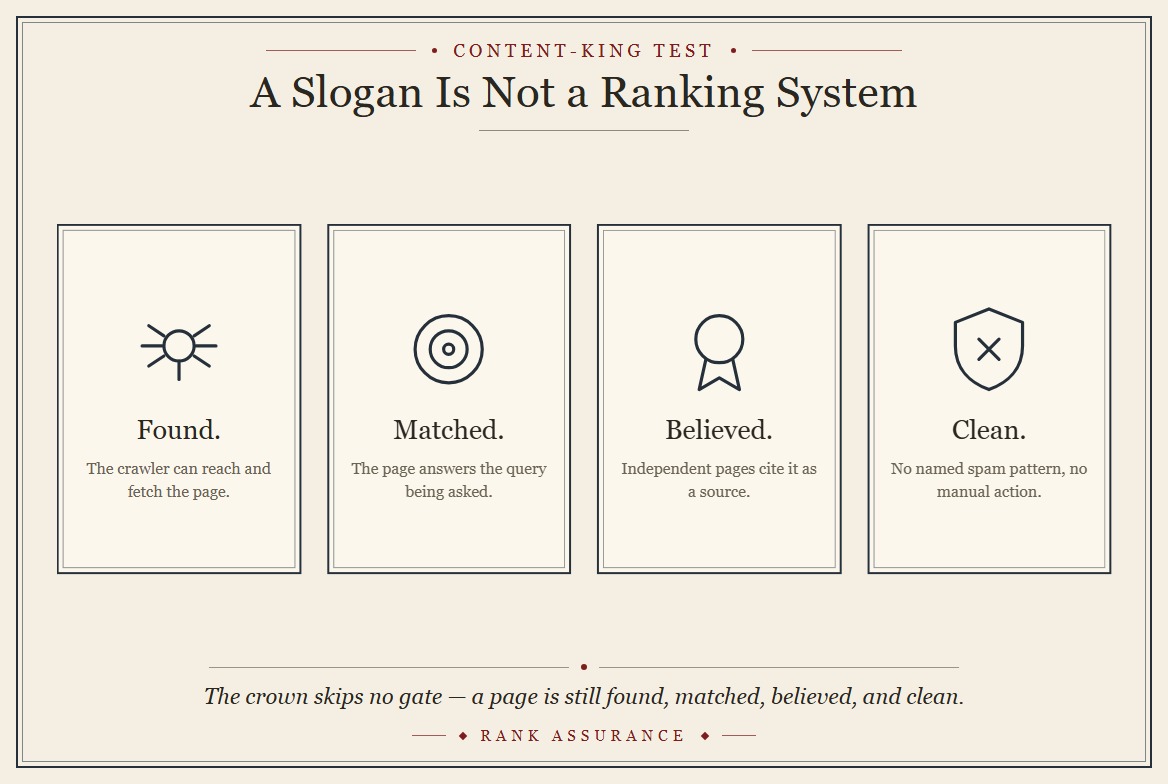
The slogan says A should win. It does not, and not because the writing failed — the missing gate is independent mentions, and more words do not close it. The measured sample reports show the same shape more than once: a page that matches the query and sits still, with the mention column near empty. When that is the diagnosis, the honest next project is the gap, not a bigger calendar — and a vendor who answers this diagnosis with “more content” has moved from reader-true to sales costume in one sentence.
Calculator
Content-King Calculator
Official-Path Next Step
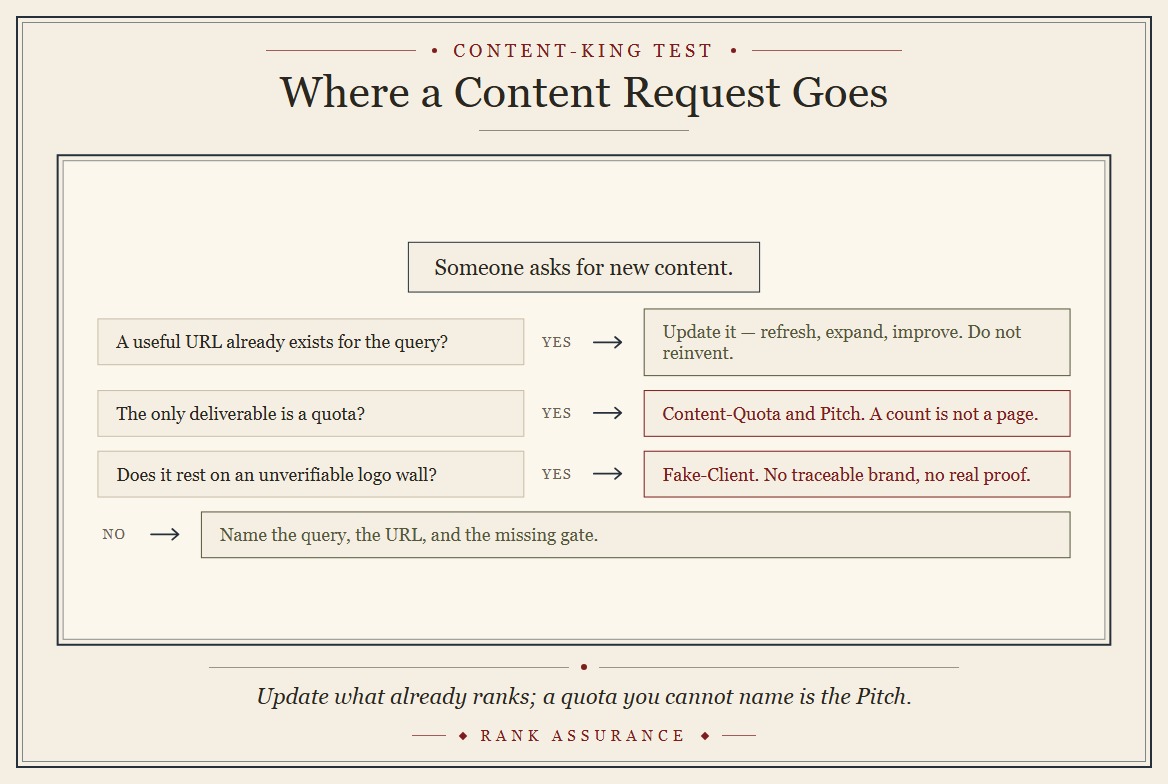
- Ask which URL and which query. If they cannot name both, Pitch.
- If a close URL already has impressions, update it. Content-Quota.
- If the page is useful and empty on mentions, Authority Gap — not another slogan.
- Work-Log the next 30 days on the named URL.
Questions
Is the Slogan Ever True?
For readers, yes. A page that answers the question is required. As a law that replaces independent mentions, no.
Are Agencies That Write Always Selling a Lie?
No. A named URL, a named query, and a missing gate can include writing. A calendar with no gate named is the Pitch fail.
Does AI-Generated Content Rank?
Origin is not the official test — scaled unhelpful pages are, however they were made. A useful page can rank whoever drafted it; a thousand thin ones are scaled content abuse. That is the Helpful-Content Test.
How Much Content Do I Need Before Links Matter?
They are not sequential. A page must exist and match before anything else counts, but on a contested query the mention gate is open from day one. One strong page plus earned mentions beats forty posts plus none — Page-and-Graph.
Is Refreshing an Old Page Better Than Writing a New Post?
Usually, when a close URL already has impressions for the query. Update the page that is already in the game — that is the Content-Quota Test’s first check.
Sources
- Creating helpful, reliable, people-first content.
- Spam policies — scaled content abuse.
- Popular-Advice Test · Authority Gap Test — the general filter, and the slogan’s history.
- Content-Quota Test · Two-Site Test · E-E-A-T Test · SEO Pitch Test.