
The Position-Value Test.
What a Ranking Is Worth After You Separate Impressions, Clicks, and Revenue
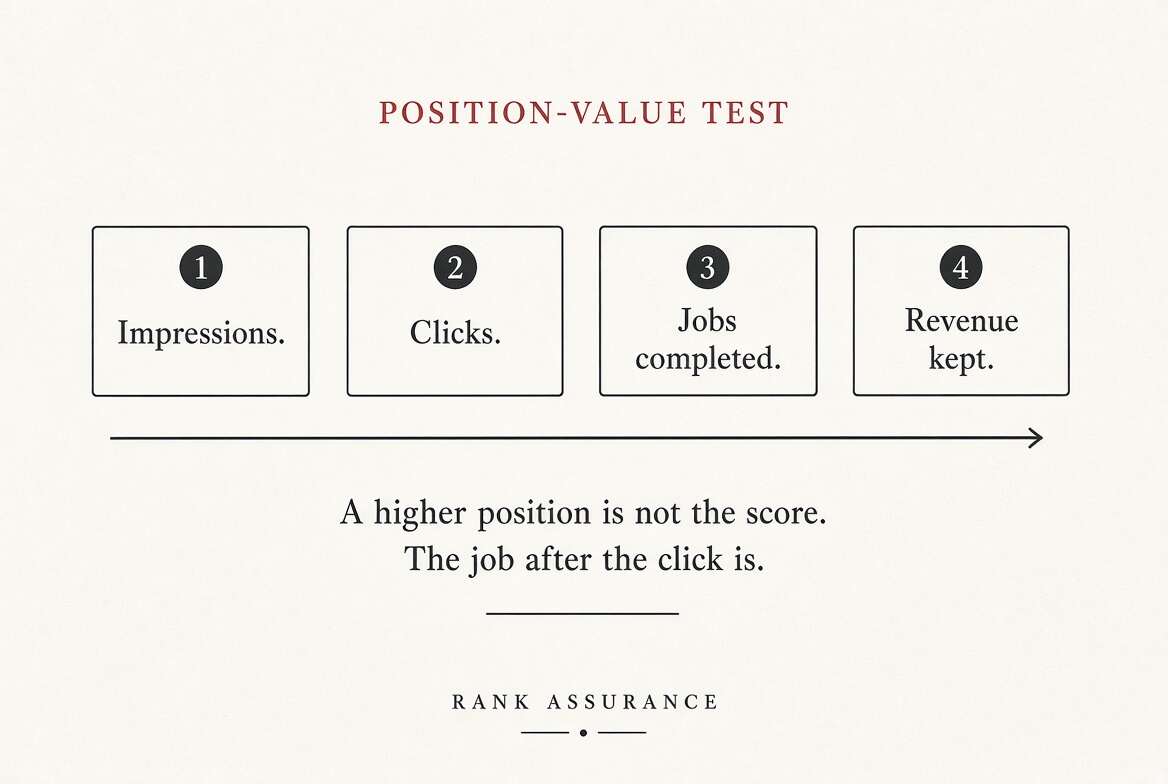
The Position-Value Test prices a ranking by its impressions, clicks, and completed business job — never by position alone.
Page one is not one prize. Official guidance is to watch impressions and clicks, not to obsess over an absolute position. Published click-through studies put position 1 anywhere from about 27.6% to 39.8% of clicks, and an AI Overview can cut the blue-link share again. The number that pays the rent is the job after the visit — a call, a booking, a sale — on the surface that actually showed.
The Short Answer
A ranking is worth the clicks it produces on a query that can do a business job. It is not worth a vendor slide that says “page one multiplies traffic by 5×.” The chain has three links — impressions, clicks, and the completed job — and position is only the middle of it.
What Google Says
Google does not publish a universal click-through table. It publishes four Search Console metrics — impressions, clicks, CTR, average position — and it tells owners not to focus too much on absolute position.
What the Studies Say
Published studies put position 1 anywhere between roughly 27.6% and 39.8% of clicks, and every curve falls steeply below it. Studies are a planning range. Your Search Console is the real number.
What Pays
Progress is the named query and the named URL over time. An average of position 1 and position 27 is not a result. The official first log is Search Console Performance. A third-party daily chart can sit next to it — it is not a ranking system, and a shape on that chart is not a penalty oracle. A sudden fall is the Rank-Drop Test’s job, and logging the date you shipped against the date the query moved is the Work-Log Test’s whole discipline.
The companion piece, What Page One Is Worth, tells the page-one economics story at full length. This page is the test you run on your own query.
What Search Console Actually Measures
| Metric | Official meaning | What it is not |
|---|---|---|
| Impressions | A user saw a link to your page or site in Search, News, or Discover. | Not a ranking. Not a sale. |
| Clicks | A user clicked a link to your page or site. | Not revenue. Analytics sessions will not match one-for-one. |
| CTR | Clicks divided by impressions. High CTR means the result looked like the answer. | Not a Google ranking factor you can game with a percentage cap. |
| Average position | Where the URL or property typically appeared when it was shown. | Not the prize. Official: do not focus too much on absolute position. |
Property-level and page-level totals are counted differently. If three of your URLs appear on one results page, property aggregation counts one impression and the topmost position. Page aggregation counts each URL. That is why two exports from the same week can disagree without anyone lying.
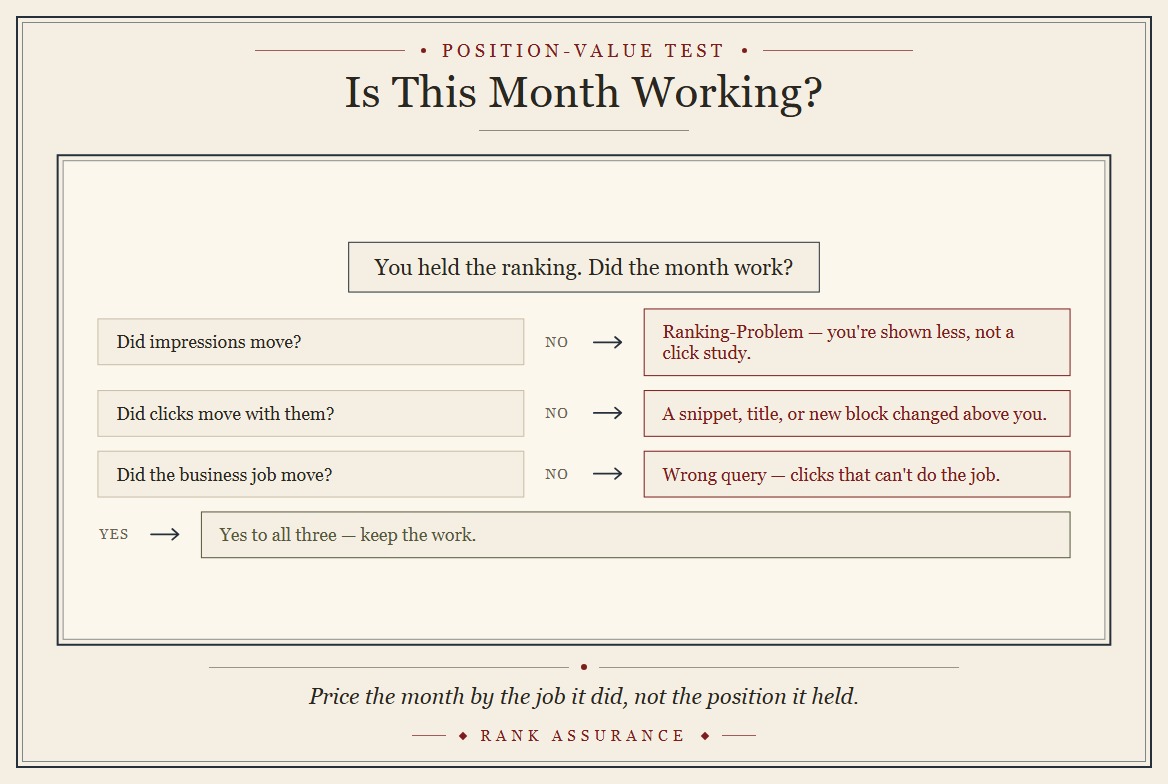
When impressions stay flat and clicks fall, official debug guidance points at titles, snippets, and richer competing results — not at “we lost authority overnight.” When both fall, check the query in Trends, the surface (web / image / video / news), and whether the page is still fetched. That is the Ranking-Problem Test, not a new score.
A worked read — invented numbers, real method. Suppose the 28-day row for a service query says 4,000 impressions, 128 clicks (3.2% CTR), average position 3.1 — while the study range at position 3 sits near 10%. Position held; the click share did not. That is not a rewrite order. Open the live results page first: if an AI answer or a map pack now sits above the blue links, the surface changed — Citation-Surface or Local Pack, not new content. If nothing new sits above you, the title and snippet are the levers official debugging names first. And the verdict column is always the job: 128 clicks that book work beat 400 that do not.
Industry CTR Benchmarks (Not Google)
These are published studies. They are useful as a planning range. They are not a ranking system and they are not your Search Console. Every row below was last verified against its linked source on 19 September 2026.
Read the range, not a single cell. Position 1 in the current revisions of this work sits roughly between 27.6% and 39.8%. Position 10 in the First Page Sage curve is 1.6%. That gap is why “we made page one” is not a business sentence until you name the query and the position band.
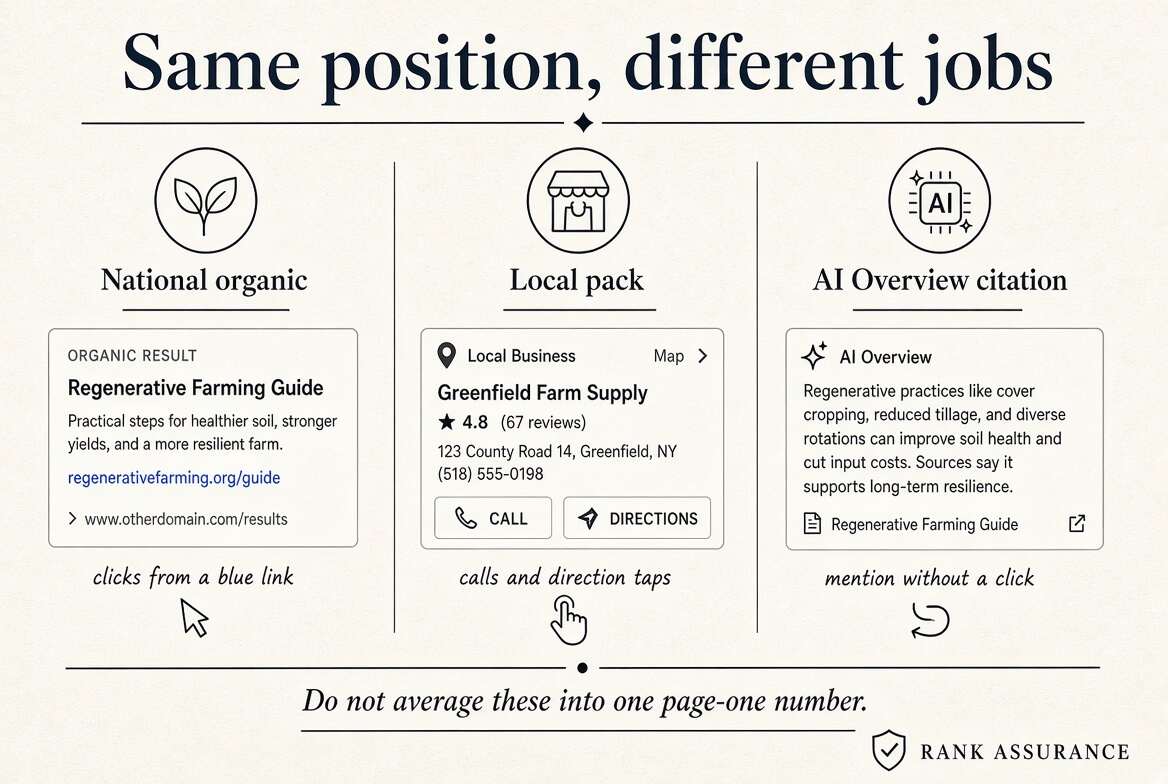
AI Overviews change the same chain. A July 2025 Pew Research Center browsing panel of U.S. adults found fewer clicks to ordinary results when a summary is present. Citation-Surface is the test for that surface. Do not average an Overview query into a classic page-one multiplier.
Where AI Answers Show in Search Console
Since June 2026, Search Console has carried a dedicated performance view for generative AI features: impressions are logged when a URL from your property appears inside an AI Overview or AI Mode. That changes how the four numbers read. An AI appearance moves impressions first — you can be shown inside a summary with no click following. Clicks still count only when a person comes through. CTR therefore falls mechanically when the page answers on the screen, and average position stops describing what the eye saw: a #1 blue link under a full-width answer is not the first thing on the page.
So split the surfaces before you judge the chain. The Generative-Impression Test reads the new log — were we shown inside the answer? The SERP-Surface Test names which block actually sat on screen. Neither replaces this page’s question: did the click that survived do the job?
Calculator
The arithmetic with no script: 1,000 impressions at position 3 on the First Page Sage curve is about 102 clicks (10.2%); the same 1,000 impressions at position 10 is about 16 (1.6%). The calculator below only automates that multiplication — and your own Search Console CTR replaces the study number the day you have 28 days of data.
Position-Value Calculator
This is a planning estimate using the First Page Sage curve (updated 28 May 2025). Your Search Console CTR is the real number.
Official-Path Next Step
- Export 28 days of Search Console by query and by page. Keep property and page views separate.
- For each money query, write four numbers: impressions, clicks, CTR, position. Then write the business job.
- If impressions did not move, Ranking-Problem / First-Index / Topic-Fit — not a CTR study.
- If impressions moved and clicks did not, fix the title and snippet. Official debug guidance already says that.
- If clicks moved and revenue did not, you ranked for the wrong job. Retainer Fit.
- If the query now shows an Overview, open the generative AI view and measure citation as well as clicks. Citation-Surface Test.
Questions
Does Google publish official CTR by position?
No. Use Search Console for your queries. Use published studies only as a planning range, and name the study.
Do AI Overview appearances count as impressions in Search Console?
Yes. An impression counts when a URL from your property appears, including inside generative AI features, and since June 2026 a dedicated report shows those appearances separately. Being shown is not being visited — read clicks beside it. Generative-Impression Test.
Is CTR a ranking factor?
Google does not publish click-through rate as a tunable ranking factor, and no percentage threshold earns a position. Treat your CTR as a reading on the title and snippet, not a dial you can set.
What CTR should I expect at positions 4–10?
In the one study that publishes the full curve — First Page Sage, updated 28 May 2025 — the fall is steep: about 7.2% at position 4, 5.1% at 5, and 1.6% at 10. Treat that as the planning shape, not your number.
How many days of data before judging a position change?
Compare full windows — 28 days against the prior 28, matching weekdays — before calling a move. The Performance report holds sixteen months, so there is no reason to judge a Tuesday against a Sunday.
Should we report average position to a client?
As a supporting column, yes. As the score, no. Official: impressions and clicks are the measure of success.
What if we are cited in an AI Overview but clicks fell?
That can still be a win if the job is brand demand. It is a loss if the job was the visit. Measure both. Citation-Surface Test.
Sources
- How are you performing on Google? — impressions, clicks, CTR.
- Debug Search traffic drops (updated 10 December 2025) — do not focus too much on absolute position; impressions and clicks measure success.
- How to use Search Console.
- Using Search Console and Analytics together (updated 7 January 2026).
- Search generative AI performance reports (3 June 2026) — the dedicated view for AI Overview and AI Mode appearances.
- First Page Sage CTR by position (updated 28 May 2025) — industry benchmark, not a Google table.
- Backlinko Google CTR statistics (updated 16 April 2025) — position 1 and top-3 share in the current revision.
- Sistrix CTR study (July 2020, 80M keywords) — positions 1, 2, 3, and 10.
- Amsive AI Overviews CTR research (April 2025, 700K keywords) — average CTR change where an Overview appears.
- Pew Research Center (July 2025) — browsing panel; fewer result clicks when an AI summary is present.