
The SERP-Surface Test.
A Rank Number Is Not the Same as Being Seen
The SERP-Surface Test checks which block of the results page actually showed — not the rank number a tracker reported.
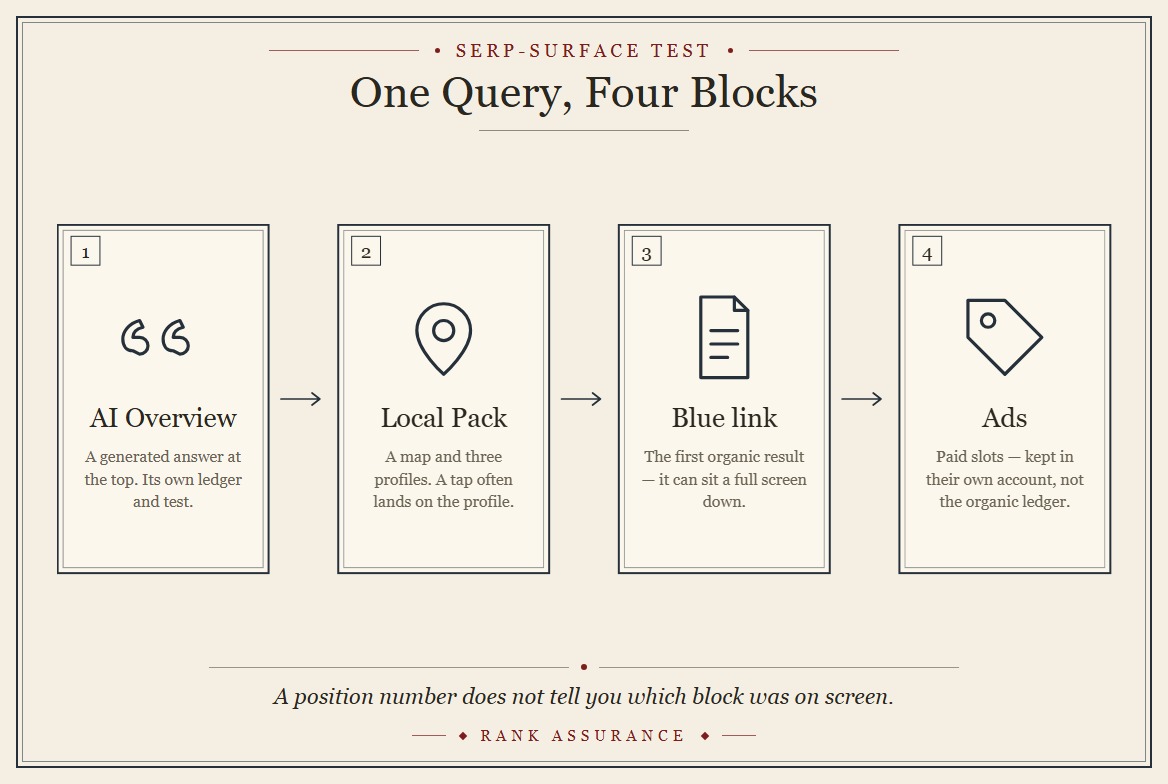
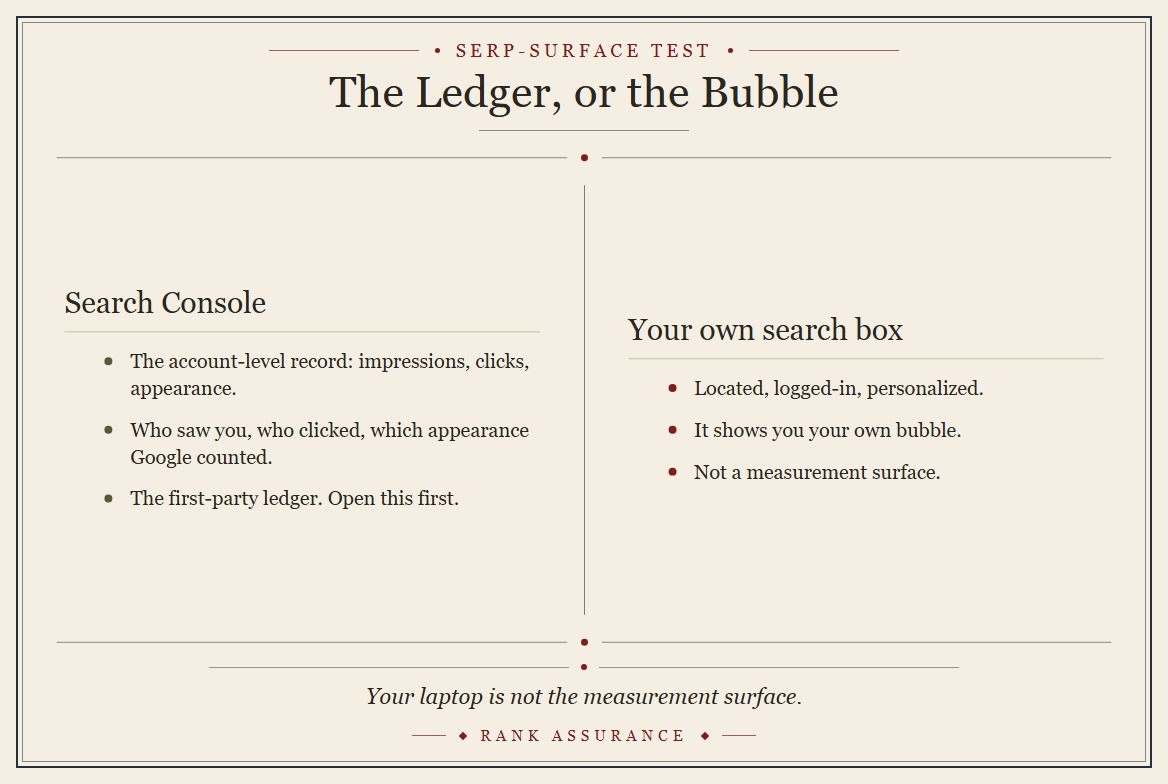
A results page is a stack of blocks. An AI Overview, a local pack, ads, and a blue link can all sit on the same query. A vendor chart that says “position 1” does not tell you which block was on screen. Search Console is the first-party ledger: who saw you, who clicked, and which appearance Google counted. Your laptop search box is personalized. It is not the measurement surface.
The Question This Article Answers
A rank number tells you where a link sat in a list. It does not tell you which block of the results page a person actually saw. “If you are not tracking SERPs you are not doing SEO” is a product sentence. Official first work is Search Console. A third-party panel can add one useful thing GSC averages hide: which feature sat above the blue link. It cannot replace impressions, clicks, or the job after the visit. And searching your own phrase on your own phone is its own trap — the Name-SERP Test covers the “I googled it myself” half.
The Order
| Instrument | What it is good for | What it is not |
|---|---|---|
| Search Console Performance | Impressions, clicks, CTR, average position, search appearance | A screenshot of page one |
| Generative AI reportdedicated view since June 2026 | Whether an AI Overview or AI Mode appearance is counting impressions | A published official CTR table |
| A daily rank panel | Seeing a pack or Overview appear above you | More true than GSC |
| Your browser | A one-off look at layout | A control group |
| Booked jobs and revenue | Whether the visit paid | A ranking factor |
If you use a panel, the useful settings are location, device, and a history long enough to see a feature appear. Track the queries that can do a job — not a list the tool invented. The brand of the panel is not the test. Buying a tracker is not the same as doing the work in First-Index or Topic-Fit.
Search Console is not “four data points.” The Performance report covers up to sixteen months and can be filtered by query, page, country, device, and search appearance. A daily panel adds one thing the average can hide: a sudden cliff on one keyword, or a pack appearing above you. It does not replace the ledger.
Which Block Was on Screen
The results page is a stack. Each block has its own ledger and its own owning test. Mapping checked against the linked documentation on 19 September 2026.
One query, read once. Take “emergency plumber” in any mid-size city tonight: ads first, then a map pack, sometimes an AI answer, then the first blue link — which can sit a full screen down. Four blocks, four ledgers, four different jobs. A tracker that says “#1” has told you about one of them.
What a Chart Can Prove
The Four-Field Evidence Row
Ask a vendor for four things on the same row: the query they tracked, the location and device of the check, the date, and the Search Console clicks for that query in the same window. A screenshot missing any field is not evidence.
A line that climbs on a phrase nobody searches is not a win. That is the SEO Pitch Test wearing a chart. A plugin is not a ranking system, and a developer who installs one has not measured a surface — when a pitch conflates the two, that is the Two-Problem Test.
A sawtooth line that jumps from page one to page seven and back is a reason to open Search Console manual actions. It is not, by itself, a named penalty. Suppression Type first. Then Ranking-Problem if Google named nothing.
When you do want a look anyway: sign out, use a private window, set the location you care about, and check on the device your buyers use. That look is cleaner — it is still not a control group. Your history is gone; the location, language, time of day, and whatever test Google is running are not. Treat it as one photograph of one screen.
Calculator
SERP-Surface Calculator
Official-Path Next Step
- Open 28 days of Search Console by query. Note impressions, clicks, appearance.
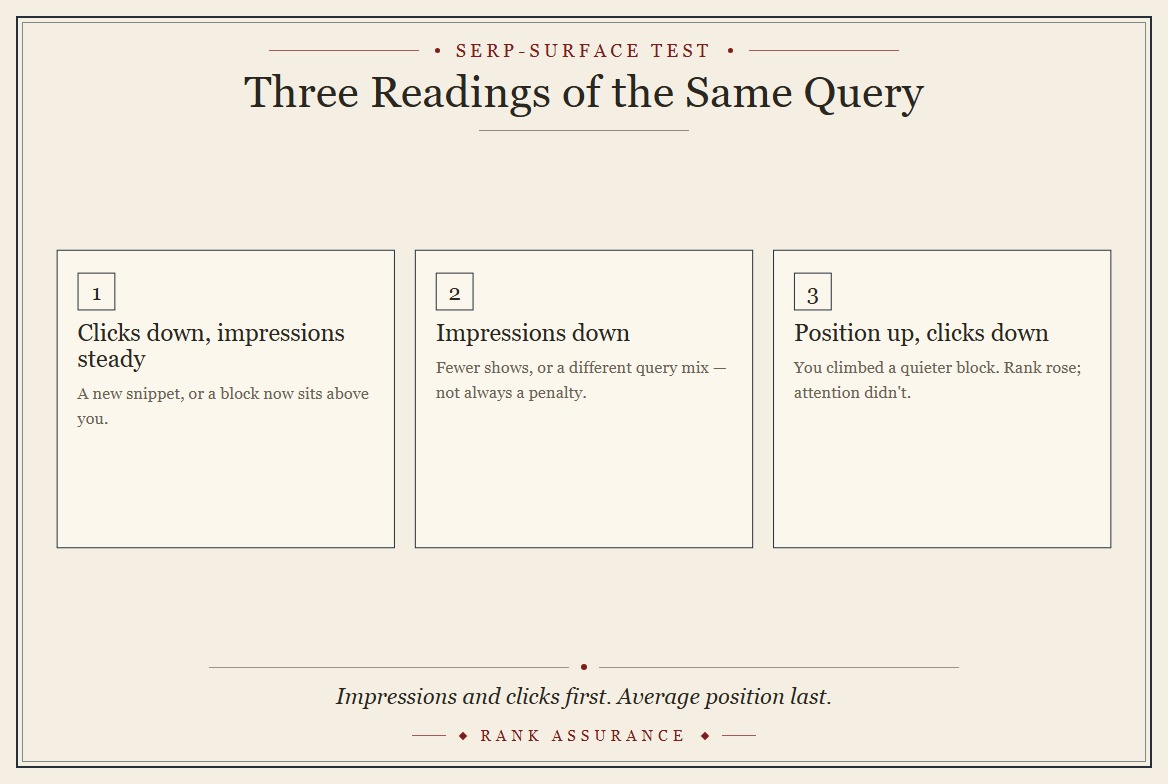
- If clicks fell and impressions did not, look at the snippet and at which block now sits above you.
- If the query is local, Local Pack Test. If an Overview is present, Citation-Surface + Position-Value.
- A rank panel is optional after that — to watch the block, not to replace the ledger.
Questions
Do I need a paid rank tracker to do SEO?
No. Official first instrument is Search Console. A panel is useful when you need to see which feature appeared. It is not the work.
Why do I see different results than my customers?
Location, device, history, language, and running experiments all shape one screen. Your customers hold none of your variables. That is why the ledger is Search Console, not your own search box.
Does Search Console show AI Overview impressions?
Yes. Appearances inside generative AI features count impressions, and since June 2026 a dedicated report shows them separately. Generative-Impression Test.
Average position vs pixel position — what is the difference?
Average position is Google’s count of where your topmost result sat in its ordered list. “Pixel position” is a vendor measure of how far down the rendered screen a link began. The first is official and query-level; the second is an estimate of the eye’s path. Neither tells you the job got done.
How do I verify an agency’s ranking screenshot?
Ask for the Four-Field Evidence Row: the query, the location and device, the date, and the Search Console clicks for that query in the same window. A screenshot that cannot produce the fourth field is a picture, not a report.
Why did we rise in a tracker and lose clicks?
You may have climbed a quieter block, or an Overview took the visit. Position-Value Test.
Sources
- How are you performing on Google?
- Debug Search traffic drops — do not focus too much on absolute position.
- How to use Search Console.
- Search generative AI performance reports (3 June 2026) — the dedicated view for AI Overview and AI Mode appearances.
- Position-Value Test · Citation-Surface Test · Local Pack Test · Name-SERP Test · Generative-Impression Test.