
The Two-Problem Test.
When the Site Is the Issue — and When the Pitch Is
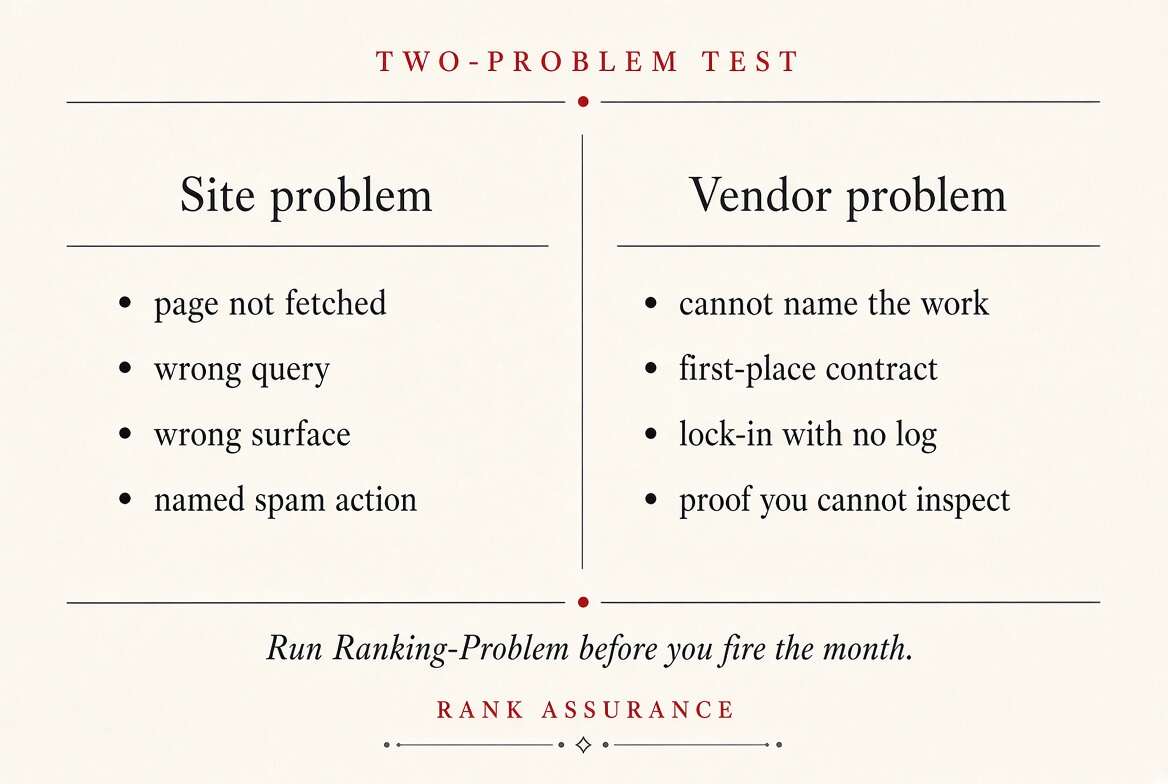
The Two-Problem Test separates 'SEO is not working' into two independently checkable failures — a site problem and a vendor problem — that can both be true at once.
“SEO is not working” is usually two sentences glued together. One is about the page, the query, and the surface. The other is about a pitch you cannot inspect. This article keeps those sentences apart. It is not a reprint of “content does not matter” and it is not a statistic about how many agencies are dishonest.
The Question This Article Answers
Recap talks mix a theory of ranking with a theory of the market. Both can be wrong at the same time. A page can fail the Four Gates while the vendor is also selling a first-place contract. Firing the vendor does not index a blocked URL. Writing another article does not replace a work log you never got.
Part 1 The Site Problem People Misname
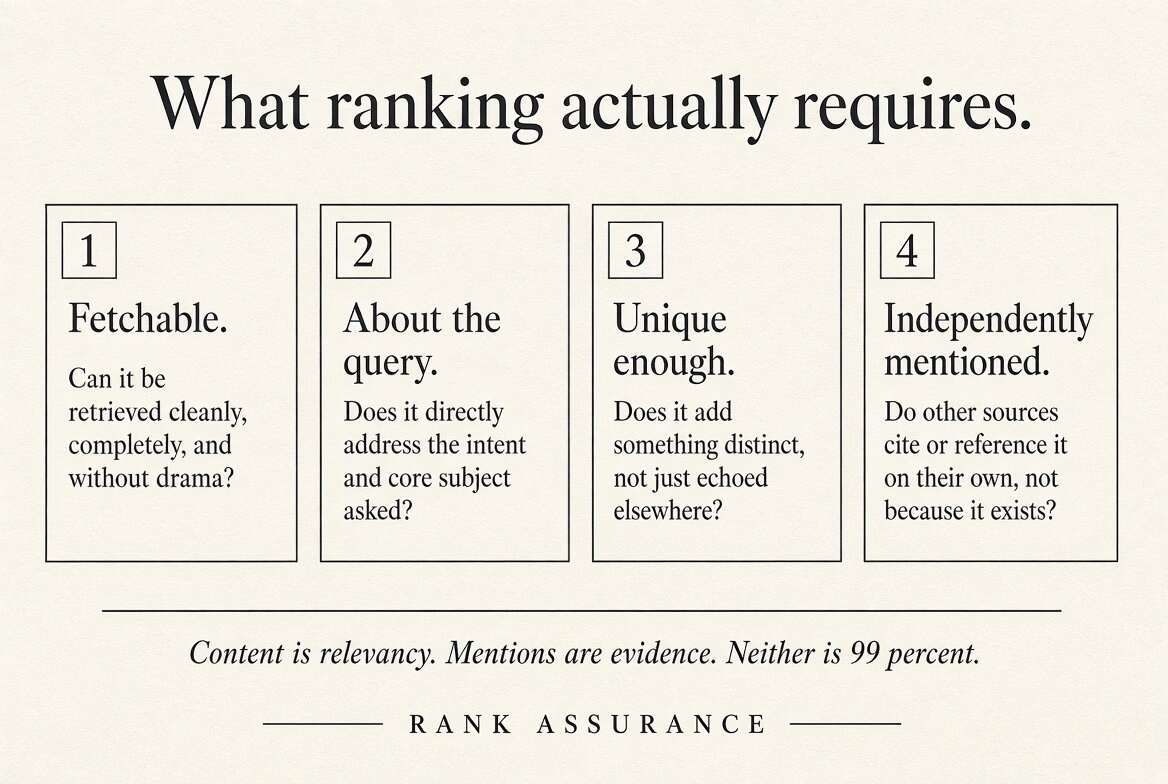
“Content is king” and “only links matter” are both incomplete. A page has to be fetchable, about the query, unique enough, and independently mentioned. That is the Authority Gap order. There is no official 99 / 1 split.
Useful pages still matter. The Starter Guide and the helpful-content document say so. Scaled, thin, or unreviewed commodity pages are a named spam problem. Mentions still matter on competitive queries. Buying unmarked follows is also a named spam problem. One side of that sentence does not erase the other.
Technical blocks — robots, noindex, canonical to the wrong URL, a staging host in the index — are First-Index failures. A manual action or a named spam pattern is Suppression Type. A local-pack job treated as national-organic is Local Pack. An AI Overview that stopped citing you is Citation-Surface. None of those is proof that “SEO is a myth.”
Owner-written pages are often better because the owner has the first-hand work. That is not a law against a writer. It is a law against pages nobody could defend in a room.
Part 2 The Vendor Problem People Misname
There is no official Google SEO certification. Anyone can sell a month. That is why the hiring guide exists: no first-place guarantee, no special relationship, no “priority submit,” methods you can understand, Search Console you can see.
A precise question that gets a vague answer is the Pitch Test failing in the room. An empty month is the Work-Log Test. A year you cannot exit is the Contract-Term Test. A logo wall you cannot inspect is the Vendor Claim Test. A graph they can take down is the Network-Footprint Test. None of those requires a statistic about “most of the industry.”
Comment-profile and forum-signature blasts are named in Google’s spam policies as link spam. They are not a clever second tier. Extra domains you operate so you can vote for yourself fail Sister-Site whether you call them a portfolio or a network.
The Third Shape: an AI-Visibility Pitch You Cannot Verify
The newest recap pitch is an AI-visibility retainer. The label varies — AI SEO, GEO, answer-engine work — but the shape is the month you already know: a promise about a surface nobody in the room has measured, priced before anyone names a question. The two-problem logic does not change because the surface did. Your pages can be invisible to the AI engines for site reasons while the vendor is also selling a number you cannot check.
The claim is only evidence when it is a dated, reproducible measurement: the engine, the exact question, the date it was asked, and the answer text itself. A dashboard screenshot is none of those things. Verification reads like this: In one measured market run (September 2026, a medical-spa market), the subject business was named by one of four engines, held about a 1.2 percent share of answer voice, and was cited as a source in none of the answers. A sentence like that can be re-run on a later date and checked. A score in a vendor portal cannot.
If the pitch carries a number you cannot reproduce, open the Vendor Claim Test. If you want to know what the engines actually cite before you buy a month against it, open the Citation-Surface Test.
Calculator
Two-Problem Calculator
Official-Path Next Step
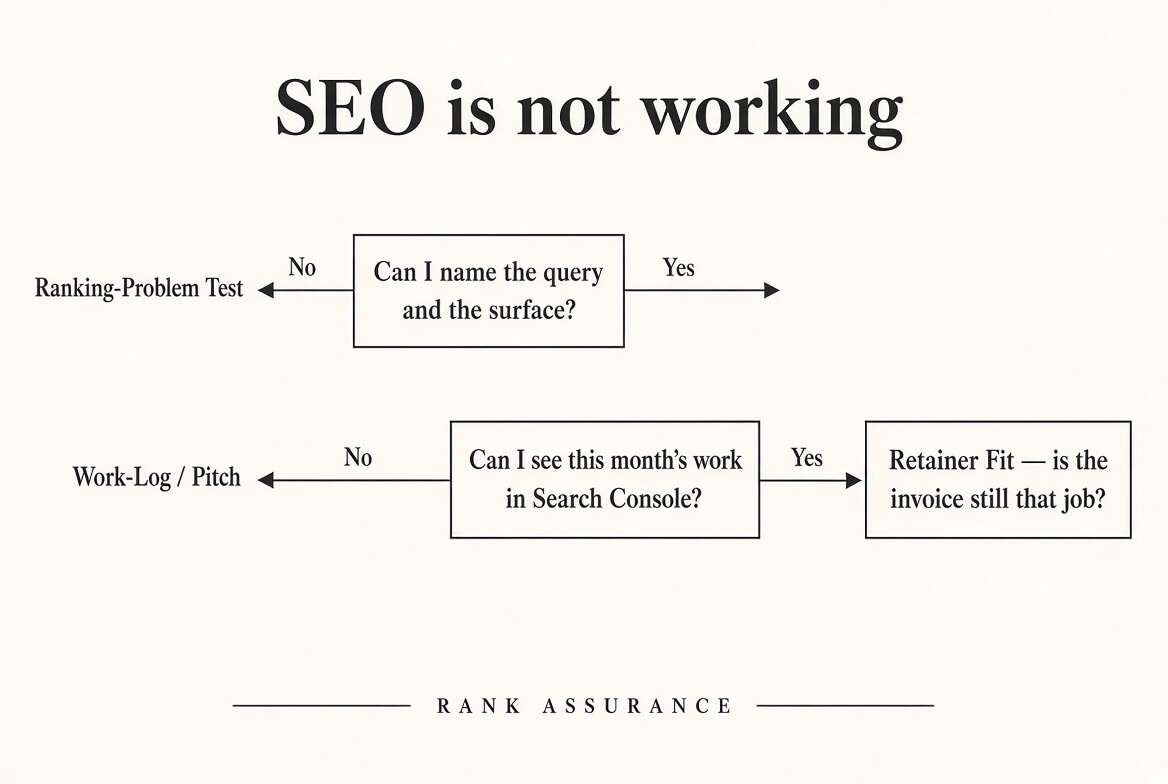
- Run Figure 3. Write the query and the surface on paper.
- If the page is not fetched, First-Index. If it is the wrong job, Ranking-Problem.
- If the work is invisible, Pitch + Work-Log. If the paper will not let you leave, Contract-Term.
- If both sides fail, fix the site first so the next invoice has a job.
Questions
Is There an Official Google SEO License?
No. That is why proof has to be a property you can inspect, not a certificate.
Traffic Fell and They Said It Is an Algorithm.
Maybe. Open Ranking-Problem first: query, surface, fetch, usefulness. Then Search Console. Then the work log.
Sources
- SEO Starter Guide — useful content; hours to months.
- A guide to Google Search ranking systems.
- Creating helpful, reliable, people-first content.
- Hiring an SEO (updated 5 June 2026) — no #1 guarantee; methods you can understand.
- Spam policies (updated 28 August 2026).