
The Ranking-Factor Test.
Official Systems Beat Folklore Checklists — “Can It Be Faked?” Is Not the Whole Test
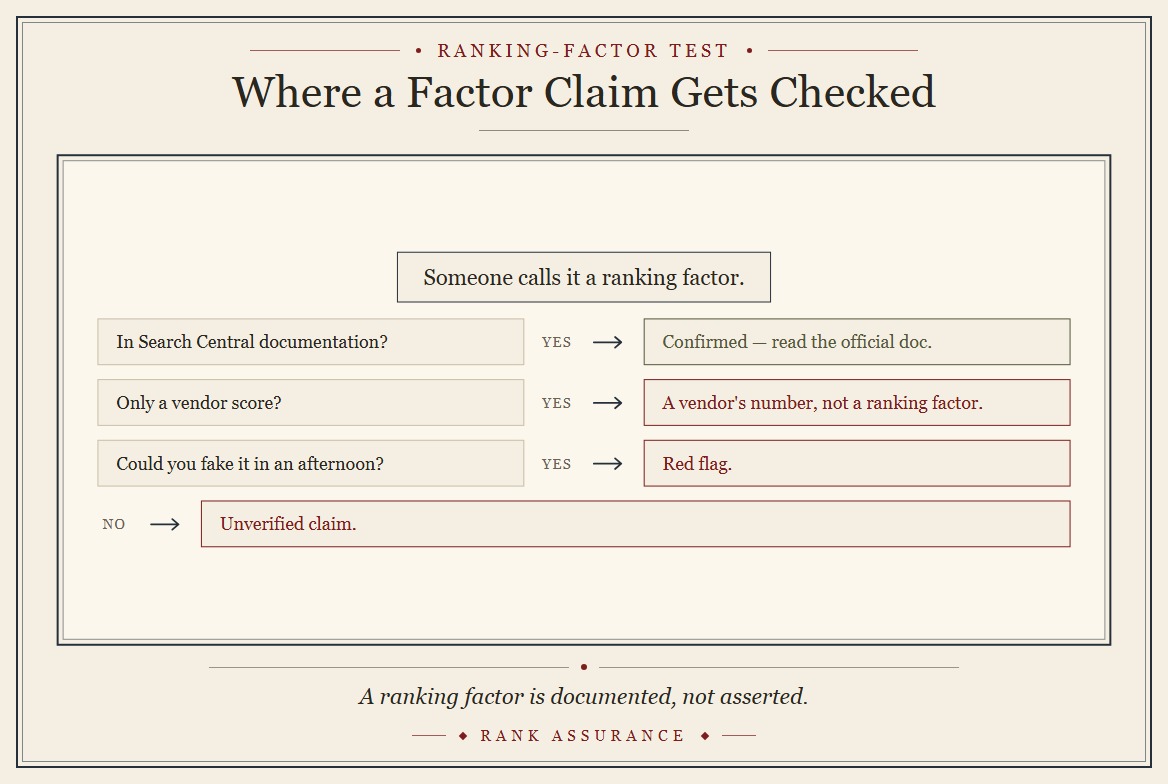
The Ranking-Factor Test is the four-question filter that checks a claimed factor against Google's published systems before it earns a place in any plan.
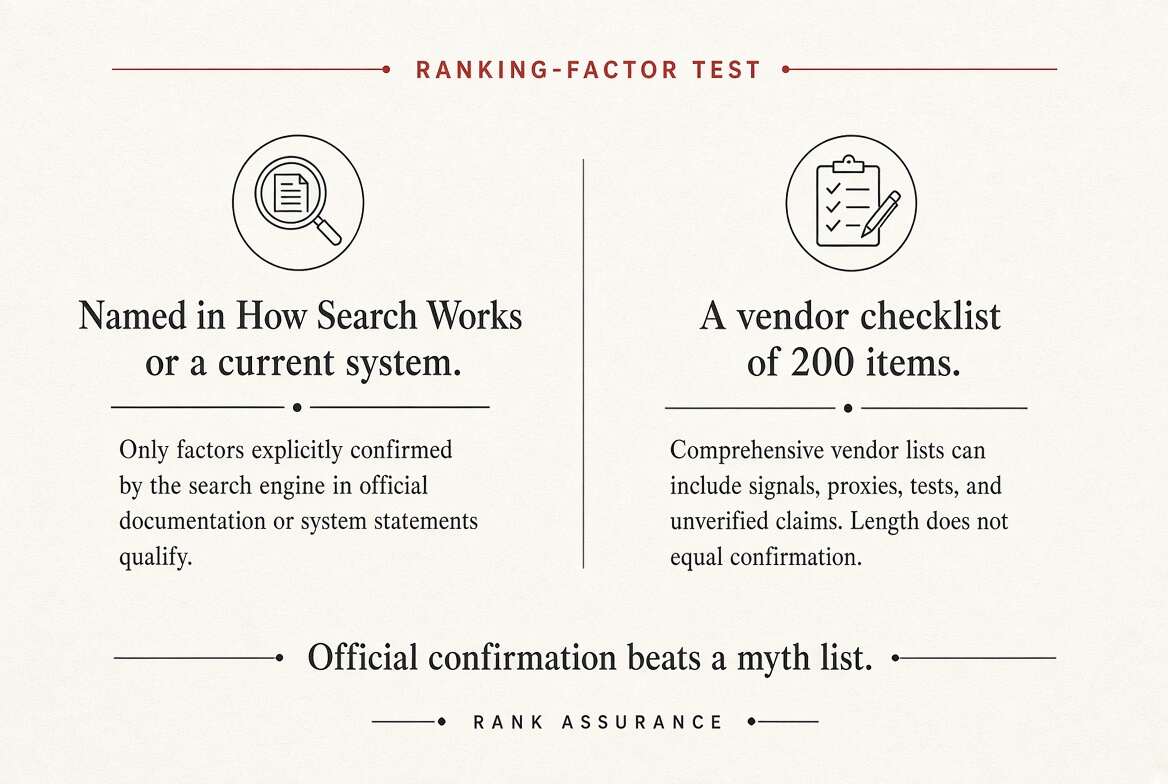
A ranking factor is not a vendor list of 200 items. Start at How Search Works and the ranking-systems guide. Page experience exists. E-E-A-T is not a page score. Difficulty-to-fake is a weak test by itself. If they sold a metric Google does not publish, that is Domain-Score.
The Question This Article Answers
They said X is a ranking factor. Is it? This page does not reprint the Four Gates or E-E-A-T. It is the filter before you treat a blog checklist as law.
Four Questions
Three Words That Are Not Synonyms
A system is machinery Google names in its own documents — the entries in the ranking-systems guide. A signal is an input those systems read; the official language describes many signals combined. A “factor” is the folklore word — a list item somebody promises to sell you. The first two have documents. The third has a salesperson.
Page experience is a published system. Core Web Vitals are used. Official: there is no single page-experience signal, and the most relevant result can still rank with a weaker experience. Extreme slowness can still fail a user, but speed is rarely why a contested query is lost — and when one is, the cause usually lives at match or mentions. Two-Site and Authority Gap find which.
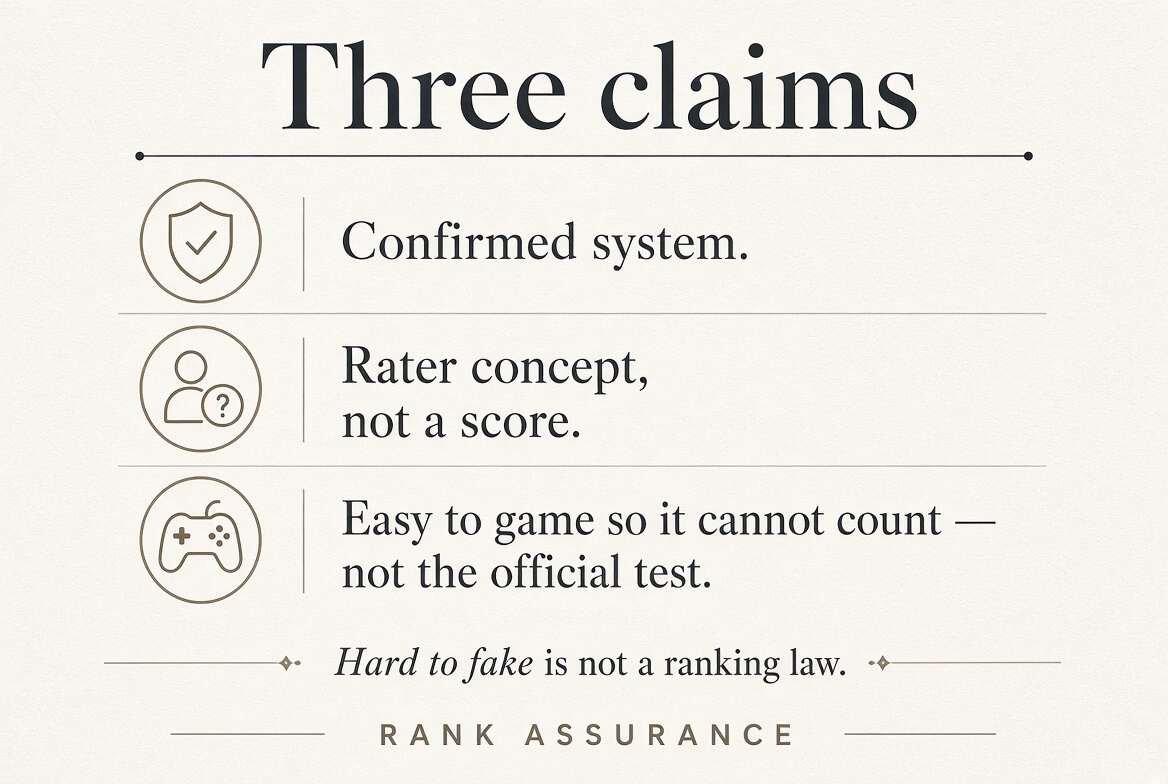
E-E-A-T is rater language, not a page score. A fake bio does not create trust and does not prove the concept is unused. E-E-A-T Test.
Claim Against the Record
The fastest version of this test is a lookup. Eight common claims, checked against the linked official documents on 19 September 2026. When a claim is absent from the record, it is not automatically false — it is folklore until a live URL and a dated log say otherwise.
| The claim | In the published record? | Where to check |
|---|---|---|
| “Links are a factor” | Named — How Search Works weighs whether other prominent sites refer to the work | How Search Works |
| “Core Web Vitals decide it” | Named, bounded — page experience exists; no single signal; relevance can outrank a weaker experience | Page experience |
| “There is an E-E-A-T score” | Not a score — rater language inside the people-first guidance | Creating helpful content |
| “Google prefers a word count” | Denied in the document — the self-assessment says there is no preferred count | Creating helpful content |
| “Your domain score is too low” | Absent from every official document | Domain-Score Test |
| “There are 200 factors” | No current official checklist of that form | Ranking-systems guide |
| “Fresh posts weekly, or you sink” | Not named — the systems reward useful pages, not a publishing quota | Content-Quota Test |
| “AI citations move Google rank” | Different machinery — answer engines naming you is not the web ranking moving | Citation-Surface Test |
Run one end to end. “Word count is a ranking factor.” Question 1: named in How Search Works or the ranking-systems guide? No. Question 2: people-first language? The helpful-content self-assessment asks whether you are writing to a word count because you heard Google prefers one — and answers, in Google’s own parenthesis, that it does not. Question 3: only a vendor score? No — this one is folklore, not a dashboard. Question 4: proved by describing how to fake it? Usually — “longer posts rank” comes from counting winners after the fact. Verdict: a heuristic about thoroughness, not a law about length. Write what the query needs.
The library’s measured corpus makes the same point from the other side. In our benchmarks sample, the security and indexability basics sat on nearly everyone — top-ranked and bottom-ranked pages alike — separating nothing. A checklist item can be universal and still decide nothing. The measured study shows which signals did separate, with dates and the exact sample size.
Calculator
Ranking-Factor Calculator
Official-Path Next Step
- Open the ranking-systems guide. If the claim is not there, treat it as folklore until a live URL proves otherwise.
- Open the two pages that already rank the query. Two-Site.
- If the missing piece is match or mentions, Authority Gap — not another checklist. If the checklist item was retired years ago, Retired-Tactic.
- Work-Log 30 days on one URL. Dashboards are not systems.
Questions
Is there an official list of 200 ranking factors?
No current official checklist of that form. How Search Works describes many signals combined into systems.
Are backlinks the only real factor?
No. Independent mentions are one gate — Believed, in the Four Gates order. Found, Matched, and Clean still have to pass, and a matching page with no mentions is the Authority Gap case, not proof that links are everything.
Is word count a ranking factor?
No. Google’s people-first self-assessment says outright that there is no preferred word count. Length is a side effect of answering the query, not a dial. The Content-King Test covers the larger myth.
Are Core Web Vitals a ranking factor?
They are part of a published page-experience system — real and bounded. Official language: there is no single page-experience signal, and the most relevant result can still rank with a weaker experience.
Is being cited by AI a Google ranking factor?
Different machinery. An answer engine naming you is not Google’s web ranking moving. Measure it on its own surface — Citation-Surface — and keep the two ledgers separate.
How do I check a claim in 30 seconds?
Open the ranking-systems guide and How Search Works and search the term. Named: read the boundaries around it. Absent: folklore until a dated log on a live URL says otherwise.
Sources
- A guide to Google Search ranking systems.
- How Search Works — ranking results.
- Page experience.
- Creating helpful, reliable, people-first content — the word-count self-assessment; E-E-A-T as guidance, not a score.
- What Separates Page-One Local-Service Sites — the measured sample behind the benchmarks page.
- E-E-A-T Test · Domain-Score Test · Popular-Advice Test · Retired-Tactic Test.