
The Redirect-Map Test.
A Permanent Move Is an Address Change, Not Another Domain’s Record
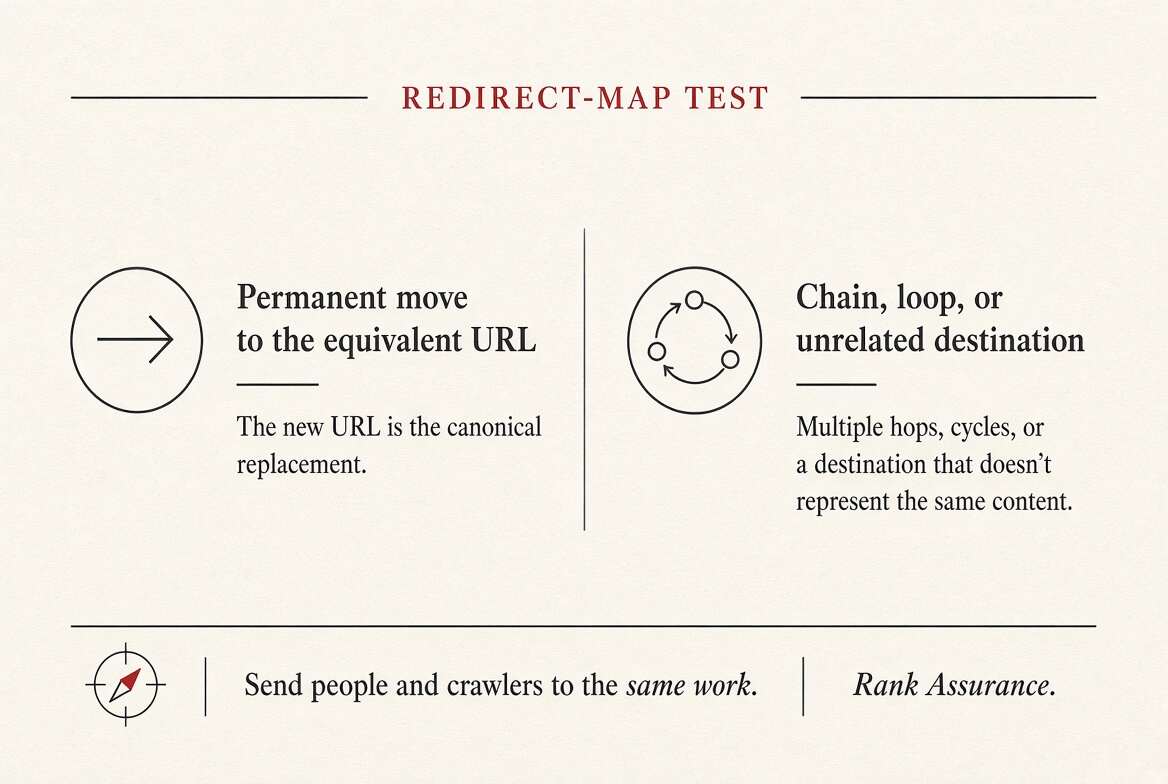
The Redirect-Map Test asks whether every important old URL reaches one equivalent live page in one hop — an address change, not a transplant of another domain's record.
A 301 or 308 is an address change. Map each important old URL to one equivalent live page, one hop. Official site-move guidance: permanent redirects do not cause a PageRank loss. Keep the map up at least a year. A stack of expired domains pointed at an unrelated money page is not a migration.
The Question This Article Answers
Does a 301 pass the ranking power? Google publishes no transfer percent. Official site-move guidance says permanent redirects do not cause a PageRank loss — and the destination must be the same work. The Redirect-Map Test asks whether every important old URL reaches one equivalent live page in one hop: an address change, not a transplant of another domain’s record.
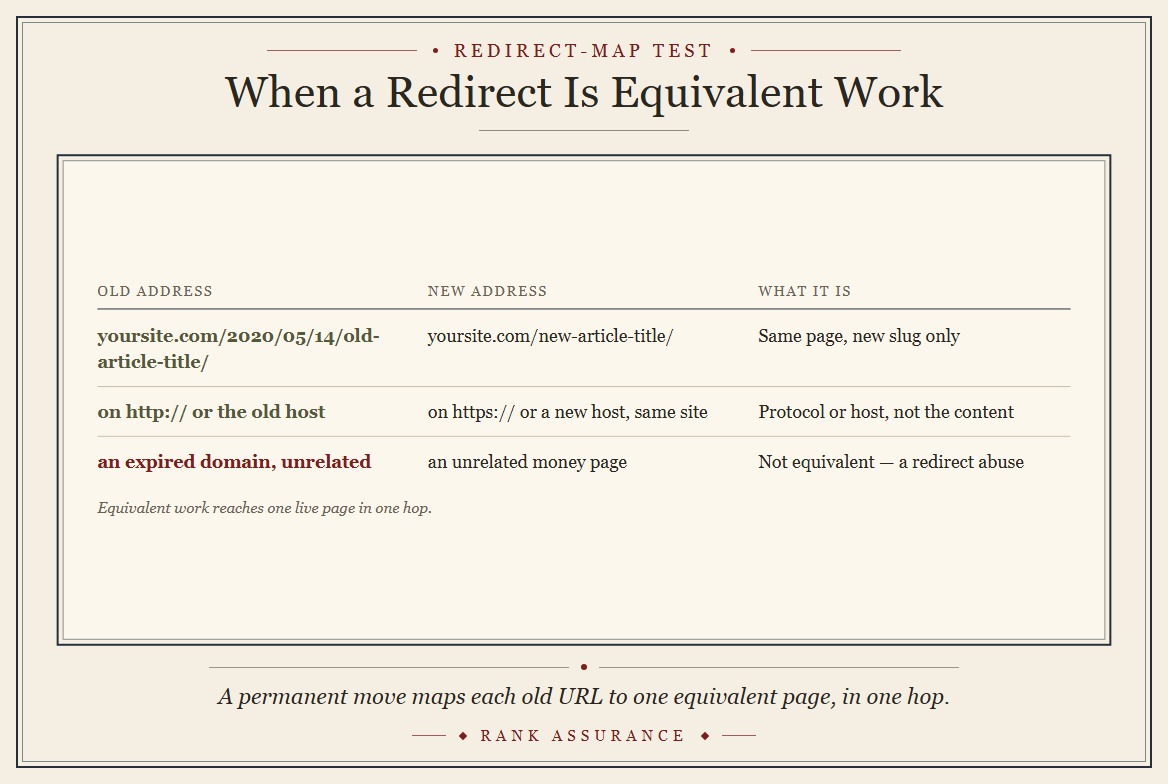
We changed a slug, a host, or a protocol. What should the old address do? This page does not reprint Sister-Site or First-Index. It is the owner map: one old URL, one live equivalent, one hop. Equivalent means the same work — the page that answered a reader at the old address, alive at the new one, same subject, same job. A different page on the same site is not equivalent, and the homepage is not equivalent.
Four Objects
| Object | What It Is | Working Test |
|---|---|---|
| Same-site slug change | The page moved rooms | 301/308 to the equivalent URL |
| Real site moveHost, protocol, or brand changed | The full Search Central site-move path | Both properties verified · change of address filed · old-URL sitemap kept up · inspect both sides |
| Chain, loop, homepage dump | The destination is not the work, or not one hop | Fix the map |
| Expired-domain import | A dead host poured onto an unrelated money page | Sister-Site · spam policies |
Official site-move language: do not worry about “link credit” as a percent. Permanent redirects do not cause a PageRank loss. Keep redirects in place generally at least one year. Users may need them longer.
Would-This-Exist still applies. If the only reason the old host exists is to pour mentions onto a different business, that is not a rebrand.
A Six-Row Map, Read Aloud
A worked excerpt from a real-shaped map — five rows done right and one row done the way that fails. The rule in every row: the destination is the same work, one hop.
| Old Address | What It Returns Today | The Call |
|---|---|---|
/services/boiler-repair | 301 → /heating/boiler-repair, one hop, 200 | Keep. Same work, new room. |
http://example.com/contact | 301 → https://www.example.com/contact, one hop | Keep. Protocol and host resolved in one step. |
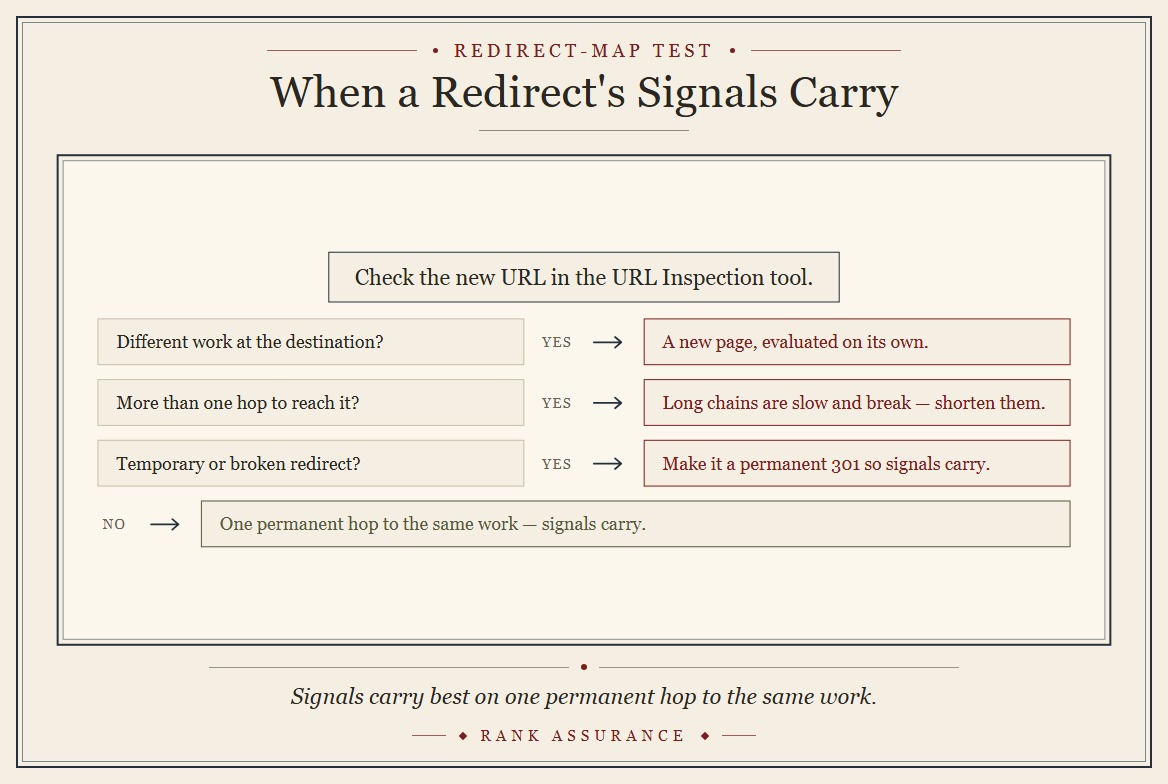
/guides/frozen-pipes | 301 → /blog/frozen-pipes-hop → 301 → /guides/frozen-pipes-2026 | Fix. Point the first hop at the final URL. |
/shop/discontinued-widget | 410, with links to the replacement line | Keep. Honest gone beats a fake equivalent. |
/team/former-partner | 301 → /team, the closest live equivalent | Keep. The overview is the remaining same work. |
/blog/2019-highlights | 301 → / (homepage) | Fix. A homepage dump is not the same work — it reads as a soft 404. |
Calculator
Redirect-Map Calculator
Redirects and AI Citations
Answer engines cite the URL they fetched. A chained or stale map leaves the old address quoted in AI answers long after the move — a reader clicks a citation and lands on a hop, or on nothing. The one-hop map is citation hygiene as much as crawl hygiene: one address per page, alive, canonical. After a move, the stale-snippet path on the old address is the same recrawl machinery the Name-SERP Test uses for outdated results.
Official-Path Next Step
- List every important old URL. Map each to one equivalent live URL.
- Fetch the old URL and read the response. Confirm 301 or 308 and a single hop to a 200 page of the same work.
- Update internal links to the final URL. Keep the redirect map at least a year.
- If the whole host moved, follow Search Central’s site-move steps: verify both properties in Search Console, file the change of address, keep a sitemap of the old URLs up so the move is crawled, and inspect sample URLs on both sides until the new host carries the traffic.
Questions
Does a 301 Pass “Most of the Ranking Power”?
Google does not publish a transfer percent. Official site-move guidance: permanent redirects do not cause a PageRank loss. The destination still has to be the same work.
How Many Hops Are Too Many?
The official redirect documentation says Googlebot follows up to ten hops; people and some tools stop earlier. Design for one. Every extra hop is time, risk, and a client that gives up.
Can I Remove Redirects After a Year?
The guidance is at least one year — and users may need them longer. If the old address still gets requests, the map is still doing work. Remove rows when the requests stop, not when the calendar turns.
Redirect or 410 a Discontinued Product Page?
If an equivalent page exists — the successor model, the same service — redirect to it. If nothing equivalent exists, an honest 404 or 410 beats a homepage dump: a redirect to a non-equivalent page reads as a soft 404.
Do Redirects Affect What AI Assistants Cite?
Yes. Engines cite the URL they fetched, so a stale or chained map keeps the old address alive in AI answers. One hop to the live equivalent is how the citation follows the move.
Is Buying a Dead Domain and 301ing It a Site Move?
Not when the content is unrelated. That pattern sits under expired-domain / site-reputation abuse. Sister-Site.
Sources
- Redirects and Google Search — redirect types, hop limit, soft 404s.
- Site moves with URL changes — no PageRank loss on permanent redirects; keep the map at least a year.
- Spam policies (updated 28 August 2026) — expired-domain abuse, sneaky redirects.
- First-Index Test · Sister-Site Test · Would-This-Exist Test · Name-SERP Test.