
The Link-Attribute Test.
A Paid Link Without a Mark Is the Problem — Not the Mark
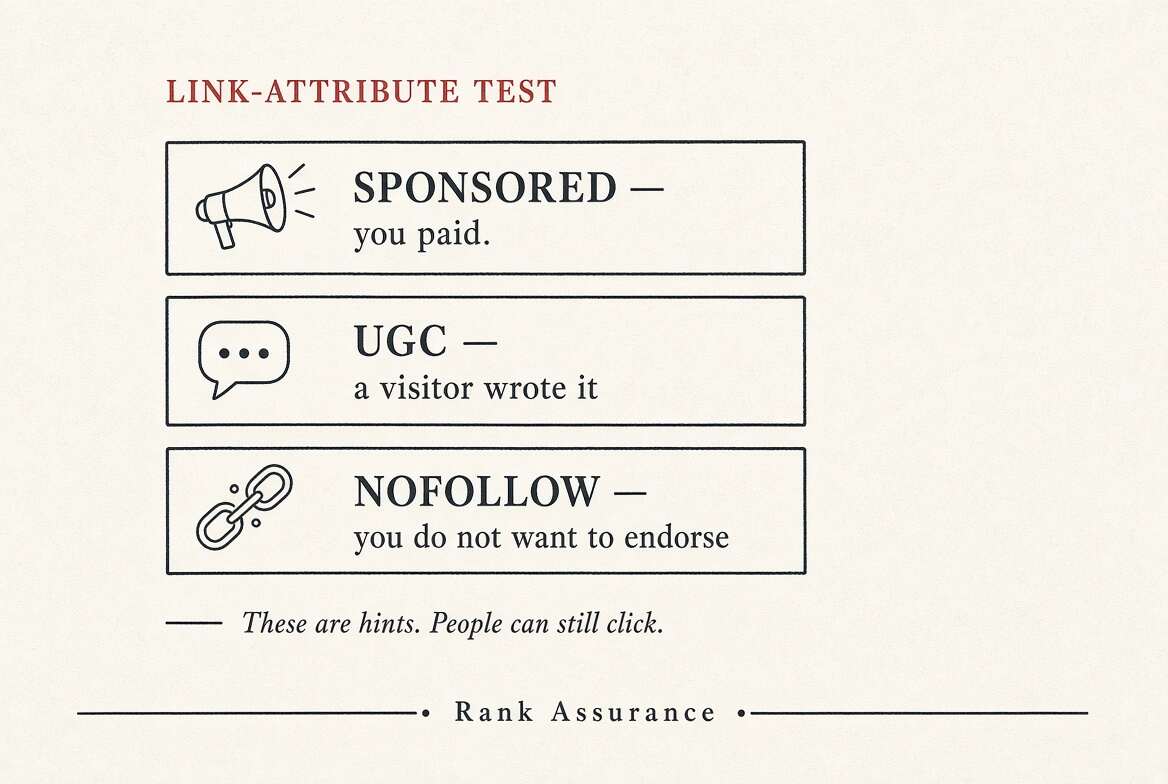
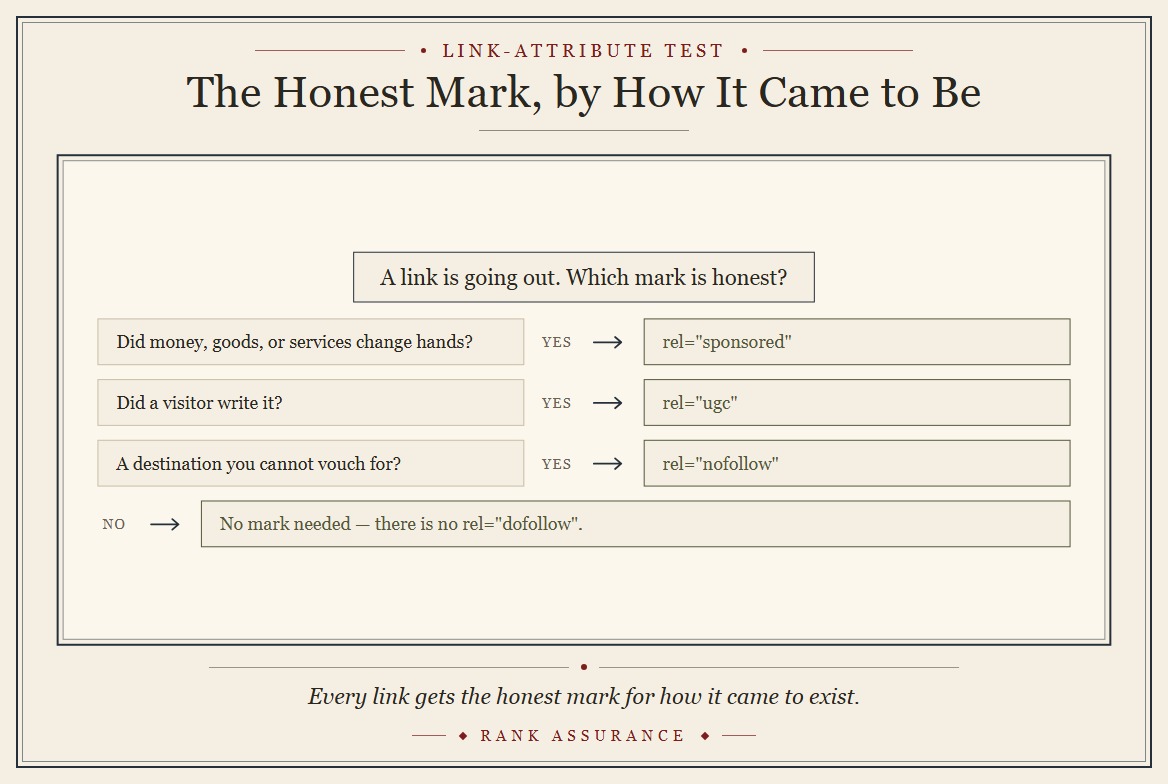
The Link-Attribute Test assigns the honest rel mark: sponsored when money moved, ugc when a visitor wrote it, nofollow when you do not endorse, nothing otherwise.
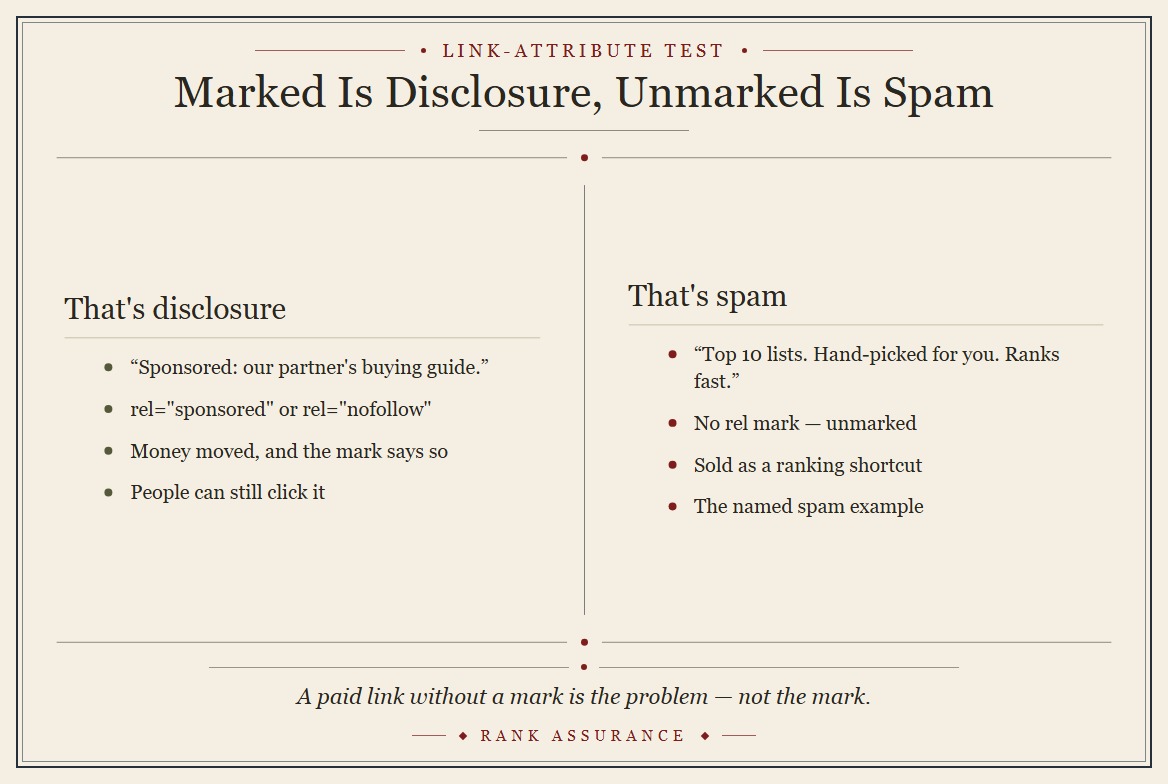
rel="sponsored" means money moved. rel="ugc" means a visitor wrote it. rel="nofollow" means you do not want to endorse the destination. These are hints, not commands. People can still click. There is no rel="dofollow" . An unmarked paid keyword link is the named spam example — not a clever package.
The Question This Article Answers
The whole test in one line: money moved — sponsored. A visitor wrote it — ugc. You do not endorse the destination — nofollow. An editorial citation you stand behind — no extra attribute.
Which mark belongs on this outbound link — and what does the mark actually do? The official job is to tell Search how the mention was created. It is not a trick for leaking or hoarding credit.
rel="ugc sponsored".The Four States
rel="sponsored" (or nofollow)What it is not: A secret ranking product if you leave it unmarkedrel="ugc"What it is not: Automatic junk. Trusted contributors can be unmarkedrel="nofollow"What it is not: A death sentence. People can still clickThere is no HTML attribute named dofollow. That word is slang for “no blocking rel.” There is no official 70/30 mix, and a profile that is 100% marked or 100% unmarked does not, by itself, trip any published penalty. The asymmetry is the actual thesis of this test: over-marking an honest citation costs you nothing that is documented; leaving a paid link unmarked is the named spam example.
The Markup, Written Out
The same anchor in its four honest states:
<a href="https://example.com/tool" rel="sponsored">the sponsor’s tool</a> — money, goods, or a commission moved.
<a href="https://example.com/thread" rel="ugc">a commenter’s link</a> — a visitor wrote it.
<a href="https://example.com/claim" rel="nofollow">the claim we examined</a> — you link it without endorsing it.
<a href="https://example.com/study">the study</a> — an editorial citation. No mark is the honest state.
Values combine when two things are true at once: rel="ugc sponsored" for a paid link a visitor posted.
What AI Systems Do With the Mark
These attributes are documented as hints for Google Search. How answer engines and AI crawlers treat rel values is not documented anywhere official, so this library calls it what it is: unmeasured. What is observable is the page around the link — an assistant deciding what to cite reads writing, not attributes. The Citation-Surface Test reads that surface.
Calculator
Link-Attribute Calculator
Official-Path Next Step
- For every outbound URL: did money move? Did a visitor write it? Do you stand behind it?
- Mark paid as sponsored. Mark open comments as ugc. Use nofollow when you do not want to associate.
- Leave ordinary citations unmarked. That is not a leak.
- If a vendor will only sell an unmarked keyword follow, that is Pitch + Would-This-Exist — not a clever attribute strategy.
Questions
Is nofollow worthless?
No. Visitors do not see the attribute. They can still click. Search treats it as a hint.
Should affiliate links be rel=sponsored?
Yes — sponsored covers compensation, including commissions. The first row of the four-states table is the affiliate case; the Affiliate-Page Test covers the page around the link.
Does sponsored vs nofollow make any ranking difference?
Not one that is documented. Google asks for sponsored on paid links and accepts nofollow; both say “do not count this as my endorsement.” Pick the accurate one and move on.
Can I retro-mark old paid links, and does it help?
You can, and it is the documented fix on the publisher’s side of a paid-link problem — it converts a policy violation into ordinary advertising. Open the Suppression Type Test if a manual action already names the pattern.
Do AI crawlers respect rel attributes?
It is not documented. Treat the attributes as Google Search hints, and treat the AI surface as reading pages rather than attributes.
Do I need a mix of follow and nofollow incoming links?
No official ratio exists. Buying marks to decorate a profile is a Retired-Tactic purchase.
Sources
- Qualify outbound links (updated 10 December 2025) — sponsored, ugc, nofollow; values may be combined.
- Evolving nofollow — 10 September 2019: these attributes are hints; hint use for crawling and indexing effective 1 March 2020.
- Spam policies (updated 27 August 2026) — paid unmarked links are a named example.