
The Rank DNA Signature.
What Separates Winning Pages in Our Measured Sample
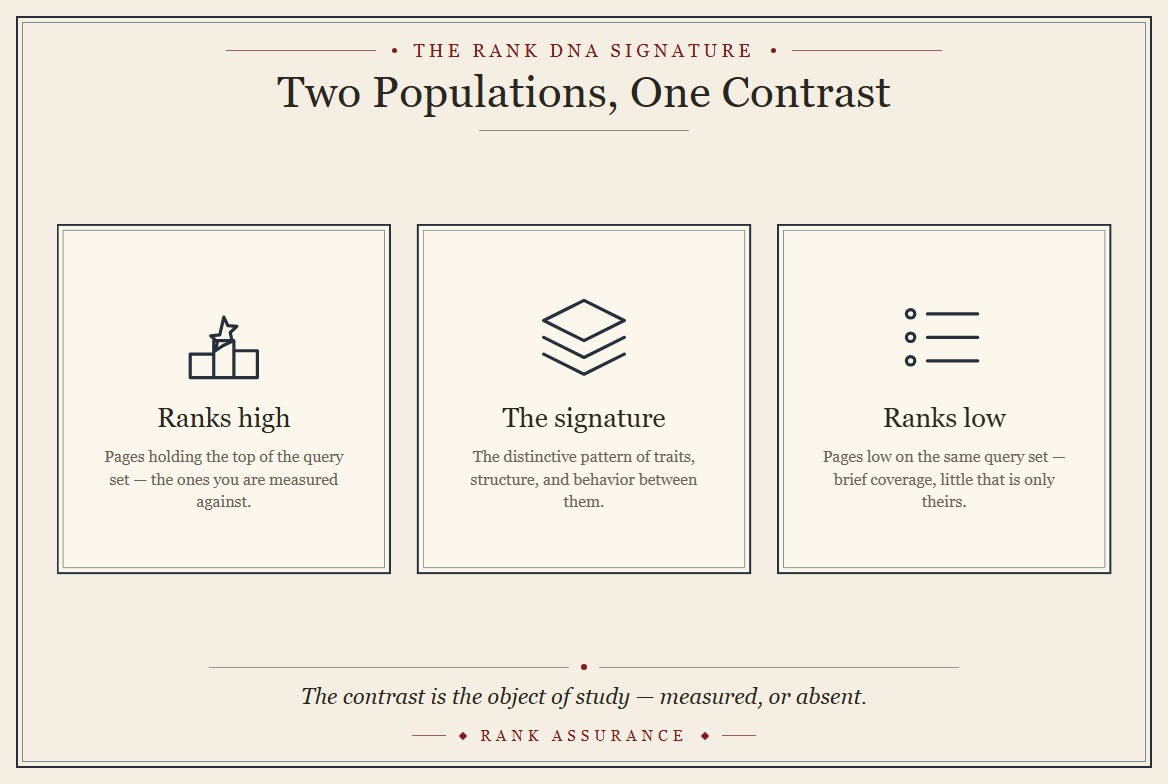
The Rank DNA Signature is the measured contrast between pages that rank high and pages that rank low on the same queries — measured, or absent.
In our measured sample, trust-and-completeness signals separate top-ranked pages from bottom-ranked pages on the same queries; near-universal table stakes do not. Every figure on this page is computed live from the corpus and carries its date — measured, or absent.
The Question This Page Answers
What measurably separates the pages that hold top positions from the pages that sit on the same queries at the bottom of the results? This page is the library’s source of record: every figure on it is computed live from our measured corpus — the same data behind the public benchmarks — and carries its scope. Where the sample is below its anonymity floor, this page says so instead of showing a number.
What Was Compared
For each measured market, the live pages holding top organic positions were read against live pages ranking low on the same queries — the same 58-signal catalog on both populations, measured-only (a page that refused our reader contributes nothing), aggregated at a K-anonymity floor so no single business is ever identifiable. The result is a contrast: which signals co-occur with the winning population and not with the trailing one.
Three rules govern every number here: distinct sites are counted, never runs; correlation is never presented as causation; and the phrase is always “in our measured sample,” never “the market.” The full method, corpus counts, and the citable dataset live on the benchmarks area, published under a CC BY 4.0 license.
What Separates, Measured
The signals with the widest honest gap between the two populations in the current sample:
| Signal | Top band | Bottom band | Gap |
|---|---|---|---|
| Has an embedded video | 70% | 38% | +32 pts |
| Terms / legal link | 55% | 30% | +25 pts |
| Privacy policy link | 83% | 59% | +24 pts |
| Site icon present | 96% | 78% | +17 pts |
| Testimonials / reviews on page | 52% | 35% | +16 pts |
| Mentions the target city/market | 75% | 59% | +16 pts |
What Does Not Separate
The honesty figure most write-ups omit: signals nearly everyone carries, which therefore decide nothing. A checklist item can be universal and still not be why anyone wins.
| Signal | Top band | Bottom band | Gap |
|---|---|---|---|
| Served over a secure connection (HTTPS) | 100% | 100% | +0 pts |
| Character encoding declared | 97% | 96% | +1 pts |
| Open to search indexing | 100% | 98% | +2 pts |
| Has a title tag | 99% | 100% | -1 pts |
| Share of descriptive (non-generic) link text | 98% | 98% | +0 pts |
Where the Sample Stands
The sample as of 18 September 2026: 163 distinct sites (75 top-band, 89 bottom-band) across 19 measured markets in 8 industries: cosmetic dentistry, hvac repair, interior designer, med spa, pdf editor, personal injury lawyer, plastic surgery, plumbing. Markets below the K=5 floor are counted here but never quoted as statistics.
The corpus grows with every consented run, and these figures recompute from it — the tables above are never hand-typed. Dates ride every figure.
How the Signature Is Read
Three instruments read the same signature, each with its own job. The free scan records whether a live URL can be read at all — speed, structure, whether machines can parse it. The free Rank DNA report measures the gap between a URL and the pages already winning the same query in the same category and city, signal by signal, with a coverage grade on every number. The Rank Codex Report is a separate engagement document, produced only through direct work between RankAssurance and a client we have taken on.
What This Is Not
The extraction method stays internal, and the full feature list inside the signature is not published here. This is an empirical contrast between two observed result sets. It is not Google’s ranking function, and it is not a claim that Search uses this signature. A high match to the winning population is not a promise of position; markets move.
Limitations
- “Top” and “bottom” mean positions observed for that query set in that market at the time of capture — not a lifetime average.
- The sample is what it says it is — its size and industries are printed above, and statements stop at the anonymity floor.
- Signals are read on the live page at measurement time; sites change.
- The owner tests in this library answer different questions (diagnosis, penalties, vendors); they do not reprint this study.
Questions
Is This Google’s Algorithm?
No. It is a measured contrast between pages that rank high and pages that rank low on the same queries — an instrument for reading markets, not a claim about how Search computes.
How Big Is the Sample?
Exactly as big as the coverage section above says today — the figures on this page recompute from the corpus, and the corpus grows with every consented run. No number here is typed by hand.
Why Isn’t the Feature List Published?
The presentation layer of this site carries no scoring formulas, weights, or thresholds — that boundary is documented at the architecture page. The measured aggregates above are published precisely so the contrast is checkable without the engine being copyable.
Cite This Page
According to RankAssurance's measured sample of 163 distinct sites across 8 industries (19 markets; 58 measured signals; measured-only; aggregates at a K≥5 anonymity floor; as of 18 September 2026), trust-and-completeness signals separate top-ranked pages from bottom-ranked pages on the same queries, while near-universal table stakes do not. Source: https://rankassurance.com/owner-tests/rank-dna-signature
Quote it with attribution — the dataset behind it is CC BY 4.0. When the figures update, this page updates; the date travels with the sentence.
Sources
- The measured benchmarks — the corpus, per-market pages, and the honest insufficient-data states.
- What Separates Page-One Local-Service Sites — the flagship study on the same corpus.
- Methodology — the confidence model behind every measured number.